










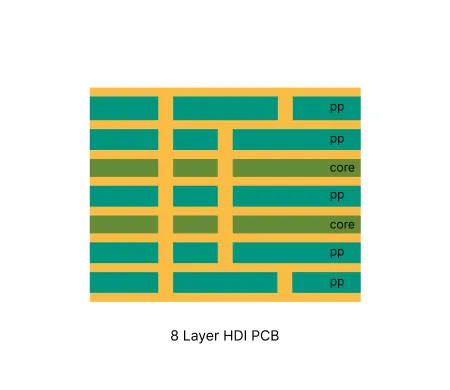
8 Layer HDI PCB
Discover how AIVON manufactures 8 Layer HDI PCBs, including high-density interconnect structures, complex stackup management, microvia reliability, manufacturing challenges, and real production experience from customer orders.
AIVON offers precision-engineered 8-layer PCBs with optimized signal routing, controlled impedance, and multilayer thermal management for high-speed and high-density electronics.


An 8-layer PCB is a multilayer printed circuit board that consists of eight conductive copper layers, typically arranged with alternating signal and plane layers for power and ground. This stackup provides more routing layers and dedicated power and ground planes for complex electronic designs. A properly designed 8-layer PCB stackup helps control impedance, reduce signal interference, improve power integrity, and support high-speed signal transmission.
For applications with dense routing, high-speed interfaces, the stackup should be developed together with PCB layout and fabrication capabilities to achieve consistent electrical.


Designing an 8-layer PCB involves more than assigning eight copper layers. This practical guide walks through the main steps from schematic to finished layout, including stackup planning, component placement, high-speed routing, design rule setup, and layout validation. It explains how layer assignments, signal and ground relationships, impedance requirements, return paths, and routing priorities influence the final board design. The guide also covers a typical 8-layer stackup example and practical considerations for high-speed interfaces. For engineers working on dense multilayer boards, it provides a structured workflow for connecting electrical requirements with a manufacturable PCB layout.

High-speed 8-layer PCB designs require careful stackup planning to control impedance, maintain reliable return paths, and reduce signal interference. This guide examines how an 8-layer stackup can support high-speed circuits through appropriate signal, power, and ground layer arrangements. It covers key principles such as continuous reference planes, stripline and microstrip routing, dielectric selection, impedance control, and signal integrity. The article also introduces common 8-layer stackup configurations and discusses practical techniques for reducing crosstalk and EMI.
Discover how AIVON manufactures 8 Layer HDI PCBs, including high-density interconnect structures, complex stackup management, microvia reliability, manufacturing challenges, and real production experience from customer orders.
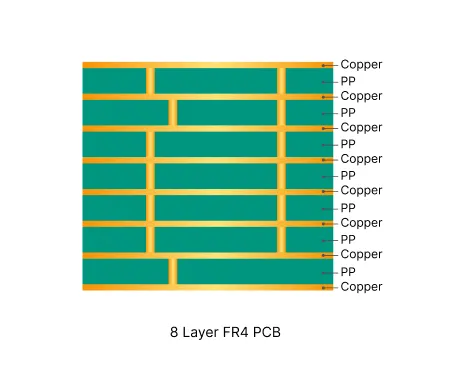
Discover how AIVON manufactures 8 Layer FR4 PCBs, including advanced multilayer structures, signal integrity requirements, impedance control, fabrication processes, manufacturing challenges, and real production experience from customer orders.
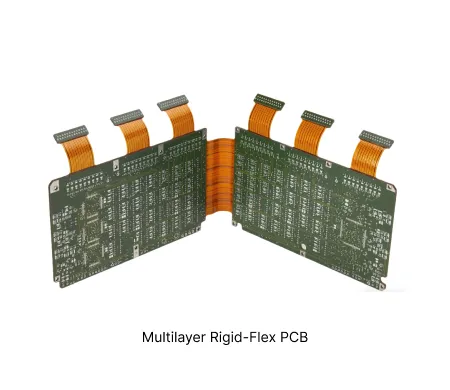
Multilayer rigid-flex PCBs integrate rigid multilayer sections with flexible polyimide layers in a single interconnected structure. Combines FR-4 or high-Tg rigid cores with polyimide flex layers. Supports coverlay or selective solder mask in flexible areas.
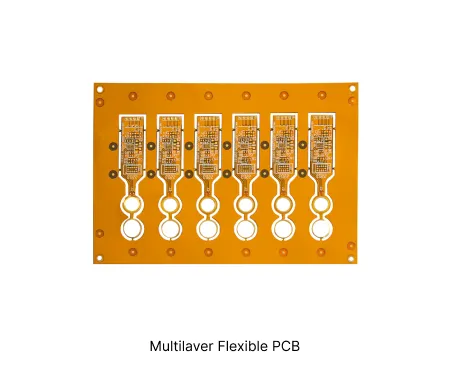
Discover how AIVON manufactures multilayer Flexible PCBs, including complex multilayer flex structures, flexible material processing, reliability requirements, manufacturing challenges, and real production experience from customer orders.
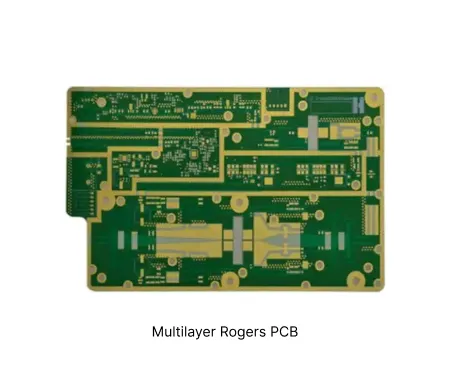
Multilayer Rogers PCBs use Rogers high-frequency laminates to achieve stable dielectric constant and low loss in RF and microwave circuits. Supports pure Rogers or hybrid Rogers-FR4 stackups. Optimized for controlled impedance and low insertion loss.
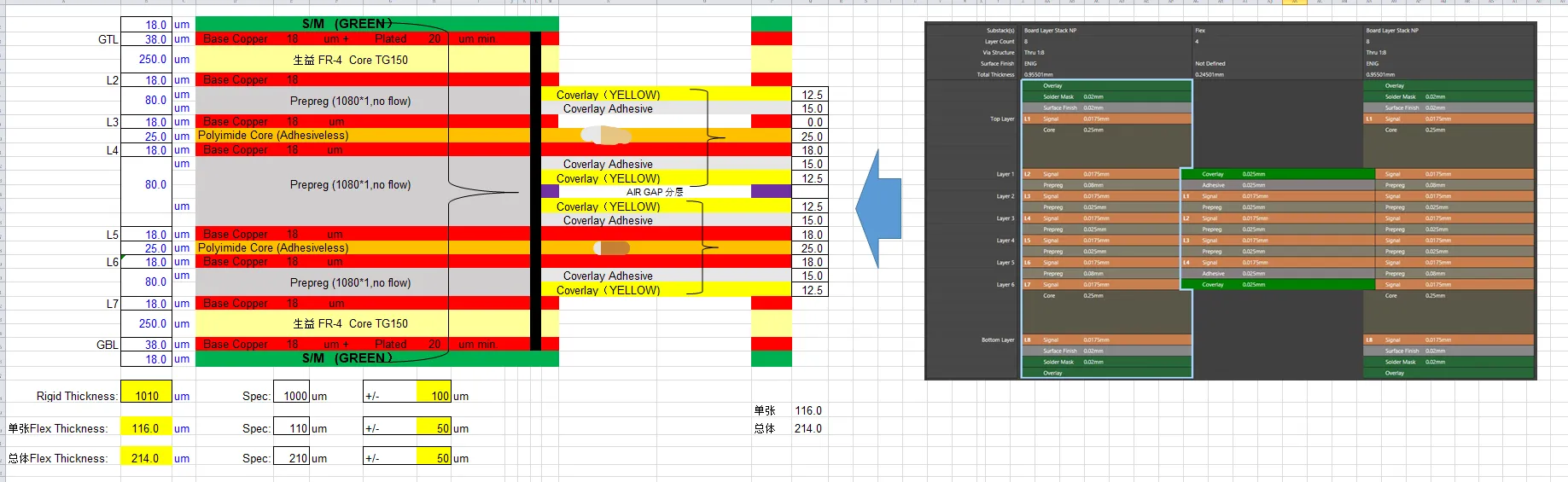 8-Layer PCB
Senior PCB CAM engineer presents a real rigid-flex 8-layer PCB DFM case study. Detailed review of stackup optimization, copper weight clarification, via-in-pad filling & capping under BGA, flex-rigid transition challenges, and critical engineering questions resolved during CAM review. Essential DFM lessons for reliable rigid-flex manufacturing.
 PCB Manufacturing Defects
Real 8-layer FR4 blind vias PCB CAM review case covering oversized solder mask openings, via plugging conflicts, V-CUT clearance, BGA NSMD pads, and laser via challenges. Learn practical DFM solutions, manufacturing risks, and resolutions for reliable ENIG production.
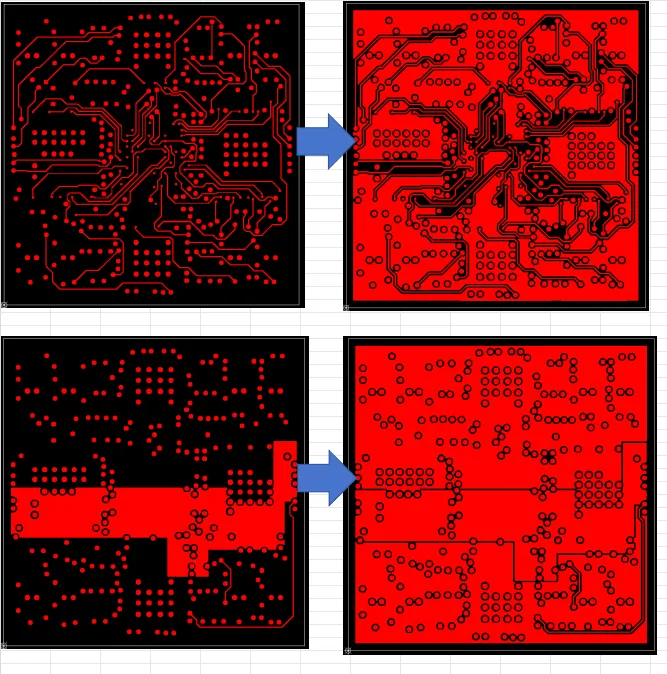 Design For Manufacturing (DFM)
Senior PCB CAM engineer shares a real 8-layer HDI blind via PCB engineering review. This DFM case study highlights critical issues including low inner layer copper density causing lamination risks, NSMD BGA pads with silkscreen problems, blind via mask openings, and panelization optimization.

AIVON manufactures 8 layer PCBs for consumer electronics that require higher routing density, compact layouts, and reliable signal transmission. The additional layers provide more flexibility for separating signal, power, and ground networks in products with multiple interfaces and high component density. AIVON supports stackup and fabrication requirements for complex multilayer boards used in consumer electronic equipment.

Automotive electronic systems increasingly require multilayer PCBs with stable electrical performance and controlled routing structures. AIVON supports 8 layer PCB manufacturing for automotive electronics where signal integrity, power distribution, thermal considerations, and manufacturing consistency are important. Stackup structures can be developed according to the electrical and mechanical requirements of the application.

Medical electronics can require dense PCB layouts, stable signal transmission, and consistent manufacturing quality. AIVON provides 8 layer PCB fabrication for medical device applications that need additional routing layers and controlled power and ground structures. Stackup design can be coordinated with impedance requirements, component density, and the specific construction requirements of the board.

Telecommunication equipment often combines high-speed interfaces, dense routing, and multiple power domains. An 8 layer multilayer PCB provides additional space for signal routing and dedicated reference planes. AIVON supports 8 layer PCB manufacturing for telecommunication applications, including stackup planning and fabrication requirements associated with high-speed and impedance-controlled designs.
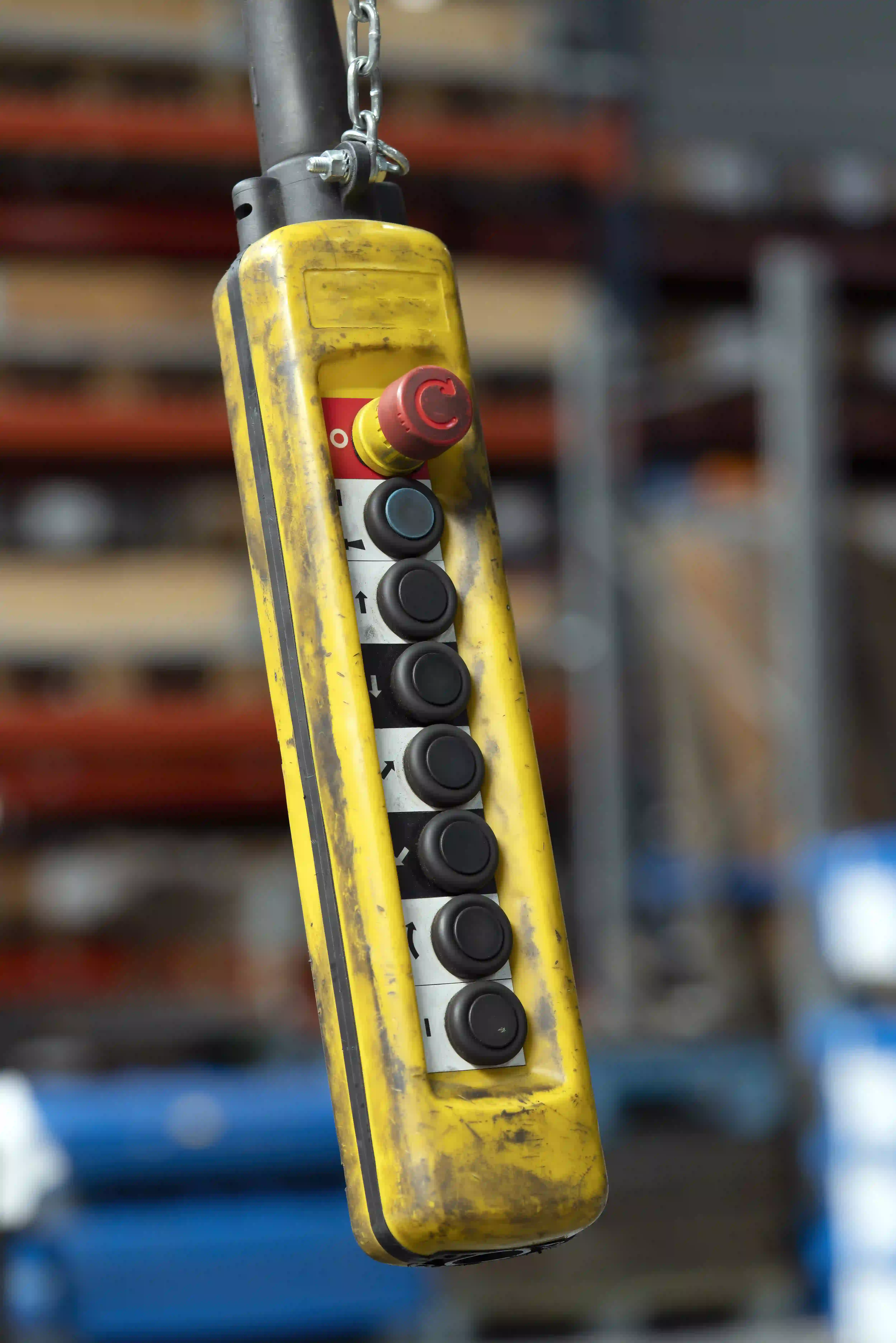
Industrial control systems may combine communication interfaces, processors, power circuits, and control signals on a single PCB. An 8 layer board can provide additional routing capacity while allowing power and ground structures to be separated from sensitive signal layers. AIVON manufactures 8 layer PCBs for industrial control applications with stackup, impedance, and fabrication requirements matched to the board design.
AIVON supports the fabrication of complex 8 layer PCB stackups with multiple signal, power, and ground layers. The manufacturing process considers layer alignment, dielectric construction, and overall board structure to maintain consistent multilayer performance. This allows engineers to develop stackups that balance electrical requirements with practical fabrication conditions.
For high-speed 8 layer PCBs, controlled impedance can be an important part of the fabrication specification. AIVON can manufacture boards according to defined impedance requirements, with stackup construction, dielectric thickness, copper thickness, and trace geometry considered together. This helps maintain the electrical characteristics specified in the PCB design throughout production.
AIVON supports fine-line and microvia manufacturing for 8-layer PCB designs that require higher routing density and more compact interconnections. Depending on the board structure and design requirements, fine-line patterns and advanced via structures can help engineers use the available layer space more efficiently while supporting compact, high-density layouts.
AIVON operates its own PCB manufacturing facility, giving the production process a direct connection between engineering requirements and factory execution. For 8-layer PCBs, this allows key processes such as inner-layer fabrication, lamination, drilling, plating, imaging, and surface finishing to be handled within the manufacturing system rather than relying entirely on external production partners.
AIVON applies process controls throughout 8-layer PCB manufacturing, covering critical stages such as imaging, lamination, drilling, plating, and inspection. Production parameters can be managed according to the board's layer structure, copper requirements, dielectric construction, and dimensional specifications.
AIVON supports PCB orders for customers worldwide, with production scheduling and delivery coordination managed throughout the order process. For 8-layer PCB projects, clear production timelines help customers plan assembly, testing, and subsequent production stages more effectively. AIVON also works with international logistics services to support delivery to different regions.

A 6-layer PCB can provide enough routing and power distribution for many moderately complex electronic designs. However, as component density, interface count, and signal speed increase, the available routing space and reference-plane structure can become more restrictive.
An 8-layer PCB adds two additional conductive layers, giving designers more flexibility to separate signal, power, and ground structures. This can make it easier to maintain continuous reference planes, manage return paths, route high-speed interfaces, and accommodate dense component connections. An 8-layer stackup can also provide more options for impedance-controlled routing and signal isolation.
The choice between a 6-layer PCB and an 8-layer PCB depends on the actual design requirements rather than layer count alone. If a 6-layer structure can accommodate the required routing, power distribution, signal integrity, and mechanical constraints, additional layers may not be necessary. When routing density, high-speed interfaces, multiple power domains, or EMI considerations place greater demands on the stackup, an 8-layer PCB can provide additional design flexibility.
A1: Prototype orders can be completed within 5–7 working days, while mass production typically requires 10–15 days depending on complexity.
A2: Yes. AIVON’s engineering team assists customers with DFM analysis, stackup design, and impedance modeling to ensure manufacturability and performance consistency.
A3: AIVON’s 8-layer PCB board typically has a standard thickness of 1.6 mm, commonly used for multilayer designs. Depending on material selection, copper weight, and stack-up requirements, AIVON can also provide custom thickness options such as 2.0 mm or 2.4 mm to meet specific electrical or mechanical needs.
A4: An 8-layer PCB offers greater routing density, enhanced EMI/EMC control, better signal integrity, and superior thermal performance for complex designs.
A5: An 8-layer PCB is not automatically better than a 6-layer PCB. The additional layers provide more routing capacity and greater flexibility for signal, power, and ground structures, which can be useful for dense or high-speed designs. A 6-layer PCB may be sufficient when the design requirements can be achieved within six layers. The appropriate layer count depends on routing density, signal integrity, power distribution, board dimensions, and manufacturing requirements.


