Overview
The 21st century is the digital era, and demand for digital consumer products is growing rapidly. Video products account for a large share and are increasingly common in daily life. In these devices—whether digital camcorders or phones with imaging functions—the core component is the audio/video processor. The choice of processor determines device cost, performance, and market positioning.
This design uses Texas Instruments' TMS320DM270 (DM270) as the main processing chip.
Feasibility Analysis
The DM270 is a digital media processor based on a multi-processor architecture. It integrates a C5409 DSP and a 32-bit RISC ARM7TDMI processor in a dual-core configuration. The ARM7TDMI handles non-imaging functions and acts as the main system controller, while the DSP performs audio and video encoding/decoding. The chip also includes an image processing engine (iMX) dedicated to operations such as DCT, inverse DCT, motion estimation and compensation, and a variable length codec (VLCD).
TI also supplies compatible audio/video peripherals that can interface with the DM270. For example, TVP5040 and TVP5145 can be used as video A/D converters, and AIC23 can be used as an audio A/D.
The DM270 integrates an MMC/SD controller for external card expansion to support large-capacity storage, and an on-screen display (OSD) module to drive external displays such as LCDs and TVs.
System Block Diagram
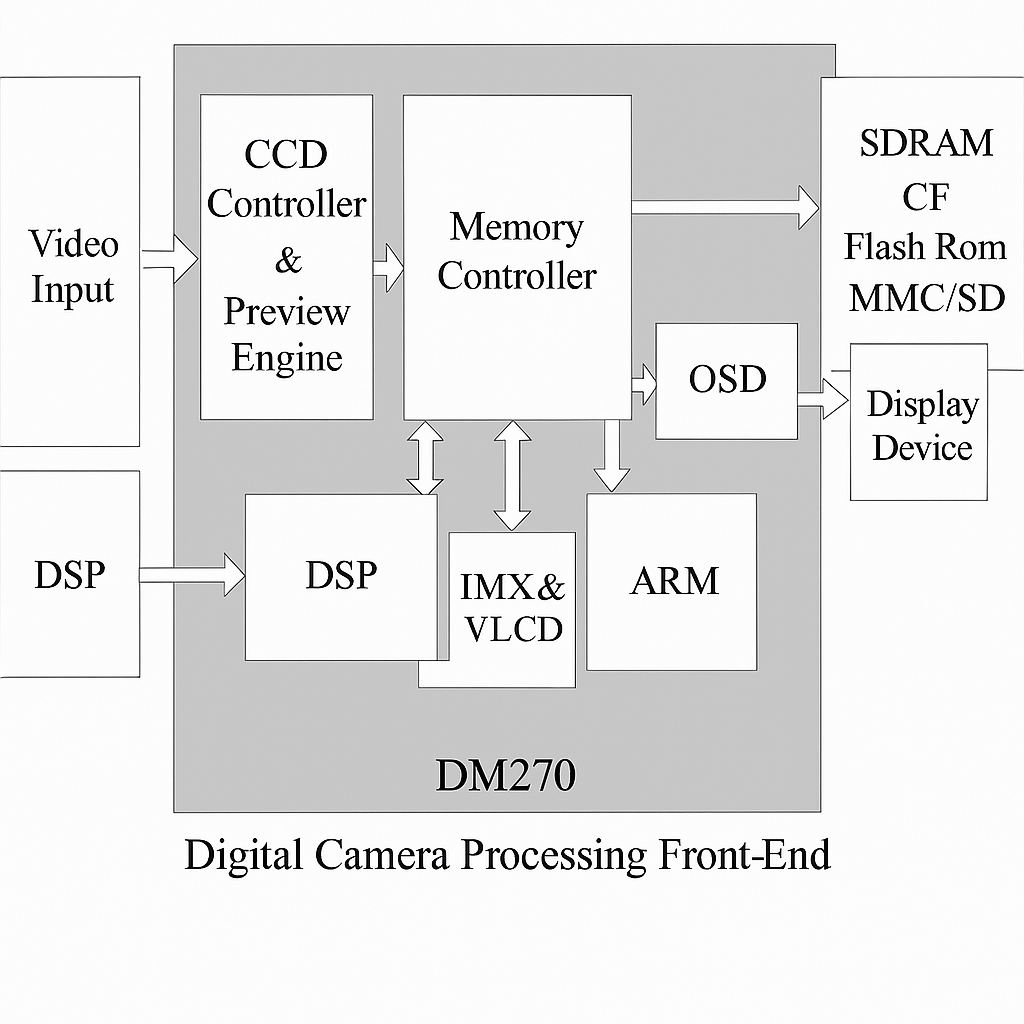
Figure 1 System block diagram
Design
The system front end consists primarily of a video input module, an audio input module, and the DM270 processor. The back end supports connection to storage devices and display devices (LCD, TV).
Video Module
The video input module captures image data at the front end with a CCD/CMOS sensor, then forwards data to the processor for preprocessing and compression prior to storage.
Video Capture and Input
The DM270 provides a programmable CCD interface that accepts standard CCD or CMOS image sensor data and supplies necessary timing logic. It supports both progressive and interlaced sensors and can handle resolutions up to 4096×4096 pixels. In the reference system, an OV7620 CMOS camera is used; it outputs YUV data directly into the system. The chip includes a hardware 3A module to automatically adjust lens focus. The DM270 also contains a preview engine that enhances CCD images, performs automatic white balance, and supports various scaling sizes, which reduces CPU preprocessing load.
Video Compression
The DM270 supports real-time MPEG-4 encode/decode at VGA resolution and 30 fps, and also supports other compression standards such as JPEG, motion-JPEG, and H.263. The internal image coprocessor iMX accelerates DCT, motion estimation/compensation, and interpolation operations, while the VLCD module handles bitstream encoding. On the developed platform, the system achieves VGA MPEG-4 at 24 fps and H.263 at 30 fps for real-time compression, decode, and LCD display.
In addition to video recording, the platform supports still-image capture in JPEG format. The development platform can produce JPEG images up to 2048×1536 pixels.
Video Output and Display
The camcorder must provide local playback functionality. The DM270 includes an OSD controller and has a VENC and D/A output stage that generates NTSC or PAL video signals for external displays. The DM270 can decode compressed MPEG-4 streams or JPEG images to YUV and present them via the OSD. The OSD module supports four image layers (two YUV video layers and two bitmap layers) to enable layered composition. A bitmap layer can display operation menus and serve as a graphical user interface for adjusting system parameters.