Introduction
This article describes a design that uses the OTP MCU CSU8RP3125 from Chipsea Technology in an e-cigarette application. The solution provides precise battery-voltage monitoring to prevent overcharge and undervoltage, measures atomizer current, and implements atomizer overcurrent protection. The design leverages the chip's built-in timing, ADC, and PWM features to control an LED breathing indicator and manage power-safety functions.
Background
An e-cigarette (electronic atomizer) replaces conventional cigarettes by vaporizing a liquid that typically contains nicotine. Typical devices consist of a lithium battery, an atomizer, and a cartridge. The atomizer converts the liquid into inhalable aerosol without producing combustion smoke.
Chip Features Used
- Internal 16 MHz high-speed clock source with ±1% accuracy for PWM timing.
- Built-in 12-bit ADC with about 1% measurement error plus internal reference source for accurate voltage and current measurement.
- Low-voltage reset (LVR) and other power management features suitable for battery-powered systems.
System Design
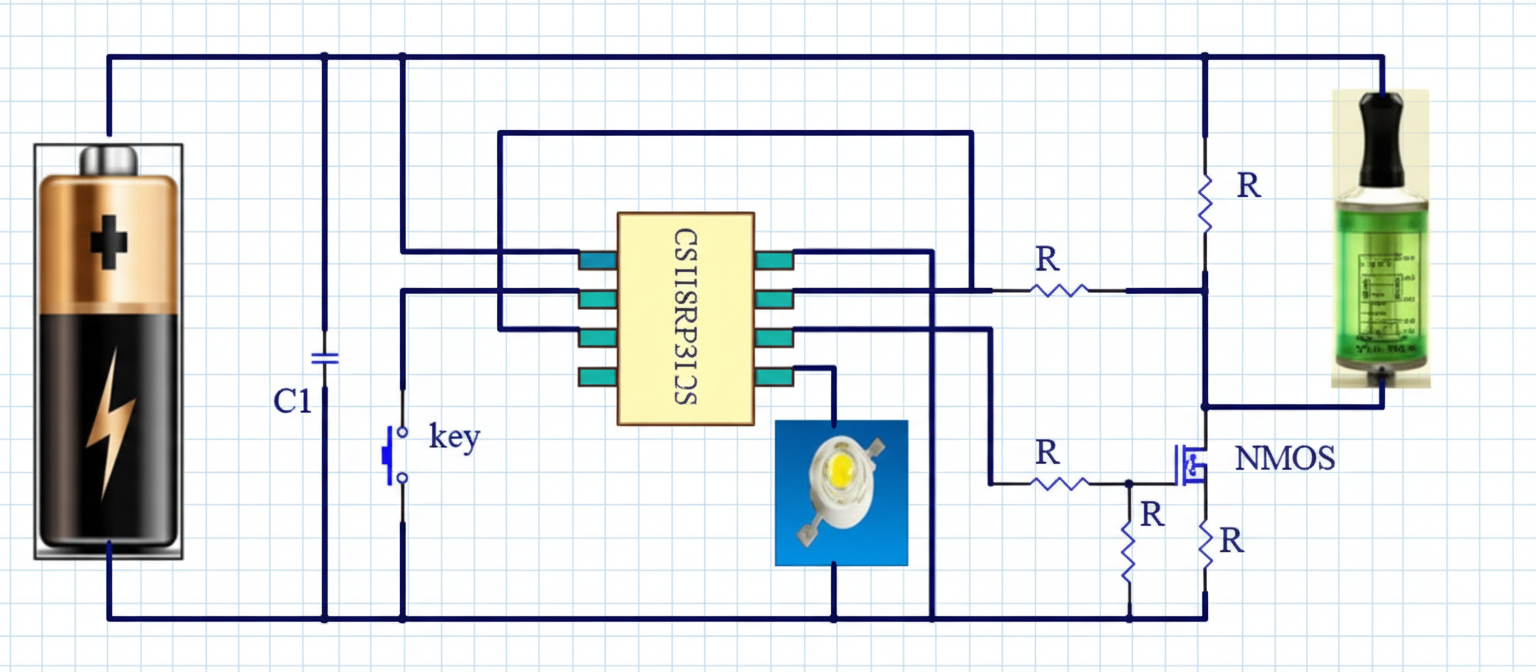
The e-cigarette system comprises the main MCU CSU8RP3125, the battery, a push button, an LED breathing indicator, and the atomizer.
Detailed Design
1. Short-circuit Protection
Short-circuit protection is implemented using the chip's low-voltage reset function. Set the LVR threshold to 2.4 V. If a short occurs at the load, the chip's VDD momentarily drops below 2.4 V and the MCU resets. The NMOS gate then returns to the reset state (low), shutting off the NMOS to protect the MOSFET.
2. Overcharge Protection
The battery is connected directly to the chip VDD. Using the internal reference voltage as the ADC input reference and VDD as the measured node, changes in VDD produce corresponding ADC readings. The firmware converts ADC values to the battery voltage. When the chip detects the battery voltage exceeding 4.2 V, it drives the NMOS gate low to open the charging path and prevent overcharge. Using the internal reference eliminates the need for an external reference and reduces the number of external divider resistors. Note: the original text references CSU8RP3215 in this paragraph; the primary device in this design is CSU8RP3125.
3. Low-voltage Alert
The same ADC-based measurement of VDD (battery voltage) is used to detect undervoltage. When the battery voltage falls below 3.2 V, the MCU drives the NMOS gate low to disconnect the load and uses PWM output to drive the LED breathing indicator to alert the user of low battery.
4. Atomizer Overcurrent Protection
An external ADC channel monitors the voltage drop from the NMOS source to ground to calculate the current through the atomizer. If the measured current exceeds a defined threshold, the MCU drives the NMOS gate low to turn off the NMOS and prevent overcurrent. The CSU8RP3125 provides sensitive ADC detection suitable for reliable overcurrent protection in e-cigarette products.
5. LED Breathing Control
The chip's PWM output controls the LED breathing effect. To ramp the LED from off to full brightness, the PWM duty increases stepwise: starting from low level and increasing a positive duty step every 3 ms until full output. To dim from full brightness to off, the PWM begins at high level and decreases by a negative duty step every 6 ms until low output. When the battery is undervoltage, the breathing transition speed is reduced to one third of the normal rate to indicate the need to recharge.
Device-Level Notes
This design targets international markets. The CSU8RP3125 provides a chip-level HBM ESD rating of 8 kV and an operating temperature range of -40 to 85°C. Evaluations show stable high-speed PWM operation, reliable ADC sampling with low thermal drift, and suitable performance for compact devices. The chip is available in an MSOP-8 package, which helps reduce PCB area and is appropriate for e-cigarette development.