Introduction
An e-cigarette is a low-voltage microelectronic atomization device that vaporizes a flavored nicotine solution into an inhalable aerosol. The device integrates a cartridge, an atomization chamber, and an intelligent control chip powered by a lithium battery. A front indicator light shows operating status and simulates the glowing tip of a conventional cigarette when the device is used. The atomizer is the core component responsible for generating the visible vapor by heating and atomizing the liquid in the cartridge.
Structure and Working Principle
Also called an atomizing e-cigarette, the device does not burn tobacco. It contains purified nicotine solution rather than tar and many combustion byproducts present in conventional cigarettes. A typical device consists of a battery (body), an atomizer or cartridge, and a mouthpiece. The body houses a power switch and a status LED. The nicotine liquid is heated in the atomizer to produce vapor; the liquid carries flavorings, which commonly include tobacco, fruit, herbal, and beverage profiles.
The device often resembles a cigarette and may include a red LED at the tip to simulate ignition while producing vapor. Typical internal components include a stainless steel housing, a lithium battery, an airflow sensor, control circuitry, power driver circuits, high-frequency ultrasonic generator, atomization chamber, and a nicotine liquid cartridge.
Operationally, the nicotine solution from the cartridge is pressurized by a micro pump into the atomization chamber. A 2.2 MHz ultrasonic high-pressure signal atomizes the liquid into droplets approximately 0.5-1.5 um in diameter for pulmonary absorption. An airflow sensor in the control chip ensures atomization only occurs during inhalation, and a microcontroller coordinates the device functions.
As with combustible cigarettes, nicotine is delivered to the lungs by inhalation for rapid absorption. The device can be configured with different nicotine concentrations and flavor recipes to suit user preferences, and cartridges can be formulated to mimic particular flavors if required.
System Design
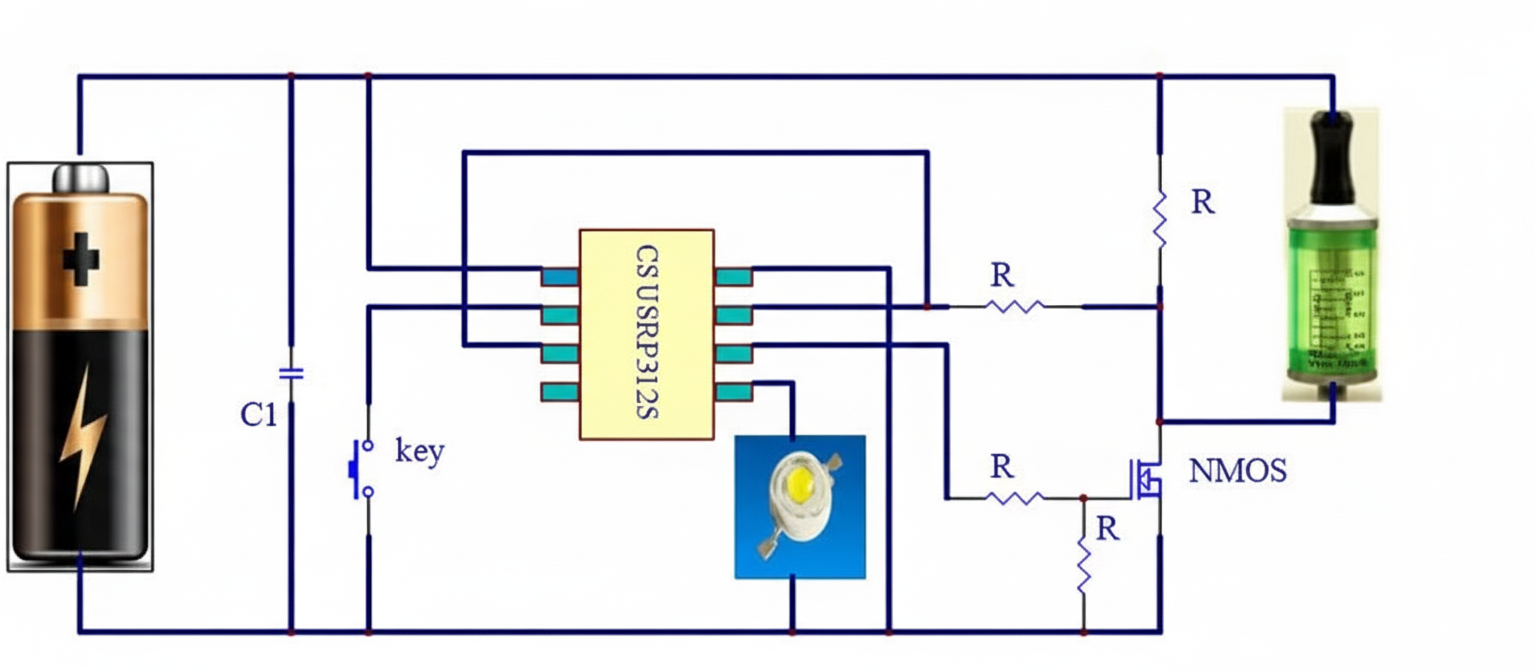
The main components include a control chip (CSU8RP3125), battery, button, breathing LED, and the atomizer.
Detailed Design
Short-circuit Protection
Short-circuit protection is implemented using the chip's low-voltage reset (LVR) feature. The LVR threshold is set to 2.4 V. If the load side is shorted and VDD falls below 2.4 V, the chip resets; the NMOS gate returns to the reset state and pulls low to turn off the NMOS, protecting the MOSFET.
Overcharge Protection
The battery is connected directly to the chip VDD. The chip uses its internal reference and VDD as the measurement reference. Because the internal reference is fixed, changes on VDD produce corresponding changes in the ADC reading. The ADC value is used to estimate battery voltage. When the chip detects battery voltage above 4.2 V, it drives the NMOS gate low to disconnect the charging path and prevent overcharging. The CSU8RP3215 chip uses an internal reference to measure battery voltage, eliminating the need for an external reference and reducing the number of divider resistors.
Circuit Characteristics
1. Constant-voltage charging, maximum voltage 4.2 V.
2. Default charging current 405 mA.
3. Charging current is adjustable by changing the resistance from pin ISET to ground. The relationship is:
ICH = 1216V / RISET
Where ICH is the charging current in amperes and RISET is the resistance from the ISET pin to ground in ohms. For example, to obtain 405 mA charging current:
RISET = 1216V / 0.405 A = 3 kΩ
For stability and temperature performance, RISET should be a 1% metal-film resistor. The charging current can be monitored by measuring the voltage at the ISET pin. The charging current can also be computed as:
ICH = (VISET / RISET) * 1000