Overview
Laptop hinges are moving components that must withstand bending moments and torques. They strongly affect the opening and closing experience. Key performance indicators such as wear resistance, torque stability, and service life depend on the following five design attributes.
Design Attributes
1. Damping Effect
Damping is a force that reduces vibration when an object is subject to external forces. The ratio between the damping force and the applied force is the damping coefficient. The damping force typically acts opposite the direction of velocity. A higher damping coefficient generally means better vibration attenuation, but excessive damping can make two parts behave like a rigid connection and eliminate intended buffering. Damping is often used together with springs; if damping is too large it will not provide the desired cushioning.
Damping provides several benefits:
- It helps reduce the resonance amplitude of mechanical structures.
- It helps a mechanical system return quickly to a stable state after an impulse shock.
- It helps reduce sound radiation resulting from mechanical vibration, lowering mechanical noise.
- It helps reduce the ability of a structure to transmit vibration.
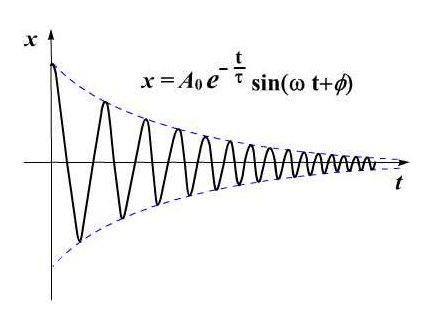
Figure: damping diagram
2. Opening Angle
The opening angle is the rotational range of the laptop screen. Typical designs fall into two types: conventional hinges, which usually do not flip beyond 180 degrees, and 360-degree convertible hinges that allow more flexible usage scenarios. The larger the hinge opening angle, the wider the range of applicable use cases.
3. Limit Angle
Angle limiting can be implemented in two ways: by setting a stop on the hinge or by setting a stop on the laptop chassis. Both methods achieve the same limiting effect; the choice depends on which is more convenient for the design. Common limit angles include 135°, 145°, 180°, and 270°.
4. Self-locking Function
Many laptop hinges include a self-locking feature. Near the closed position (commonly between 15° and 30°), the closing torque increases to produce a self-locking effect. Common self-locking structures include wrap-around designs, single-washer axis, and dual-washer axis arrangements.
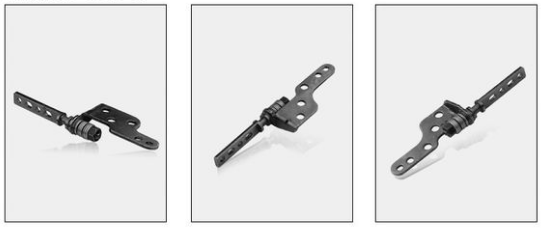
Figure: forms of self-locking structures
5. Wear Compensation Structure
Wear compensation typically uses a spring that presses radially to keep the rotating ring in close contact with the base through friction. Because the spring continuously applies pressure, it compensates for material worn away from the rotating ring and base. This approach avoids the loosening problem that can occur with fixed fasteners as parts wear.
Common Laptop Hinge Structures
1. Protruding Hinge
A protruding hinge is mounted on the main body so the screen fits more tightly against the chassis. When opening, the screen rises, which prevents the screen from blocking the laptop rear and allows convenient placement of ports and cooling vents on the rear. From the perspectives of space utilization and increasing port count, this design is advantageous. Protruding hinges typically allow larger opening angles, often 150°–180°. A drawback is that the screen thickness at the mounting area must match the hinge, limiting how thin the screen enclosure can be.
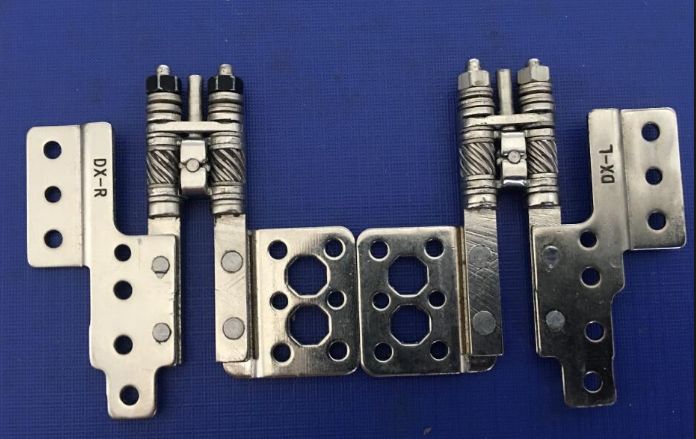
Figure: protruding hinge
2. Recessed Hinge
With a recessed hinge, the pivot is located within a thicker section of the base and is not constrained by the cover thickness. Recessed hinges were developed for ultrabooks to enable thinner screen assemblies. Drawbacks include increased design and manufacturing complexity, the screen sitting further from the user, a visible gap between panels, reduced opening angle in some designs, and typically fewer external interfaces. These trade-offs are accepted for improved portability and thinner profiles.
3. Multi-axis Hinge
Multi-axis hinges emerged with the popularity of 2-in-1 convertible devices. Using interacting parallel hinge elements, they enable flexible screen flipping and allow laptop devices to adopt tablet-like form factors. This saves space and supports touch interaction, media viewing, and web browsing. Multi-axis hinges combine aspects of protruding and recessed designs and can allow a full 360° opening to meet diverse usage modes.
4. Bracelet/Chain-style Hinge
Bracelet-style hinges, such as those used on some convertible laptops, allow 360° rotation and enable multiple usage modes: laptop, tablet, stand, and tent. These hinges can involve many small interlocking parts and complex assembly processes, which increases manufacturing complexity and can pose reliability challenges.
Summary
There is no absolute best hinge type; the choice depends on the model and target use cases. Large-screen, business, and full-featured laptops often use protruding hinges to prioritize expandability and viewing comfort. Netbooks and thin-and-light laptops typically use recessed or multi-axis hinges to minimize lid thickness. Bracelet-style hinges are less common due to their complexity.
In current hinge manufacturing, low- to mid-end hinges are mainly produced by stamping, while high-end hinges commonly use metal injection molding (MIM).