Overview
Mobile phone television can be categorized into three types: one based on analog broadcast networks, one based on mobile communication networks, and one based on digital broadcast networks. The analog broadcast approach adds an analog TV module to the handset to receive analog TV programs, but its reception quality and user acceptance have been limited. Mobile communication network approaches include a unicast scheme based on 2.5G mobile networks and a multicast scheme based on 3G mobile networks. The unicast scheme uses 3GPP video formats and streaming servers to provide on-demand, live, and carousel services, for example mobile operators' WAP portals. The multicast scheme includes implementations such as Qualcomm's MediaFLO, which schedules network resources based on mobile network load and manages program playback and transmission modes. Digital broadcast approaches follow major standards such as DVB-H (Digital Video Broadcasting-Handheld) in Europe, ISDB-T (Integrated Services Digital Broadcasting-Terrestrial) in Japan, and T-DMB (Terrestrial-Digital Multimedia Broadcasting) in Korea. A national standard in China has not yet been formally issued.
Target Platform
This article discusses a digital broadcast-based mobile TV solution using TI's DM275, HOLLYWOOD DTV100x, and TSC2110 as the handset platform. The presented design is in development.
System Architecture
The mobile digital TV phone comprises two subsystems: the DVB-H mobile digital TV subsystem and the GSM/GPRS communication subsystem. Both subsystems are controlled by the application processor, which manages the DVB-H receiver and the GSM/GPRS communication module.
Mobile Digital TV Subsystem
The mobile digital TV subsystem consists of a mobile digital TV receiver, which includes a tuner and demodulator, and an application processor.
The receiver input is an RF broadcast signal from the antenna. Its output is either an MPEG-2 transport stream (TS) or IP packets. These outputs are fed to the application processor for video and audio decompression and display on the LCD. Data communication between the mobile digital TV receiver and the application processor (TI DM275) is divided into two categories: (1) control and status exchange, where the application processor initiates program download and configuration and the receiver reports runtime information and status; and (2) data streams, which deliver channel signals to be decoded, including digital video, digital audio, and data. These two categories may be transmitted over a single physical interface or separate physical interfaces. There are three physical interface modes.
The following discusses the SDIO interface between the receiver and the application processor. When using the SDIO interface, both control/status reporting and data streams are exchanged via SDIO, which can operate in either a 4-bit or 1-bit data mode, as described in Table 2.
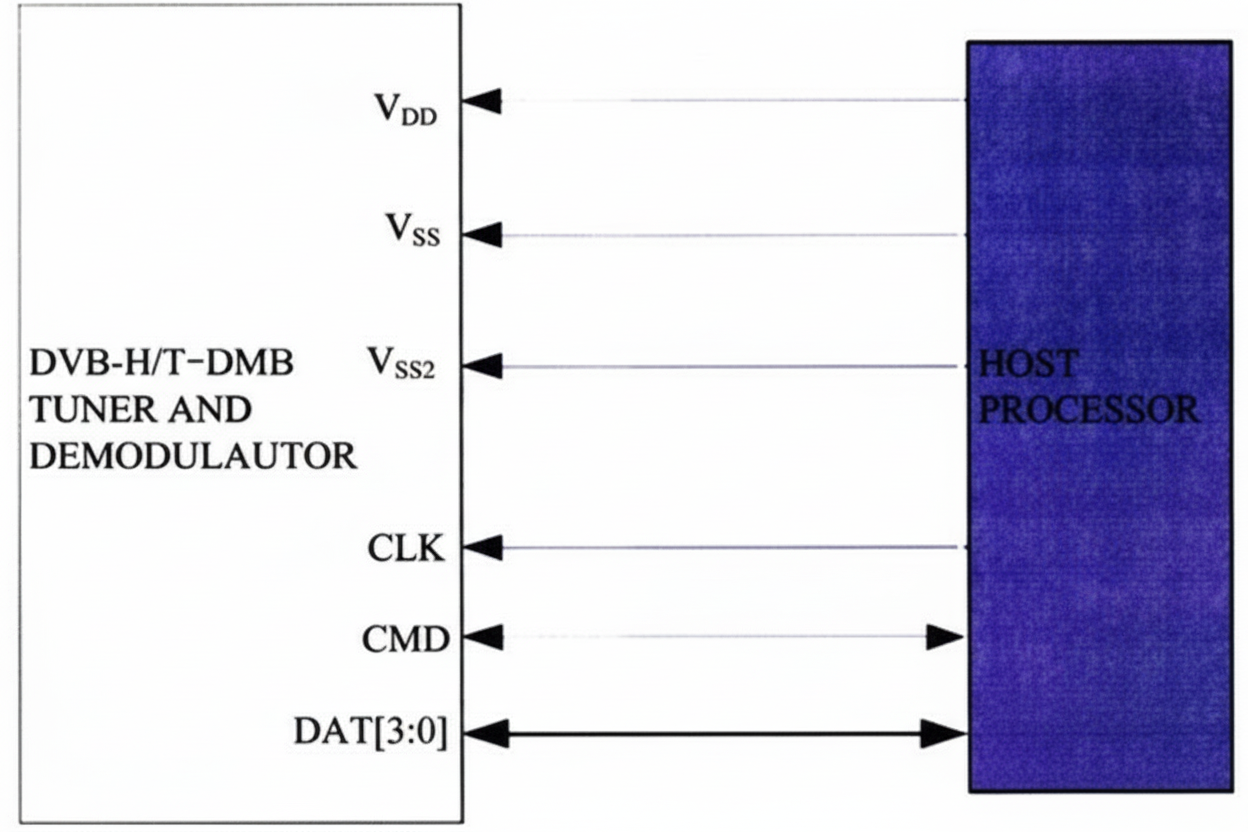
Figure 1. Receiver using a 4-bit SDIO data line interface
TI DM275 Application Processor
The TI DM275 integrates a TMS320C54x DSP core and an ARM7TDMI CPU core. The DSP core is TMS320C54x, and the CPU core is ARM7TDMI. DM275 is a portable terminal DSP that supports H.264/MPEG-4 AVC encoding/decoding and includes dedicated circuitry for separating MPEG-2 transport streams.
DM275 is the successor to TI's TMS320DM270. It contains a 102 MHz TMS320C54x DSP and an 88 MHz ARM7TDMI microcontroller in a dual-core architecture. The device adds circuitry to separate MPEG-2 transport streams and extends the iMX dedicated video processing hardware to support H.264 decoding.
DM275 codec capabilities include: encoding: MPEG-4 Simple Profile up to 640×480 at 30 fps; MPEG-4 Advanced Simple Profile up to 320×480 at 30 fps. Decoding: H.264 up to 352×288 at 30 fps; MPEG-4 Advanced Simple Profile up to 720×480 at 30 fps; MPEG-2 up to 720×480 at 30 fps; DivX up to 720×480 at 30 fps; WMV9 up to 720×480 at 30 fps.
DM275 provides multiple external interfaces including USB, UART, MMC/SD, SPI, SDRAM, and LCD. It can directly drive CCD or CMOS cameras. Its flexible programmability and strong signal processing capability allow it to adapt to various mobile TV standards, making it suitable for multimedia mobile phone applications.