Market context
The annual shopping season has begun. As a perennial hit in consumer electronics, are you planning to buy TWS earbuds?
This year the TWS earbud market is active. A mobile phone brand focused on gaming launched full-scenario esports TWS earbuds with ultra-low latency for gaming, several manufacturers released open-fit designs that prioritize wearing comfort, and adaptive noise cancellation and spatial noise control have become standard in higher-end models. Scene segmentation, attention to wearing comfort, and improvements in audio experience are common themes. A recent report from Canalys also confirms growth in the TWS market: global shipments reached 68.16 million units in Q2 2023, up 8% year over year.
Why motion sensors matter in earbuds
Consumers are increasingly aware of audio quality differences and expect better on-device audio experiences. Features such as adaptive active noise cancellation, voice enhancement, and spatial audio all rely on motion sensors, including accelerometers, gyroscopes, and magnetometers.
Motion detection supports adaptive active noise cancellation
Active noise cancellation (ANC) is well established. In steady, high-noise environments such as on airplanes, ANC can significantly reduce noise and provide a more comfortable listening experience while preventing excessive volume levels. When users move between varying environments, such as city streets or restaurants, adaptive active noise cancellation is needed to automatically adjust cancellation levels based on the surroundings. Compared with basic ANC, adaptive ANC adds a software processor that uses algorithms to calculate and adjust noise cancellation levels in real time.
Beyond algorithms, motion sensors can enhance adaptive ANC. Motion sensor data helps determine the user's current activity and adjust features accordingly. For example, the BHI380 is an IMU-based programmable sensor system that combines a gyroscope and accelerometer to recognize activities like walking and running. If the system detects a call in progress, it can automatically activate noise cancellation or, in a multi-person conversation, enable transparency mode so the user hears ambient speech.
Accelerometers improve call quality
Voice activity detection (VAD) detects human speech and determines whether someone is speaking. MEMS sensors can monitor speech via vibrations transmitted through bone conduction and trigger the microphone only when the user speaks, optimizing power consumption. With this approach, voice enhancement can use MEMS sensors to distinguish and separate speech from ambient noise, enabling clearer calls.
The BMA550 functions as both an accelerometer and an acoustic sensor to detect bone-conducted speech. When VAD identifies a call, voice enhancement can be activated to filter noise and amplify the speaker's voice. This ensures that the far-end party can hear the speaker clearly even in noisy environments.
IMU sensors behind spatial audio and head tracking
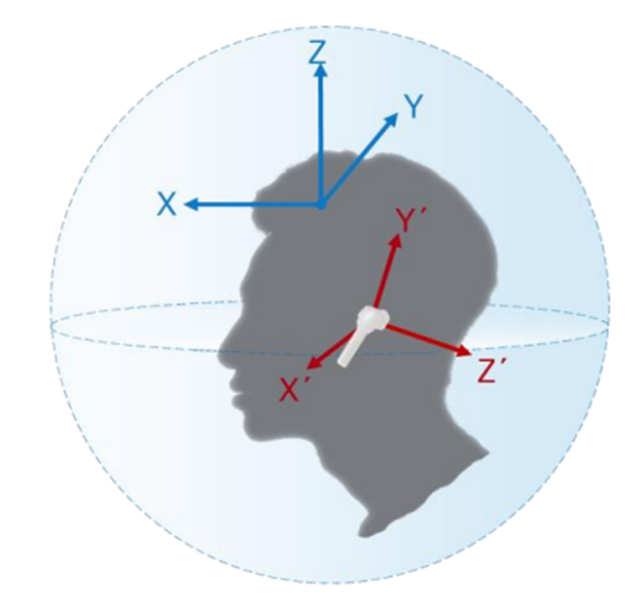
Spatial audio, or 3D audio, uses immersive audio techniques to present a three-dimensional sound field centered on the listener, restoring a stronger sense of presence, distance, direction, and movement in music.
Head-tracking enables the spatial audio experience. When a user enables head tracking in spatial audio and plays a track, the gyroscope in the earbud captures head orientation. If the user turns their head left, they will perceive the soundstage shifting accordingly so that a sound that was in front appears to move relative to the head orientation, creating an immersive effect.
In TWS earbuds, the BHI380's integrated gyroscope and accelerometer can accurately sense head motion. When paired with the BMM350 magnetometer, the system can precisely estimate head direction so the device can adjust audio rendering accordingly.
Product differentiation in a competitive market
Competition in the TWS market is intense, and product differentiation remains crucial. Focusing on specific use cases, offering semi-in-ear or open-fit designs that prioritize comfort, and continuously improving the audio experience are key strategies for standing out in the market.