Introduction
"Buzz... buzz..." At the first light of morning, my phone's vibration woke me up. I wondered how that small device produces such a pronounced vibration, so I looked into the motors embedded inside phones. Early feature phones and early smartphones used rotary motors, while more recent devices increasingly use linear motors to improve tactile feedback. Below is a concise overview of motor evolution, structural designs, and operating principles.
How do phones produce vibration?
In early phone designs, vibration was mainly used for alarms and incoming-call alerts. As touchscreen smartphones evolved, vibration has been used for tactile feedback to give a more convincing touch sensation. These vibrations are generated by tiny motors built into the phone. In early feature phones and first-generation smartphones, rotary motors dominated. With expanding use cases and higher expectations for user experience, linear motors emerged as an alternative.
Motor types and principles
Rotor motors
Cylindrical rotor motor
The cylindrical rotor motor is similar to a mini DC motor used in small hobby applications. It uses electromagnetic induction to drive the rotor. An asymmetric mass attached to the shaft creates a changing centrifugal force during rotation, causing the phone to shake and produce the vibration sound.
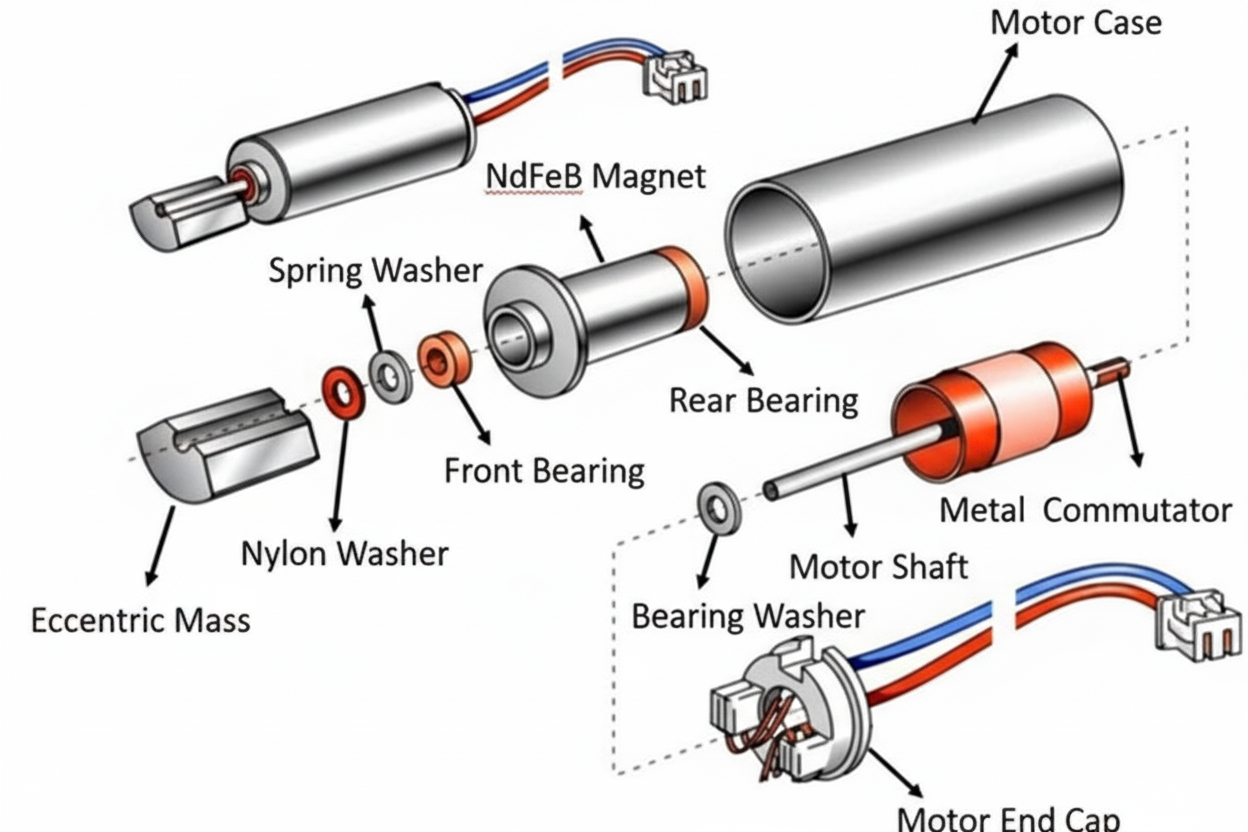
Advantages: Simple drive method and low cost. Disadvantages: Relatively large size, not ideal for thin phone designs; slow start/stop; no directional control; vibration "buzz" lacks crispness and tactile quality.
Flat rotor motor
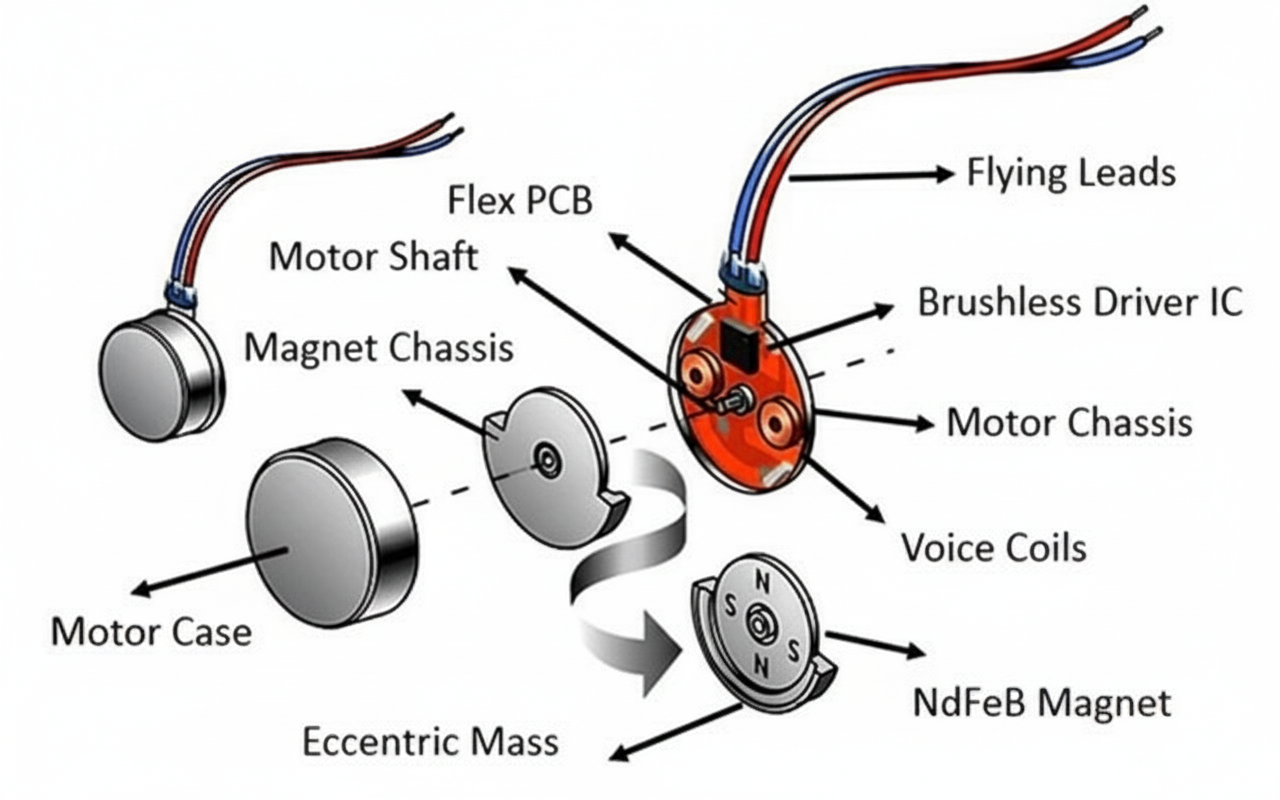
To accommodate thinner phones, flat rotor motors were developed from the cylindrical design. They still rely on an eccentric mass to generate vibration and share similar pros and cons with cylindrical rotor motors.
Linear motors
Linear motors operate like a pile driver: they convert electrical energy directly into mechanical energy and move an internal mover in a straight reciprocating direction. Driven by a dedicated driver IC, linear motors achieve shorter start/stop times and higher vibration intensity. Their sharper, more delicate "tick" or "thud" sensations are superior to those from rotary motors.
Linear motors can control vibration force and frequency independently. Built-in controllers can store multiple vibration waveforms and synchronize vibration with audio. Developers can match waveforms to different use cases or in-game events to provide rich tactile feedback.
Z-axis linear motor
Z-axis linear motors resemble flat rotor motors externally; their stator-mover reciprocates along the Z axis, producing strong vibration in the up-and-down direction. Z-axis travel is relatively short, so its tactile strength is weaker than X-axis linear motors but still much stronger than rotary motors.
Advantages: Fast start/stop, strong directional sensation, crisp and three-dimensional "thud" sound; compact size and moderate cost. Disadvantages: Short travel, vibration strength weaker than X-axis linear motors.
X-axis linear motor
X-axis linear motors are typically rectangular blocks with a mover that reciprocates along the X direction. Since a phone usually has more space along the X/Y plane, X-axis motors can use longer travel to deliver stronger tactile feedback.
Because X/Y space allows for larger form factors, X-axis motors are often used when stronger, higher-quality tactile feedback is required.
Advantages: Fast start/stop, clear directional sensation, crisper "tick" sounds; longer travel and stronger tactile feedback than Z-axis. Disadvantages: Larger size and higher cost.
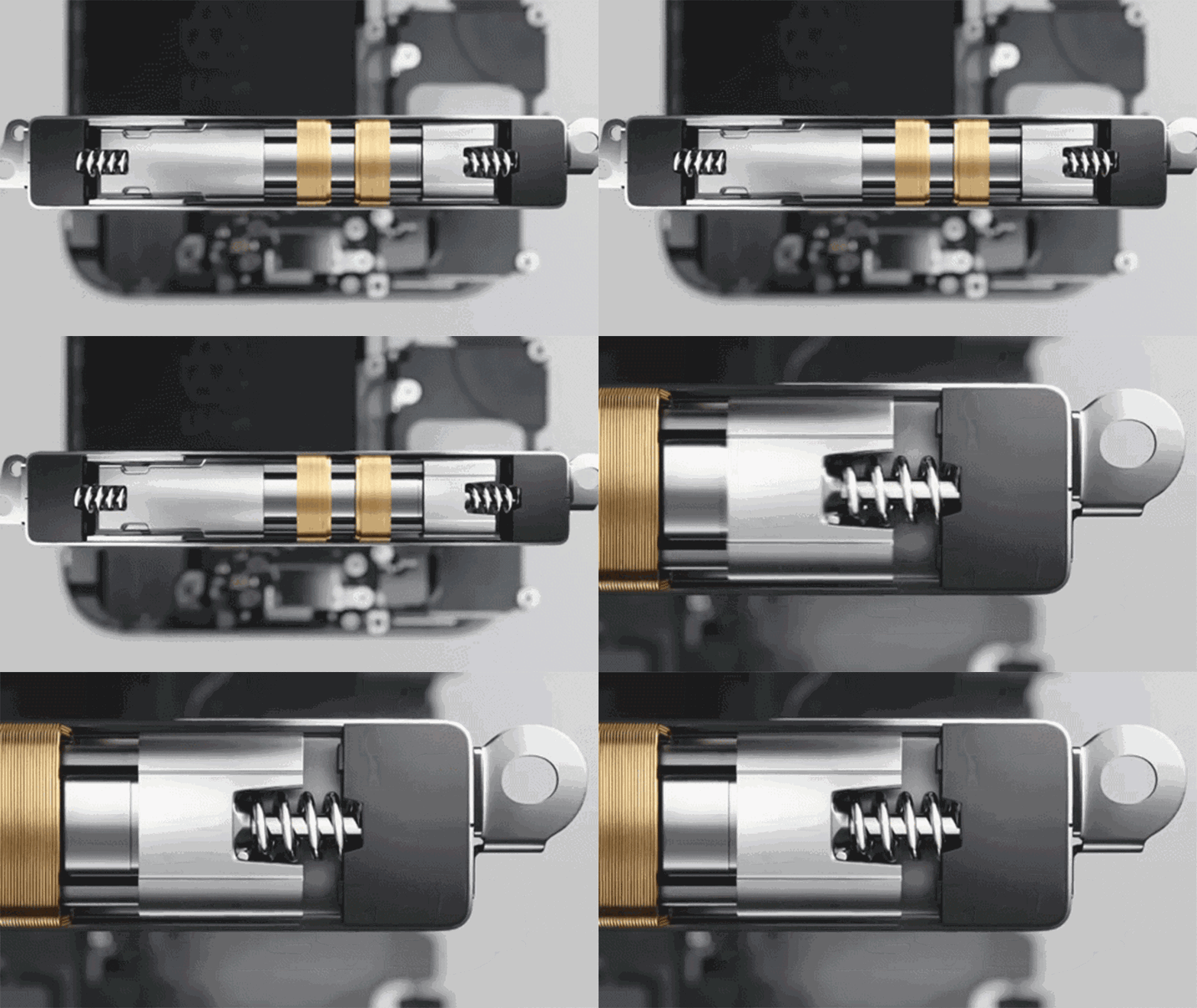
Wideband linear motor
Conventional linear motors have a resonance frequency F0 where vibration is strongest; outside that frequency the vibration intensity drops rapidly. Wideband linear motors maintain substantial vibration across a broader frequency range, enabling richer tactile effects. Due to their larger size and higher cost, wideband linear motors are currently common in high-end game controllers and are not yet widely adopted in smartphones, though some models have started to use them.
Wideband linear motors represent a likely direction for future tactile feedback. As technology advances, broader frequency response could enable more lifelike sensations. Advantages: Very wide vibration frequency range and richer tactile effects. Disadvantages: Larger size and higher cost.
Applications of linear motors
Apple introduced linear motors with the iPhone 6, and since 2018 many mainstream Chinese flagship models have followed. Linear motors have become an important feature for manufacturers and a notable element of user experience. Typical application scenarios include:
Simulated physical buttons
To improve waterproofing and overall aesthetics, some manufacturers removed physical buttons and used haptic feedback to simulate them. For gaming enthusiasts, shoulder buttons are important; some devices use dual X-axis linear motors plus pressure sensing to simulate physical shoulder keys while retaining strong tactile feel.
Game 4D haptics
By recognizing in-game events, X-axis linear motors can provide distinct feedback for gunfire, driving, collisions, jumps, and other scenarios. This direct physical feedback enhances immersion and realism.
Improving interaction
X-axis linear motors can vibrate in sync with music to enrich the audio experience; they can simulate mechanical keyboard keypresses for better typing feel on touchscreens; they are also used in alarms, camera shutter feedback, notifications, and many other scenarios.
Summary
X-axis linear motors, with their strong tactile response, diverse vibration effects, and crisp "tick" sounds, have become an important consideration when choosing a phone. Their continued development is likely to expand the range of haptic experiences available to users.
Which motor does your phone use?