Overview
Even though mobile phones are so convenient, two-way radios remain in use because they do not depend on networks, do not incur call charges in the usual sense, and connect instantly. This article explains what a two-way radio is and how it works.
Definition
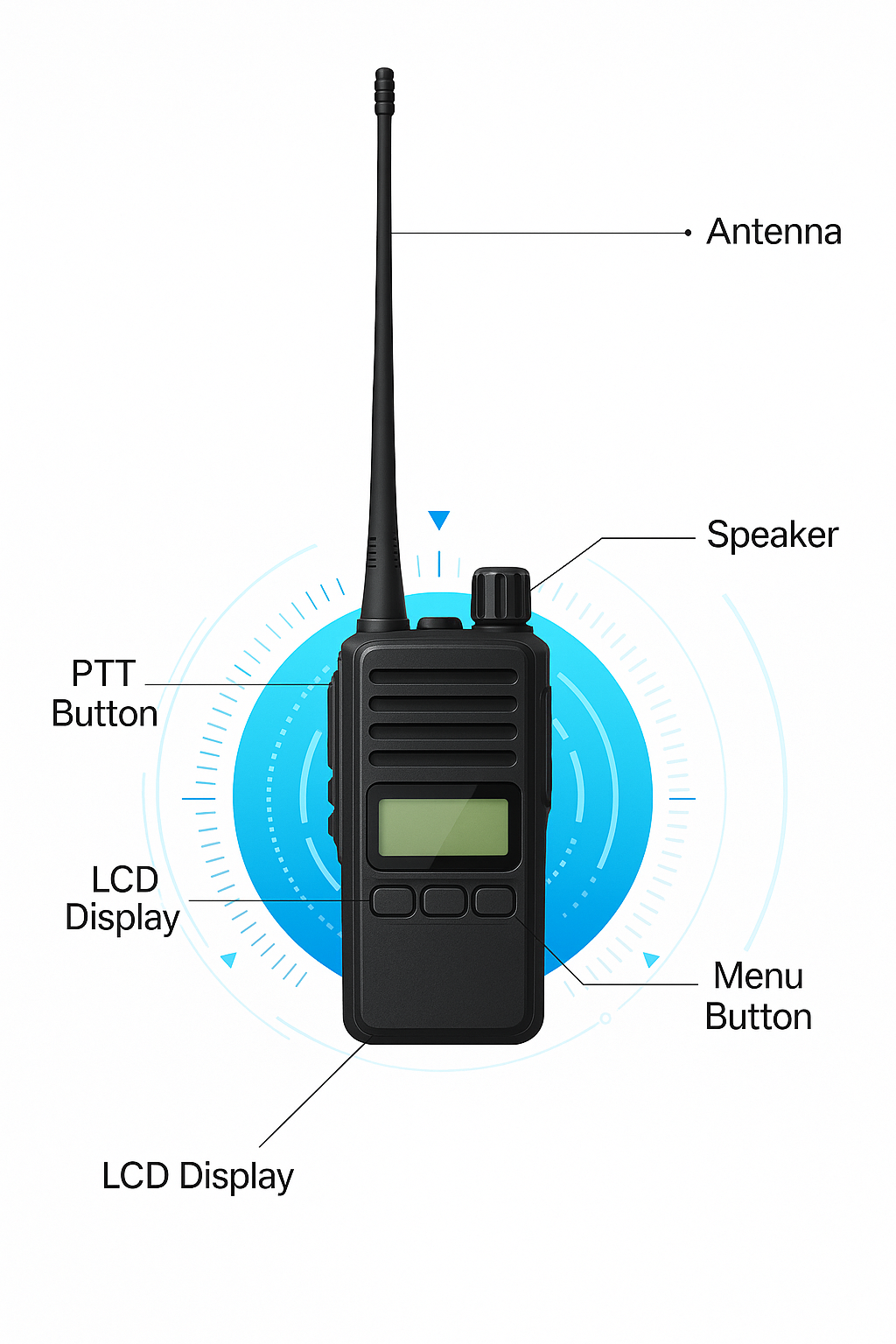
A two-way radio is a device that can both receive and transmit radio waves. A simple radio receiver can only receive. Large, high-power units that are fixed in vehicles or vessels are typically called radio stations or base stations. Small, low-power units that can be carried by hand are called handheld two-way radios, which are the most familiar type.
Basic Working Principle
The call flow of a two-way radio is similar to that of a mobile phone: receive input (voice or data) → process the input (encode it as a signal) → transmit the signal (to another radio or via a network to an application server). A typical transmit path is:
- Press and hold the PTT (push-to-talk) button to speak. The microphone converts voice into an audio electrical signal.
- An internal processor processes the audio signal, generates an RF carrier, and uses buffering, driver stages, and a power amplifier to reach the rated RF output power.
- Transmit filters suppress harmonics and other unwanted components, and the antenna radiates the signal.
A typical receive path is:
- The radio remains in receive mode while powered on.
- The antenna picks up incoming RF. The received RF is amplified and mixed with a first local oscillator signal to produce the first intermediate frequency (IF).
- The first IF passes through a crystal filter to remove adjacent-channel noise and then enters an IF processing stage, where it is mixed with a second local oscillator to produce a second IF.
- The second IF is filtered (often by a ceramic filter), amplified, and demodulated to recover audio.
- Audio processing circuits apply amplification, bandpass filtering, and de-emphasis as needed.
- Volume control and power amplifier stages drive the speaker to reproduce sound.
Key Characteristics
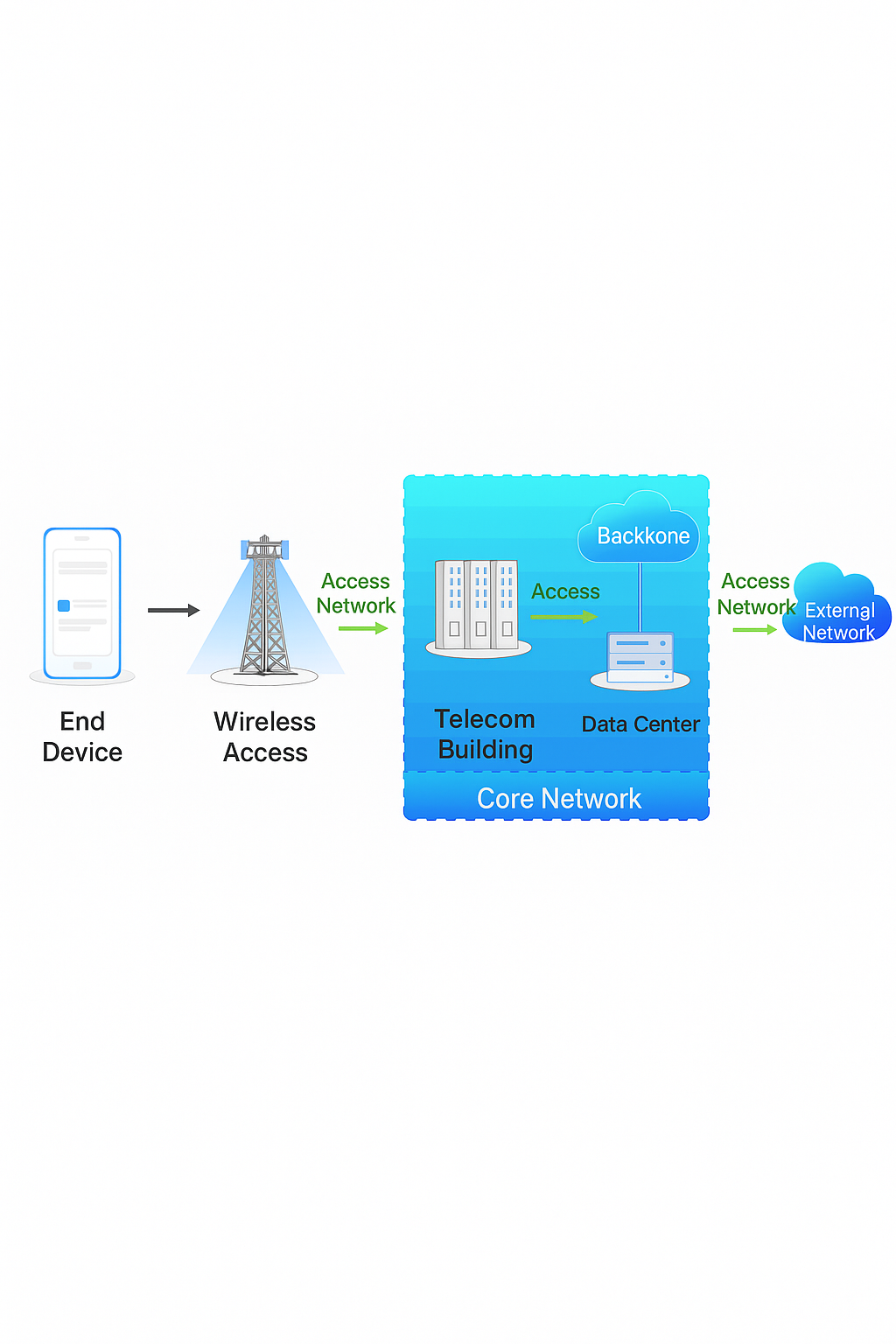
- No reliance on telecom networks: Mobile phone calls require access networks, transport networks, core networks, and external networks. Two-way radios can establish direct radio links between units without those infrastructures.
- Low direct call cost: Radio emission itself does not incur per-call charges. Note that spectrum usage and licensing may involve fees in some jurisdictions.
- Immediate connection: With a PTT radio link already established, pressing the talk button enables immediate transmission without the dialing/answering handshake required in mobile telephony, which is useful where very fast response is needed.
Core Components and Parameters
Important elements and parameters of two-way radios include:
Operating frequency bands
Frequency bands are allocated and managed by national or regional radio regulatory authorities. Typical allocations include VHF 136–174 MHz and UHF 400–470 MHz for professional radios, 433 MHz for some outdoor or low-power devices, and various bands used for cellular services. Specific civil or license-free bands vary by jurisdiction; users must comply with local regulations.
Channels
Within a band, discrete communication channels are defined using fixed channel steps (for example, 25 kHz, 20 kHz, or 12.5 kHz). Examples of channel frequencies are 409.7500 MHz, 409.7625 MHz, 409.7750 MHz, and so on. A channel scanning function allows the radio to attempt reception across multiple channels in sequence; for example, scanning 10 channels per second if each channel is monitored for 100 ms.
Transmit power
Transmit power is a key factor for range. Low-power consumer radios typically stay below 0.5 W in certain jurisdictions; handheld professional radios are commonly up to 5 W, while vehicle-mounted and base stations may use 25–100 W or more, subject to licensing and regulation.
Range
Range depends on transmit power, antenna, terrain, and obstacles. In open areas, handheld radios can maintain clear communication over several kilometers. In urban environments with buildings, practical handheld ranges are often 1–2 km.
Antenna
Lower RF frequencies correspond to longer wavelengths and therefore longer antennas for efficient transmission and reception. Handheld radios often feature relatively long external antennas for this reason.
Battery and power-saving
Radios use large-capacity batteries for longer operation and often implement automatic power-saving modes. If a radio does not transmit for a period, it may enter a low-power sleep state until a signal or user action wakes it.
Ruggedness
Handheld radios are typically designed for outdoor and industrial use, with ingress protection, shock resistance, and other durability features.
Common Applications
- Emergency communications: When infrastructure-based networks are unavailable due to disasters or outages, two-way radios enable direct contact among responders and personnel.
- Outdoors, basements, tunnels: In areas not covered by cellular base stations, two-way radios provide reliable local communications.
- Healthcare, retail, large events: In time-critical, coordinated environments, the immediacy and simplicity of two-way radios improve operational efficiency.
Types and Evolution
- Analog two-way radios: The earliest and still widely used type, which transmits analog-modulated voice on a channel. Units must share the same channel to communicate.
- Digital two-way radios: Convert voice into digital data and transmit encoded digital signals. Digital systems reduce noise and distortion and can use techniques such as time-division multiple access (TDMA) to increase channel capacity and support more users on the same frequency.
- IP-enabled radios (public network radios): Integrate with existing communications networks to extend range. With a cellular or IP interface, these radios can link over long distances through carrier networks or the Internet. Functionally, when connected to public networks, their operation becomes similar to that of mobile devices, though they may retain radio features such as PTT and longer external antennas for conventional RF bands.
Conclusion
The technical core of two-way radios and mobile phones is similar: both convert voice into RF signals and back. However, two-way radios remain advantageous in specific scenarios due to direct connectivity, rapid call setup, and operational simplicity. From analog to digital and IP-enabled systems, two-way radio technology continues to evolve to meet diverse communication needs.