Overview
The iPhone 15 generated significant attention at launch. The iPhone 15 Pro Max is Apple’s flagship for the year and includes the A17 Pro, a 3 nm application processor. Below is a technical look at the phone’s PCB layout and the key chips identified in the iPhone 15 Pro Max teardown published by iFixit.
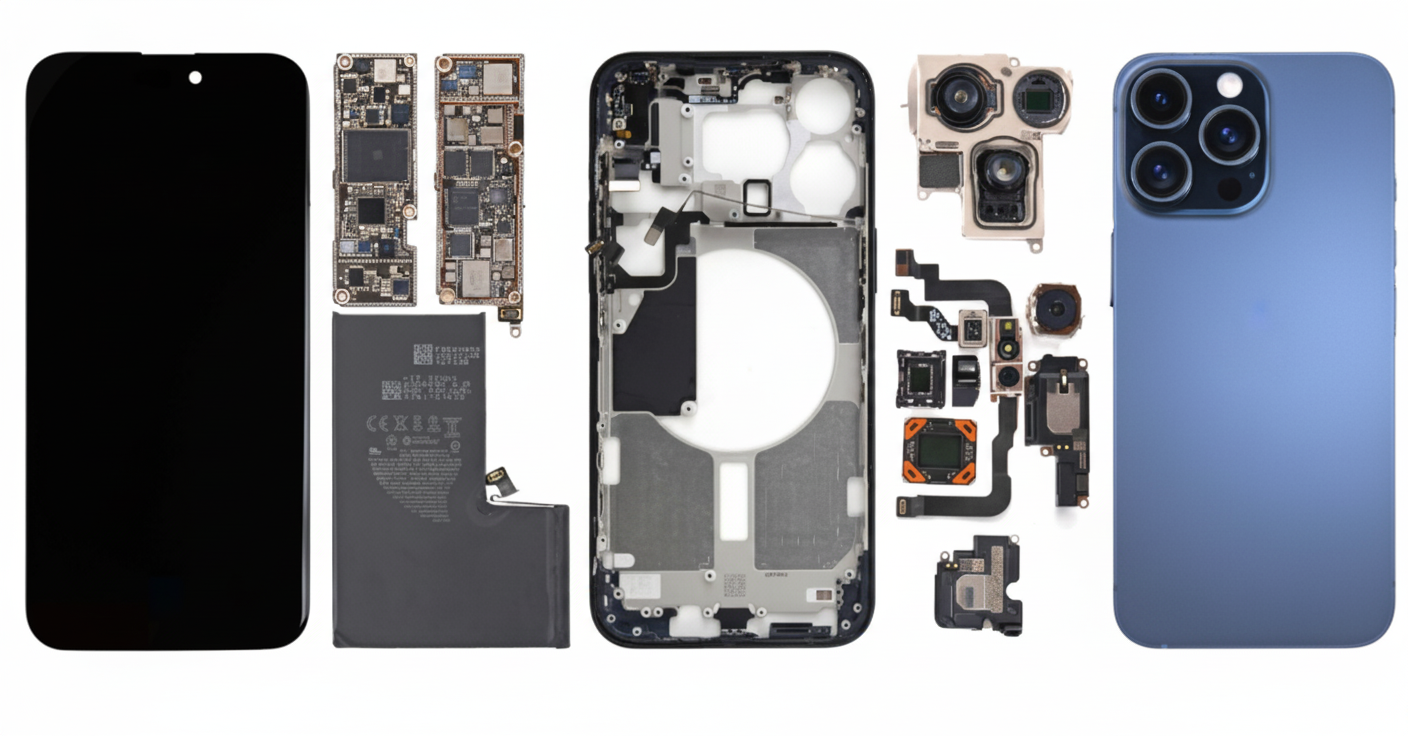
PCB preview
The phone uses two main PCBs. The main PCB hosts the A17 Pro, memory chips, and various power management and control ICs. The main PCB is composed of top and bottom layers.
The organized array of resistors, capacitors, and inductors shows a high level of layout integration.
The second board is the RF PCB, which carries many RF chips. The RF PCB has a perimeter of shielding vias that protect the radio circuitry. Critical RFICs are often surrounded by grounded shielding areas to improve performance in a noisy electromagnetic environment.
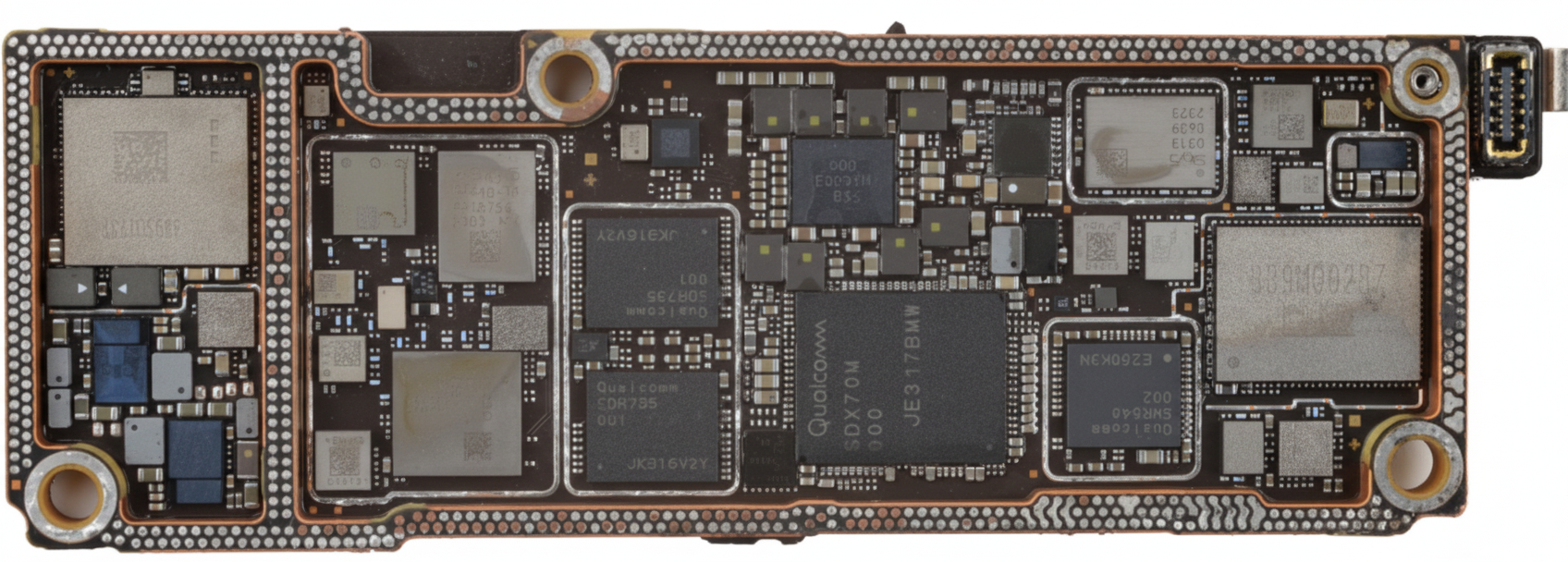
The RF PCB bottom layer is not shown in the teardown images, but its bottom side likely contains connectors and high-speed interfaces that connect to the main PCB.
Chip distribution
The rapid progress of integrated circuit technology is evident: modern smartphones provide computer-level functionality on compact PCBs. Based on iFixit information, the main chips are summarized below.
- Main PCB, top layer: The A17 Pro 3 nm application processor sits on the main PCB top layer. Various power management, control ICs, and other supporting chips are also located here.
- Main PCB, bottom layer: The bottom contains a large-area flash memory chip, the K5A4RB6302CA12304 256 GB NAND, various controllers, and high-speed interfaces that link the main board to the RF board.
- RF PCB: RF chips are mainly placed on the RF PCB top layer. The bottom layer primarily contains high-speed connector interfaces to the main PCB. The RF components for Apple handsets are still supplied by major RF vendors such as Qualcomm, Broadcom, Qorvo, and Skyworks.
Key chips
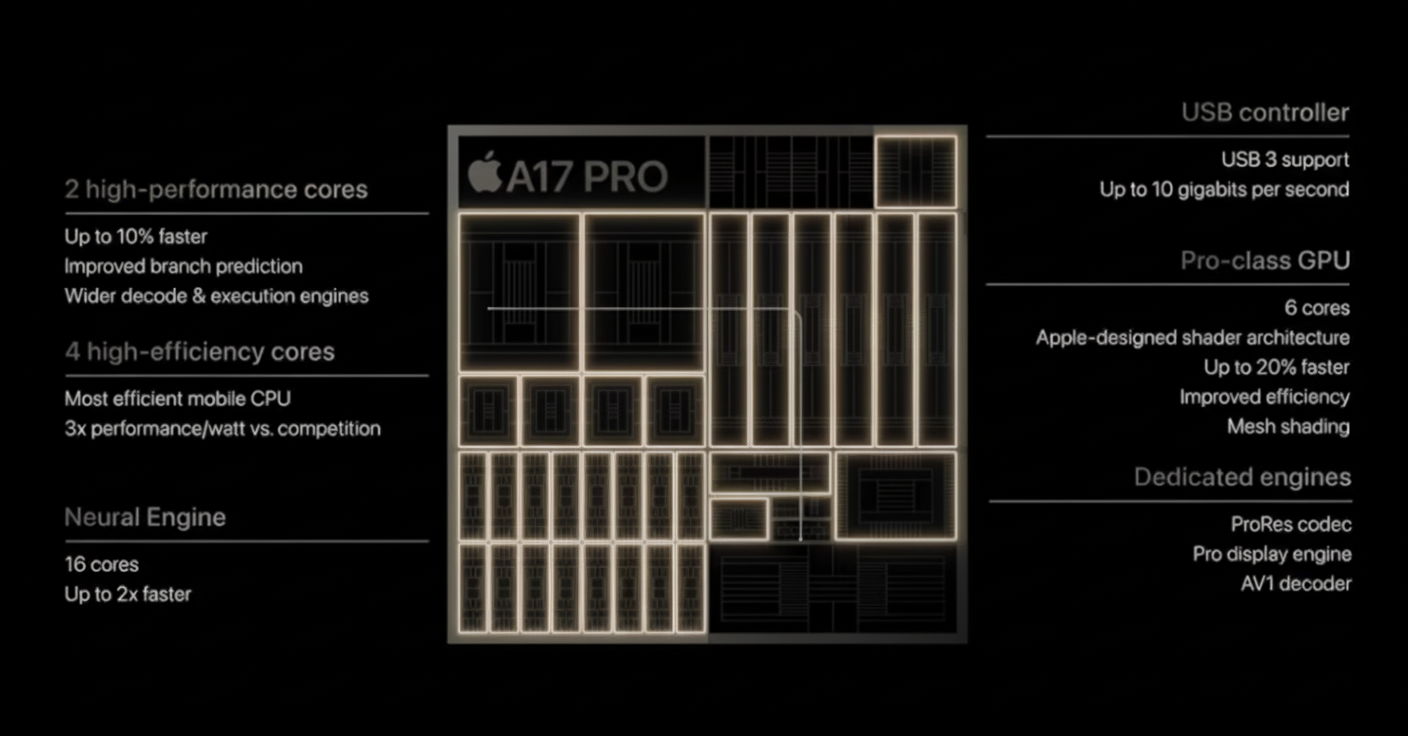
A17 Pro
The A17 Pro is the largest chip visible on the main PCB. This 3 nm application processor integrates approximately 19 billion transistors. The A17 Pro includes a 6-core CPU (2 high-performance cores and 4 efficiency cores) with a reported 10% performance improvement over the previous generation. It also features a 16-core neural engine, claimed to be roughly twice as fast as the A16 Bionic, and a 6-core Pro-class GPU with about 20% higher performance than A16. The package also includes a USB 3.0 controller and ProRes encode/decode support. The A17 Pro is manufactured by TSMC using their 3 nm process.
Qualcomm Snapdragon X70 modem
The iPhone 15 Pro Max uses Qualcomm's Snapdragon X70 modem for cellular connectivity. Historically, Apple has relied on Qualcomm modems and paid royalties for modem technology. The Snapdragon X70 supports a broad range of 5G bands, with peak downlink speeds up to 10 Gbps and uplink up to 3.5 Gbps, and covers frequencies from sub-GHz up to mmWave ranges.
Qualcomm SDR735 RF transceiver
The Qualcomm SDR735 RF transceiver has been used in many phones since its release. Apple has used two SDR735 devices in recent iPhone designs to handle complex RF requirements across GSM through 5G NR sub-6 GHz bands. The SDR735 supports flexible configurations and multiple frequency bands.
Apple used two SDR735 transceivers starting with iPhone 14 and continued the approach in iPhone 15, providing broad sub-6 GHz coverage. Qualcomm’s mmWave transceiver SMR546 is also present in versions that support mmWave bands; variants sold in some regions may omit mmWave components.
Broadcom AFEM modules (AFEM-8234 and AFEM-8245)
Teardown images show two Broadcom front-end modules, AFEM-8234 and AFEM-8245. These modules are likely custom parts for Apple and integrate functions such as multi-band power amplifiers (PAs), FBAR duplexers, multiplexers, SOI multi-mode LNAs, antenna switches, couplers, and PI controllers to support both FDD and TDD carrier aggregation configurations.
In prior iPhone models, related AFEM parts from Broadcom’s predecessor Avago were used; iPhone 15 shows updated AFEM component numbers.
Skyworks FEMs (SKY58440 and SKY50313)
The iPhone 15 includes Skyworks front-end modules such as SKY58440 and SKY50313. Earlier models used other Skyworks FEMs, and some components have been replaced by Qorvo modules in different variants. Typical FEM integration includes PA modules, input/output matching, MIPI digital control, single-ended filters, antenna and band-selection switches, and LNAs suitable for modern OFDM and high-order QAM modulations.
Integration trends and manufacturing
Modern smartphone designs show very high chip integration: most functions are implemented in integrated ICs with only passive components visible externally. This is a significant change from early phones that required many discrete analog circuits.
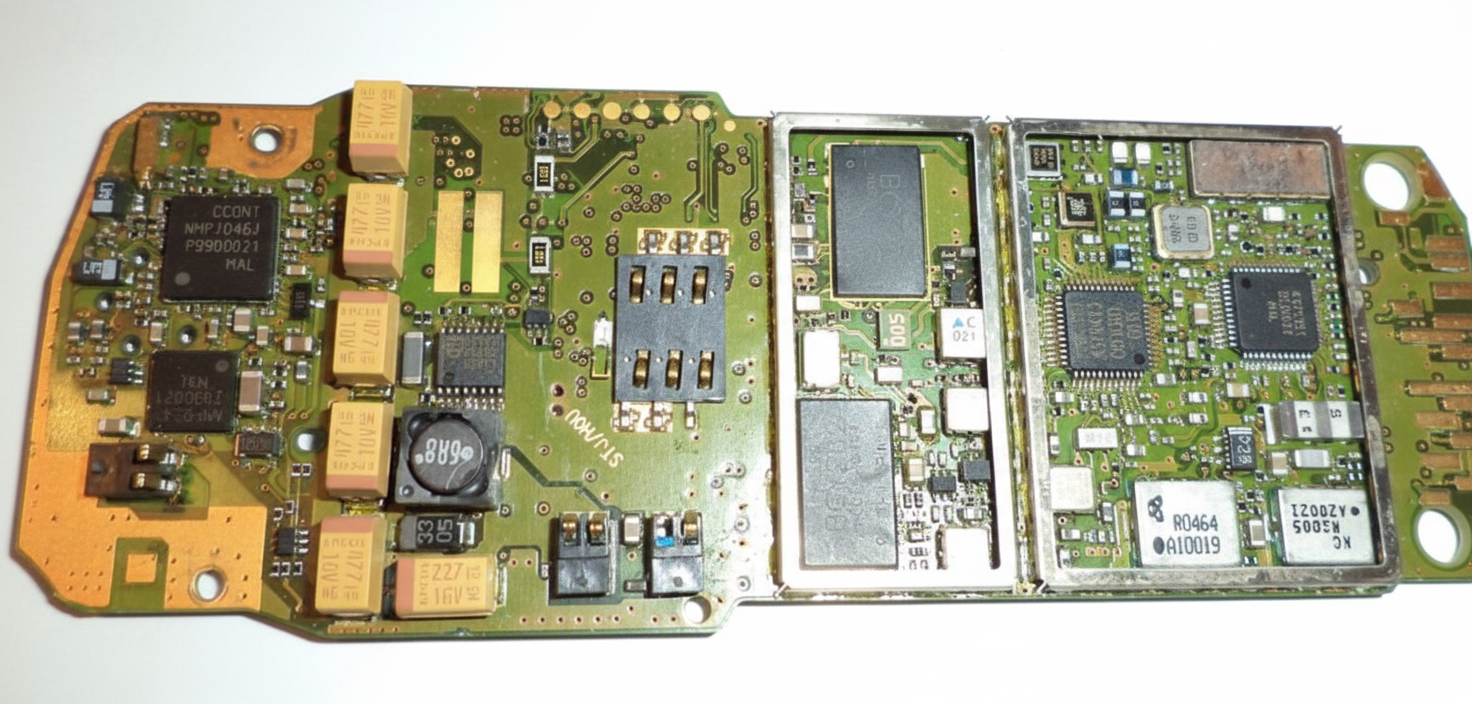
Although many iPhones are still manufactured in China and bear "Made in China" labels, the device architecture and component sourcing are dominated by a set of international semiconductor suppliers. Contract manufacturers handle large-scale assembly and production.