Overview
Although Industry 4.0 can help optimize multi-pump systems, operators may struggle to coordinate equipment correctly without an open control platform. Implementing Industry 4.0 supports optimal performance, improved reliability, and cost savings in automated systems, including municipal water and wastewater pump networks. Traditional proprietary control platforms do not fully realize these benefits.
Open platforms enable integration and interoperability among diverse systems and devices, creating a foundation for collaboration and innovation that aligns with Industry 4.0. Openness is a future trend for pump control and automation systems in general.
01 Dedicated Pump Controllers vs PLCs
Systems of pumps vary widely, and so do the devices that control them. At one end are dedicated pump controllers designed for specific pump applications; at the other are general-purpose controllers such as programmable logic controllers (PLCs), which can be programmed to control multi-pump systems, ancillary functions, or an entire pumping station.
Dedicated controllers are optimized for pump applications, with defined feature sets that make selection straightforward and allow for vendor support. PLCs, by contrast, can be programmed to provide virtually any required function and are available on multiple hardware platforms with a variety of communication options for integration into plant networks.
Both approaches have been used for decades and have advantages for particular applications, but both also have drawbacks. Dedicated controllers are often fixed in design with limited upgrade or migration paths. PLCs require specific knowledge of proprietary platforms for programming and support, and custom feature sets from third-party programming can be difficult to sustain over a system lifecycle.
Although PLCs may offer more migration options than dedicated controllers, transitioning from a legacy PLC system to a modern platform can be time-consuming and expensive, even within the same vendor family. Other shared drawbacks include limited options for process visualization and potential need for additional programming and specialized hardware.
An ideal pump controller would combine the best aspects of dedicated and PLC-based controllers. It would be built on an open platform that supports application development across diverse programming environments and, crucially, would integrate easily with other systems and devices to enable real-time data sharing and analysis for better pump system operation.
02 Open Platforms for Pump Control and Applications
Why do open platforms offer so many advantages in automation? Open platforms can host advanced technologies and applications, including industrial IoT, machine learning, and cloud communication, to provide greater connectivity, interoperability, and flexibility. In addition, open platforms enable:
- Interoperability: They allow different systems and devices to communicate and work together, integrating diverse technologies and data sources to improve efficiency.
- Data sharing: They enable data exchange between systems and applications, which is essential for process optimization and improved performance.
- Collaboration: They provide a basis for cooperation among manufacturers, programmers, vendors, system integrators, and customers to deliver more innovative products and services.
- Flexibility: They let manufacturers adopt new technologies and processes quickly and easily to respond to changing market conditions and requirements.
Open PLCs can easily access real-time data and connect to common cloud platforms such as Amazon AWS and Microsoft Azure.
03 Advantages of Implementing Automation on Linux
Linux is a popular open platform due to its openness, flexibility, stability, security, and cost-effectiveness. Running pump control applications on industrial hardware configured with a Linux operating system can provide, beyond basic start and stop functions, advanced capabilities such as:
- Predictive maintenance: Data analytics and machine learning algorithms can predict when a multi-pump system requires maintenance, enabling proactive servicing, reducing downtime, and improving reliability and resilience.
- Real-time monitoring: Continuous monitoring of pump systems provides deep insight into the performance of individual pumps and the system, enabling fast and effective intervention when issues arise.
- Improved efficiency: Data analysis can identify areas for improvement, such as determining the most energy-efficient operating point for a single pump, reducing energy use and operating costs.
- Increased automation: More data supports automation of decision-making, reducing the need for manual intervention. For example, automatic speed control of pumps in response to demand changes helps ensure the system operates at peak efficiency.
- Enhanced collaboration: Broader integration allows more cooperation between parts of the pump system and with peripheral systems, enabling real-time data sharing for faster, more effective decisions.
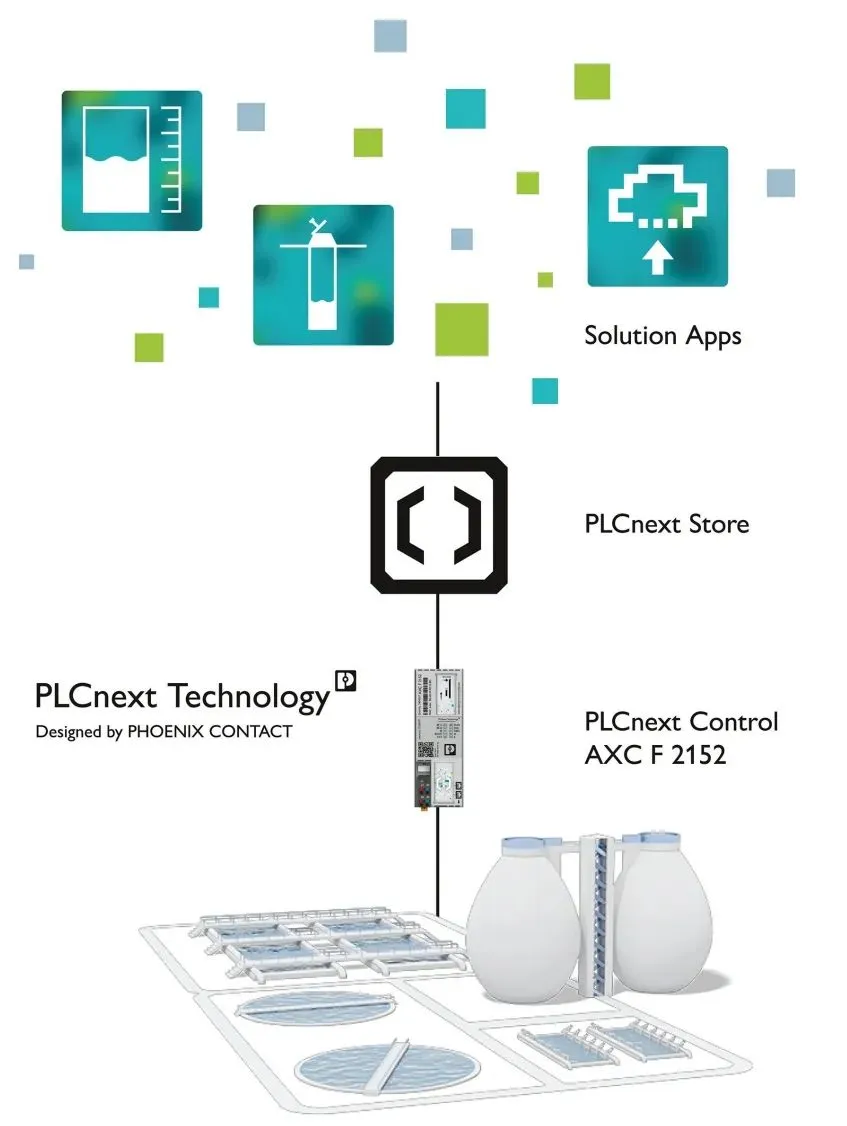
Marketplaces such as Phoenix Contact's PLCnext Store can connect software developers with users to enable advanced pump system control functions.
Pump vendors increasingly use data to increase efficiency and reduce downtime. Some platforms allow customers to remotely monitor and manage pumps, applying data analytics and machine learning to optimize performance.
04 Open Process Automation
Process optimization and cost reduction extend beyond pump systems. An ideal pump controller should support any pump or pump system and integrate easily with other systems to improve efficiency and reduce costs across a plant.
Some vendors offer advanced platforms for any pump system that use real-time monitoring to optimize performance and reduce lifecycle costs by providing details on maintenance timing or pump replacement. The downside of some of these solutions is that they are closed proprietary systems with high installation costs and require subscriptions to maintain data access.
An ideal pump controller handles control and advanced functions on a single platform to minimize cost and support requirements. Built on open platforms such as Linux, it allows integration of advanced components, cloud connectivity, and support for applications from diverse sources and programming languages.
Open process automation (OPA) is emerging as a new standard for process automation systems. Its goal is to create an open, interoperable, and secure standard that lets users mix and match hardware and software from multiple vendors for greater flexibility and innovation.
OPA advantages include the ability to customize and optimize systems for specific needs, lower costs and higher efficiency by using standard commercial components, and improved cybersecurity through secure, interoperable components. This represents a significant shift in process automation from closed proprietary systems to open, interoperable architectures that support flexibility and innovation.
Although open process automation will take time to become the mainstream approach for pump control, the underlying foundation—open platforms for industrial systems—is already available. Pump control applications running on Linux represent a direction for the future of pump control.
Key concepts
- Understand how open platforms enable interoperability, collaboration, and flexibility.
- Understand how running pump control applications on Linux can enhance interoperability.