1. Reduced-voltage starting methods
The circuits described in previous sections, whether for forward/reverse control or for automatic control, used full-voltage direct starting. For larger-capacity cage induction motors, or when the power supply capacity limits make direct starting infeasible, reduced-voltage starting methods are commonly used. These include series resistors or series reactors in the stator windings, Y/Delta reduction, and autotransformer reduction, which limit the starting current to acceptable values.
1) Series-resistor starting: starting current is relatively large, starting torque is small, and losses and resistor temperature rise are significant, so this method is seldom used. Series-reactor starting is typically applied to large-capacity motors and to synchronous motors.
2) Y/Delta starting: starting current and starting torque are reduced to about one-third of full-voltage starting, and frequent starts are possible. This method is suitable for small and medium cage-rotor motors that have six terminals and normally run in Delta.
3) Autotransformer starting: starting current is small and starting torque is large, but autotransformers are bulky, expensive, and not suitable for frequent starting. This method is often used for medium- or heavy-load cage motors.
2. Automatic control circuit for series-reactor reduced-voltage starting
The automatic control circuit for a series-reactor starter
During normal running only the run contactor KM is energized; the starting contactor KM1 and the time relay KT remain released, which extends their service life.
Series-reactor starting: Press the start button SB2. The SB2 NO contact (3-5) closes, energizing contactor KM. The KM main contacts close and the motor starts with the series reactor L connected in series. At the same time the KM NO contact (5-9) closes, energizing the time relay KT. The KT instantaneous contact (3-5) closes immediately to hold KM and KT energized, keeping the motor in the starting state.
Switching to full-voltage running: After a preset time delay, the KT delayed contact (5-11) closes and contactor KM2 is energized. KM2 latches via its self-holding contact (3-11). The KM2 main contacts close and short-circuit the starting reactor L, placing the motor on full-voltage run. Simultaneously the KM2 NC contact (5-7) opens, KM1 is deenergized and its NO contact (5-9) opens, causing KT to deenergize. This way KM and KT only operate for a short time, which helps extend the life of the time relay.
3. Semi-automatic Y/Delta reduced-voltage starting control circuit
The Y/Delta connection of the stator windings
The semi-automatic Y/Delta reduced-voltage starting control circuit
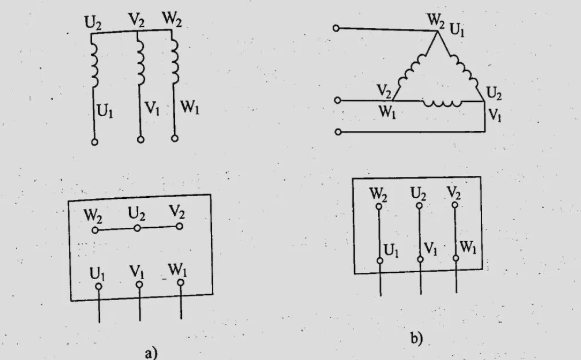
The circuit uses pushbuttons and contactors to control the motor starting sequence. Press SB2 to start and press SB3 for the running transition.
[Y start] Step 1: Press the start button SB2. The SB2 NO contact (3-5) closes, providing the current path for contactors KM1 and KM2. Step 2: Contactors KM1 and KM2 energize and self-latch; their main contacts close and the motor stator windings are connected in Y for reduced-voltage starting. At the same time the KM1 interlock contact (13-15) opens, interrupting the coil circuit of KM3 to ensure KM3 cannot be energized while KM1 is closed.
[Y/Delta transition] Step 1: When the motor reaches a sufficient speed, press button SB3. The SB3 NC contact (5-9) opens and contactor KM2 is deenergized, releasing the Y connection and ending the starting phase. The KM2 interlock contact (13-15) resets to prepare for Delta running. Step 2: Immediately the SB3 NO contact (5-13) closes, energizing contactor KM3. The motor stator windings are then connected in Delta for full-voltage running.