Overview
Many assume that larger engine displacement always means higher horsepower. However, once displacement exceeds about 6.0 L, that assumption often breaks down.
For example, Bentley's 6.0T W12 produces a maximum of 635 PS, the Mercedes?Maybach S?Class 6.0 L V12 makes 612 PS, and Rolls?Royce's 6.7T V12 produces just 571 PS. All three engines use twin?turbocharging.
By contrast, Ferrari's 6.5 L V12 naturally aspirated engine reaches 800 PS, which raises the question: why can some large?displacement engines produce relatively modest peak horsepower?
Where Horsepower Comes From
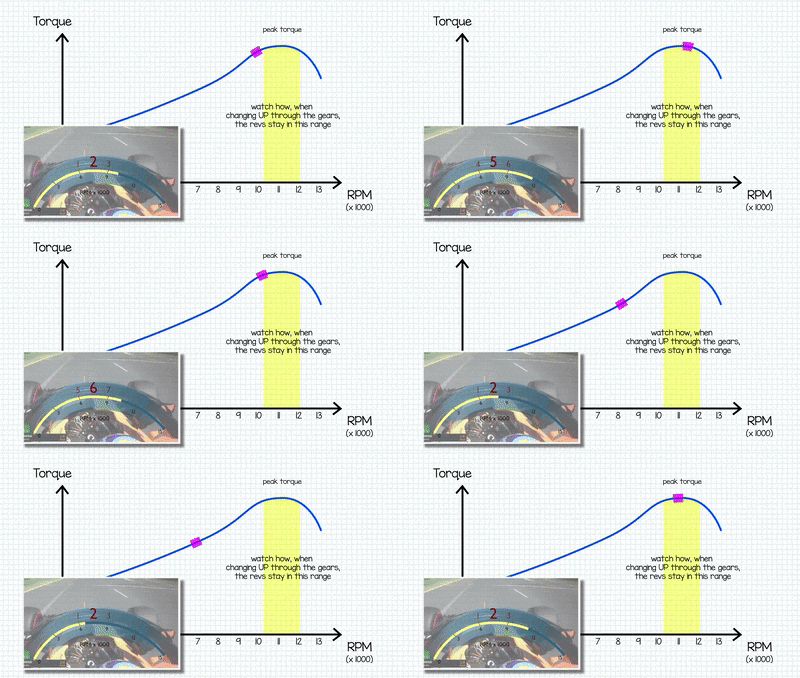
Engine power is produced when the engine completes its four strokes, driving the crankshaft to generate torque. That torque is then transmitted and multiplied through the transmission. Although the full power calculation is complex, torque and engine speed (rpm) are the key factors.
To make this easier to understand, compare the engine's working principle to riding a bicycle. Speed depends on both the force applied to the pedals, which is analogous to engine torque and determines acceleration from a standstill, and the pedal cadence, which corresponds to engine speed and determines top speed.
At the start, you increase pedal force to accelerate, but force cannot be unlimited because the chain and components have limits. Within those limits, applying maximum safe force and reaching a certain cadence corresponds to the engine's peak torque rpm.
Once a bicycle reaches cruising speed, pedal force matters less; you can maintain speed with little force and simply follow the pedal rotation. That point corresponds to the torque peak, or maximum torque. If cadence continues to rise further, the pedals may begin to act as resistance, an effect analogous to torque decay at high rpm.
Tuning Strategies: High?Rev vs High?Torque
These inherent characteristics of internal combustion engines lead to two common tuning strategies:
- High power, lower torque: Compensate for lower torque by increasing revs. This suits high?performance cars. For example, the Ferrari 812's naturally aspirated V12 produces 800 PS but only 718 Nm of torque, with peak torque occurring around 7,000 rpm and a redline that can exceed 10,000 rpm.
- Lower power, high torque: Prioritize torque and lower the rpm at which peak torque occurs. Many luxury brands adopt this approach. Rolls?Royce, Mercedes?Maybach, and Bentley target about 900 Nm of peak torque using twin turbos, with peak torque achieved below 2,000 rpm.
Why Luxury Cars Favor High Torque
There are two main reasons for choosing a high?torque, lower?power setup.
First, vehicle mass and use case differ. The Ferrari 812 weighs about 1.6 t, while many models from Rolls?Royce and Bentley exceed 2.5 t. To keep large vehicles responsive, engineers trade some peak power for higher low?end torque and lower torque peak rpm. That makes the car feel strong and effortless from low speeds and helps achieve competitive 0–100 km/h times in the 4 to 5 second range despite greater mass.
Second, product positioning matters. Top luxury cars prioritize ride comfort and refinement. A large?displacement, lower?peak?power engine provides abundant torque reserves and smoother operation during fuel injection and low?load running, improving perceived quality. The high?revving approach used by Ferrari to gain power is contrary to the refinement goals of luxury marques and is not aligned with their customers' expectations.
Conclusion
Therefore, a large displacement combined with relatively low peak horsepower is not necessarily a technical shortcoming. More often, it reflects deliberate tuning to match vehicle weight, intended use, and product positioning.
As the saying goes: "Wealthy people look at cylinder count; others look at horsepower."