LED displays are widely used for advertising and information. There are several types optimized for different applications and viewing conditions. The following summarizes common LED display classifications and typical use cases.
1. LED Rental Display
As a versatile solution within the LED Lighting and display industry, LED rental displays are designed for repeated assembly and disassembly. They are lightweight and thin, save space, and can be assembled into arbitrary shapes and sizes to achieve various visual effects. Most rental displays use SMD three-in-one packaging, offering up to 160° wide viewing angles to meet different viewing directions.
Typical applications: theme parks, bars, auditoriums, large theaters, concerts, building facades.
2. LED Small-Pitch Display
Small-pitch LED displays have small LED spacing and high pixel density. Displays with pixel pitch P2.5 and below are commonly classified as small-pitch. They typically use high-performance driver ICs, provide low grayscale and high refresh rates, and support seamless splicing of cabinets horizontally and vertically.
Example project: a small-pitch installation.
Typical applications: airports, schools, transportation hubs, esports venues, conference rooms.
3. LED Transparent Display
Also called a grille display, LED transparent displays provide high transparency and good see-through performance. They offer high transparency, relatively low resolution and power consumption, while maintaining rich dynamic color and clear details for displayed content.
Typical applications: advertising media, large shopping malls, corporate showrooms, exhibition spaces.
4. LED Creative Display
Creative LED displays are irregularly shaped screens emphasizing design and visual impact. They often have striking, artistic forms that produce strong visual effects. Common creative forms include cylindrical screens, spherical displays, cube displays, wave screens, ribbon screens, sky screens, and floor-tile screens.
Example project: a naked-eye 3D installation.
Typical applications: media advertising, sports venues, conference centers, real estate displays, stages, shopping malls.
5. LED Fixed Installation Display
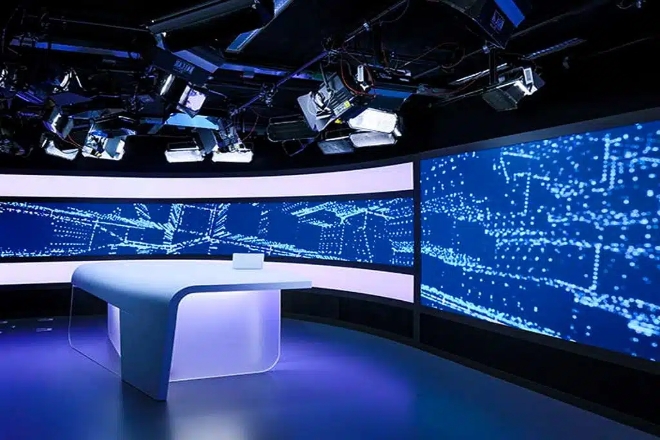
Fixed installation LED displays are conventional, one-piece installations with consistent screen size and minimal deformation. They offer wide horizontal and vertical viewing angles, and smooth, realistic video playback.
Example project: a fixed installation at a sports arena.
Typical applications: television recording, live event broadcasts, advertising.
Related Reading: LED Display System Commissioning Faults and Fixes
6. LED Monochrome Display
Monochrome LED displays use a single color, commonly red, blue, white, green, or purple. They typically show simple text or patterns.
Typical applications: transport terminals, storefront header signs, retail shops, docks, intersections, mainly for information dissemination.
7. LED Bicolor Display
Bicolor LED displays use two colors. They provide more vivid color combinations; common pairings include yellow-green, green-red, or red-yellow. Their bright colors make content more noticeable.
Typical applications: subways, airports, shopping centers, bridal shops, restaurants for information display.
8. LED Full-Color Display
Full-color LED displays can render a wide range of colors. Each pixel contains primary color grayscale components and can form 1677216 colors, producing rich and natural images. They often use professional mask designs for waterproofing and dustproofing, resulting in long service life.
Typical applications: office buildings, high-speed rail stations, commercial advertising, information release, exhibition centers.
9. LED Indoor Display
Indoor LED displays are intended for indoor use and are generally not waterproof. They emphasize high image quality and come in various formats to attract attention.
Typical applications: hotel lobbies, supermarkets, KTV venues, shopping centers, hospitals.
10. LED Outdoor Display
Outdoor LED displays are used for outdoor advertising media. Multi-level grayscale correction improves color softness, and automatic brightness adjustment ensures natural transitions. Screen shapes can be adapted to coordinate with different architectural environments.
Typical applications: seasonal decorations, company product advertising, information dissemination on buildings, public spaces, and parks.