Summary
Researchers at the Key Laboratory of Micro Magnetic Resonance, University of Science and Technology of China, Chinese Academy of Sciences — Jiangfeng Du, Zhanfa Shi, Fei Kong and colleagues — report progress in quantum precision measurement. Using a single nanodiamond's internal nitrogen-vacancy (NV) center for quantum sensing, they overcame the problem of random particle rotation and detected the electron paramagnetic resonance (EPR) spectrum of paramagnetic ions in solution under in situ conditions. The results were published as "In situ electron paramagnetic resonance spectroscopy using single nanodiamond sensors" in Nature Communications.
Background
Probing and analyzing molecules under physiological in situ conditions is an important goal in life sciences. Observing biomolecules in their native environment is necessary to determine conformational changes associated with physiological function and to address questions such as cellular signaling pathways and drug target identification. Magnetic resonance methods are compatible with physiological environments and enable nondestructive in situ measurements. With spin labeling and related techniques, they can selectively detect the resonance spectra of target molecules against a complex cellular background, making them well suited for in situ physiological detection.
Conventional magnetic resonance detects ensembles of molecules, while NV center quantum sensors in diamond can detect single molecules at room temperature and atmospheric conditions, avoiding ensemble averaging that removes single-molecule spectral features. Diamond hosts for NV centers are chemically stable and biocompatible, and fluorescent nanodiamonds containing NV centers have been used as long-lived intracellular fluorescent markers. Because NV center sensors combine high sensitivity with biocompatibility, nanodiamond NV centers are promising for in situ intracellular magnetic resonance detection.
Challenge: Random Rotation Inside Cells
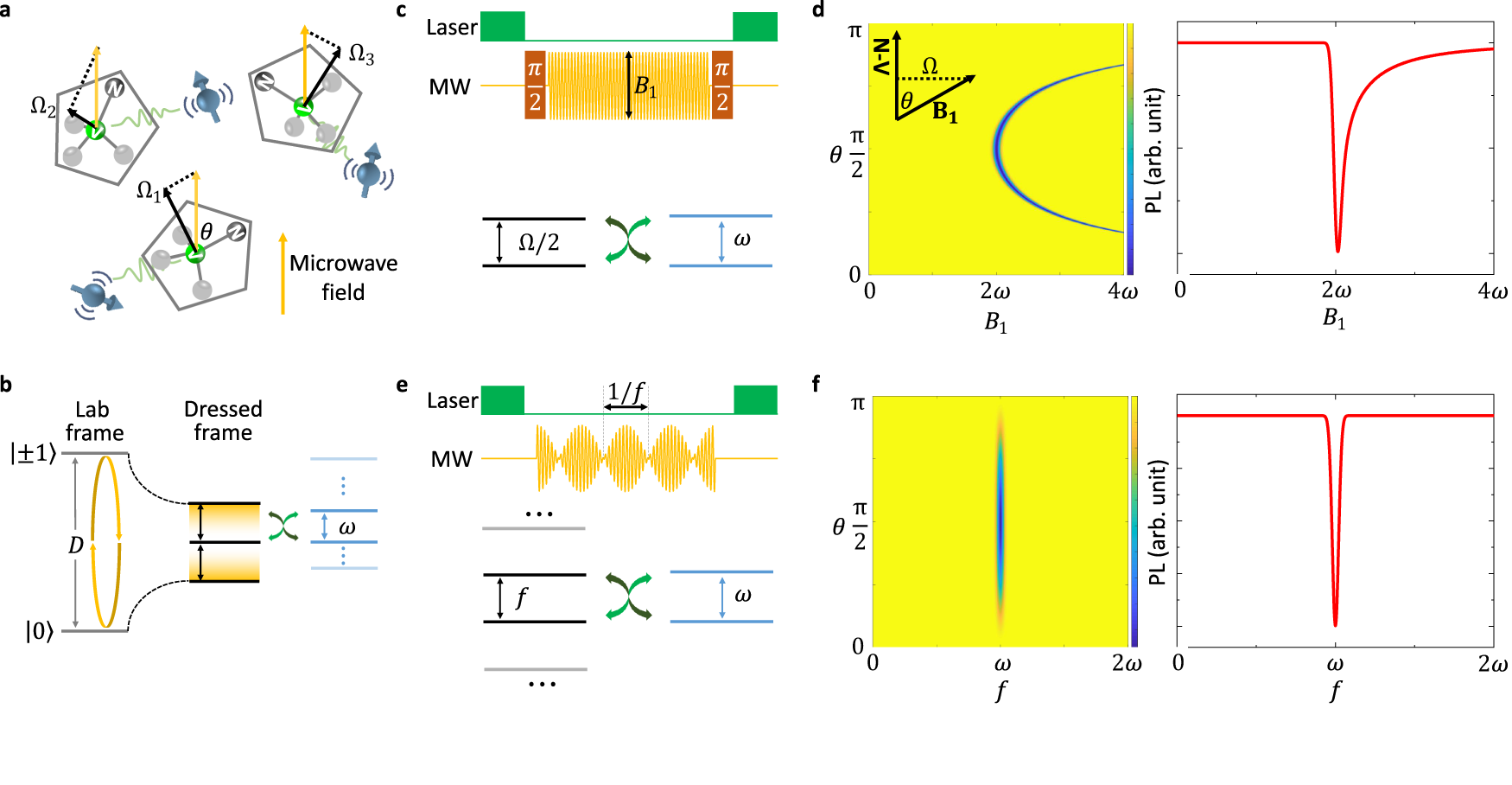
Tracking of nanodiamonds inside living cells shows they rotate randomly both inside the cytoplasm and on the cell membrane. This random rotation changes the effective microwave control field experienced by the NV center, causing standard magnetic resonance detection protocols to fail. To address this, the team designed an amplitude-modulated pulse sequence. This sequence produces a set of equally spaced energy levels on the NV center, where the spacing is determined solely by the modulation frequency and is independent of the effective control field strength. A schematic of the sequence and the resonance principle shows that when an NV center energy level matches the energy level of the target, resonance occurs and the NV center state changes. Scanning the modulation frequency yields the target's magnetic resonance spectrum, with peak positions insensitive to the NV center's spatial orientation.
In Situ Measurement in Solution
The study measured the paramagnetic resonance spectrum of ions in the nanodiamond's solution environment under in situ conditions. To mimic nanodiamond motion inside cells, researchers tethered nanodiamonds to a substrate using long-chain molecules, restricting translational motion while preserving rotational freedom. These tethered nanodiamonds can probe interior targets; the experiment used vanadyl ions in solution as the target. Although rotation makes precise quantum control of the NV center difficult, the amplitude-modulated microwave sequence still allowed measurement of the zero-field EPR spectrum of vanadyl ions.
Significance and Outlook
The detected vanadyl ion spectrum can be analyzed to extract hyperfine constants, which could in the future be used to infer the vanadyl ions' local environment. Improvements in microwave radiation structure efficiency and enhancements to nanodiamond properties are expected to increase measurement speed and move the method toward practical application. The research group previously demonstrated single-molecule magnetic resonance detection in solid-state environments [Science 347, 1135–1138 (2015)] and extended detection to aqueous environments [Nat. Methods 15, 697–699 (2018)]. This work advances the approach to in situ environments [Nat. Commun. 14, 6278 (2023)], progressing toward single-molecule-scale intracellular magnetic resonance.