Overview
These striking vortex structures have long been discussed in technical papers full of equations, so many observers are fascinated by the phenomenon but do not fully understand the underlying causes.
Some people casually claim these are fuel dumps. When a passenger or military aircraft is stationary on a runway or slowly taxiing, a tornado-like vortex can sometimes appear in front of the engine intake. How do these vortices form, are they hazardous to the aircraft, and how can they be avoided?
What is the phenomenon?
Thanks to the internet, many people have been able to see this phenomenon in recent years. Research into vortices forming in front of engines has in fact been carried out abroad for more than sixty years.
This phenomenon is called the ground vortex, often shortened to ground vortex. Since it is a vortex, the analogy is straightforward: a tornado is a vortex, and the ground vortex visually resembles a small white tornado.
How ground vortices form
When the engine intake draws air in, airflow converges from all directions toward the intake. Because the engine is close to the ground, the boundary-layer flow near the surface is constrained. If a crosswind is present, the rising flow can begin to twist and rapidly rotate, producing a vortex.
To visualize the formation process, imagine that the rotating engine intakes remove a large volume of air, creating a low-pressure region around the engine and the surface. Air from farther away rushes in to fill that low-pressure region, accelerating as it approaches. When the airflow reaches the area beneath the intake, its forward inertia tends to carry it past the intake, but the intake's suction pulls it upward. Unable to continue straight, the air is forced to turn and rise, twisting into a rotating column—the vortex.
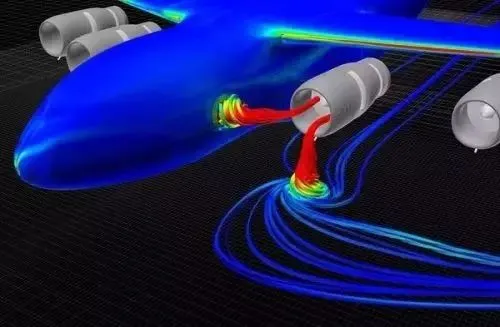
If an engine is close to the fuselage, an additional vortex can form along the fuselage.
In fact, even without a fuselage-induced vortex, a ground vortex can contain multiple rotating filaments rather than a single column.
Why vortices are not always visible
You may have flown many times without seeing such vortices. In clear, dry air they can still form, but they are not visible. Vortices become visible when humidity is high or the ground is wet, because the low pressure and corresponding temperature drop in the vortex core cause water vapor to condense into a white mist. After rain, it is often easier to observe them from a suitable angle.
Like a tornado, the vortex rotates fastest at its center.

Vortical flows have the characteristic that rotation speed increases toward the center. According to Bernoulli's principle, at the same elevation, faster fluid speed corresponds to lower pressure. Lower pressure produces lower temperature, so condensation occurs in the vortex core and the vortex becomes visible as mist.
Airflow over a wing: higher speed above the wing produces lower pressure above the wing than below, creating lift
Are ground vortices hazardous to engines?
Many observers find ground vortices visually appealing, but aircraft manufacturers consider them a condition to avoid. Modern airliners have increasingly large wings to carry more passengers, which can lead to significant wing bending and reduced lift performance. To reduce bending, engines are commonly mounted on pylons beneath the wing. This placement also lowers cabin noise and simplifies maintenance because the engines are more accessible from the ground.
However, mounting engines under the wing places them closer to the ground and makes them more susceptible to ground vortices. Like a small tornado, a ground vortex produces strong suction. If there is a loose screw or a coin on the ramp, ingestion of such debris can be catastrophic for the engine. Even if there are no solid objects, ingestion of excessive water vapor or sand and dust can cause significant wear.
How to mitigate ground vortices
Manufacturers and operators have tried several approaches to reduce ground vortex formation.
One method is to raise the engines as much as practical, but this is not always sufficient. Another approach is to direct part of the engine's bypass flow toward the ground near the vortex formation region; tests have shown this is simple and effective, though it increases engine complexity and reduces efficiency.
While there are other technical solutions, a straightforward operational measure is to keep airport ramp areas clean. The vortex itself does not damage engines; the hazard comes from debris and contaminants entrained in the vortex.