1. Integrated approach
Since the start of the special military operation in Ukraine, one year has passed. The results show that over the past year the adversary repeatedly changed air-raid tactics and combined different strike assets into single raids. Fixed-wing aircraft and helicopters have been used far less often than unmanned aerial vehicles (UAVs) and precision-guided munitions. Statistics on shot-down precision-guided weapons and UAVs indicate that the number of recently destroyed air-defense weapons is estimated to be 10–12 times higher than current stock.
At the same time, data on intercepted precision-guided weapons show that Russian air-defense systems began to achieve high performance indicators about a month after activation. It is notable, however, that the adversary continuously introduced new strike assets such as UAVs (Switchblade 300/600, Phoenix Ghost, Warmate loitering munitions) and new precision-guided munitions (M31 projectiles for HIMARS MLRS, 155 mm M982 Excalibur shells for MLRS). Due to increasing combat experience, air-defense crews were able to adapt quickly to new aerial targets. Defenders were forced to combine tactics to ensure strike munitions could be destroyed before reaching their targets.
Strike operations with UAVs and precision-guided munitions targeted not only military objectives but also civil infrastructure in frontline regions and long-range UAV targets located hundreds of kilometers from the contact line. NATO analysts used intelligence on Russian air-defense deployments to devise this dual tactic.
Analysis shows that within roughly 100 km of the special operation zone, Russian forces were able in the early months to deploy almost all types of military air-defense systems whose direct task was to protect military units from strike weapons.
Army air defense forces primarily employed Tor-M2U and Tor-M2 systems, Buk-M2 and Buk-M3 systems, and systems produced by Almaz-Antey enterprises.
Frontline settlement cover was provided by point-defense systems such as Pantsir-S1 and strategic systems like the S-400. This conventional tactical structure allowed effective countermeasures against strike aircraft and reconnaissance UAVs such as Bayraktar TB2 and locally produced reconnaissance UAVs.
2. Tor-M2U and Tor-M2 operational workflow
The Tor-M2U air-defense missile system demonstrated strong mobility and combat characteristics in the Ukrainian operational area. The system is intended to address brigade- and division-level air defense and missile-defense tasks.
In combat, Tor-M2U crews occupy positions and wait for approaching enemy UAVs to be detected by the system's all-around radar. After target characteristics are determined, gunners launch missiles to destroy targets, primarily reconnaissance UAVs. To ensure a successful engagement, vehicle crews change firing positions after an engagement to avoid counterattack.
Tor crews monitor airspace around the clock within a radius of more than 30 km and track any airborne object that does not respond to friend-or-foe queries. The system escorts convoys and conducts combat actions while deployed. It is capable of escorting bird-sized UAVs. According to a Tor crew commander, approximately 50 aerial targets were destroyed during the special military operation period.
Each Tor system can detect and identify up to 48 targets in the sky and automatically prioritize the most dangerous ones. After identification, it can simultaneously engage up to four targets. These systems can intercept targets at ranges up to 15 km and at altitudes from 10 m to 12 km, including aircraft, helicopters, UAVs and even ballistic missiles. The Tor-M2U variant improves resistance to massed attacks by modern strike weapons under electronic countermeasure conditions.
The Tor-M2 differs from the prototype primarily by increased effectiveness against massed attacks by modern strike systems under fire and electronic countermeasure conditions. The system was developed as a primary battlefield countermeasure against large-scale strikes by high-precision weapons flying directly over the combat area.
As with the prototype, a small-target detection station is used as part of the system to ensure operation on the move. Its main feature is a sectoral radiation pattern formed in the elevation plane. The scanning sectors (eight elevation sub-angles, each 4 degrees, overlapping elevations 0–32 or 32–64 degrees) provide the complex guidance station with the accuracy needed for target designation while minimizing additional search time.
The isotropy of the small-target detection station's radiation pattern makes it less sensitive to target approach angles in the elevation plane. Electronic scanning is implemented by frequency method, which allows the suppression of hostile small-target detectors using active jamming at much lower power density than that of the target's interference. The small-target detection station also has a large energy potential compared with nearest analogs. It can detect and track up to 45 aerial targets at ranges up to 32 km and rank the 10 most dangerous targets for engagement, indicating engagement order to the crew.
Tor-M2 crew commanders report that the system automatically identifies and locks the most dangerous targets and can destroy multiple targets simultaneously. In recent engagements crews intercepted a Tochka-U ballistic missile. According to the report, crews detected the high-precision, high-speed missile within about five minutes, executed escort maneuvers and made an immediate decision to engage. The missile fell short of the border and crashed in a field after being damaged in the tail, deviating from its trajectory and catching fire.
Experts at JSC IEMZ "Kupol" have actively used experience from the small-target detection station to improve Tor-M2U/M2 capabilities. Company representatives are working in the special operation area to complete functional software updates that have enhanced Tor performance against HIMARS and similar systems.
During combat, declared tactical and technical characteristics of the air-defense systems have been confirmed, and areas requiring improvement were identified. Kupol has collaborated with military operational-technical units to carry out numerous development tasks, updating system software and hardware to strengthen resistance to modern strike means.
At the same time, the full potential of modern military air-defense systems has not been fully realized, including active defense system construction and consideration of air-defense troop deployment in the operational area.
3. Air-defense system characteristics observed during the operation
The main characteristics of air-defense weapon employment during the special operation are:
- Sharp increase in the number and variety of UAVs operating within responsibility areas, including loitering munitions;
- Use of air-defense systems against artillery projectiles (including 155 mm M982 Excalibur) and multiple-launch rocket systems (including GMLRS M30/M31 launched from M142 HIMARS and M270 MLRS);
- Adversary use of high-precision intelligence from NATO sources, including space-based intelligence, and network-centric command principles to manage strike assets;
- Targeted use of anti-radiation systems (including AGM-88 HARM) to attack UAVs, reconnaissance drones and launchers of precision weapons (for example M777-M982 Excalibur).
Each issue requires a tailored response. Beyond the necessity for all air-defense weapons to operate within a unified information space, a range of organizational and technical measures is also required.
To address the rapid saturation of responsibility areas with UAVs, decoys and various types of precision weapons, three appropriate responses are proposed:
- Increase production of missile-defense systems to prevent "missile hunger";
- Efficient target allocation within air-defense forces to prevent ammunition expenditure on incorrect targets;
- Integrated use of air-defense systems to maximize efficiency, including ensuring the lowest-cost munitions are used to defeat specific attacking weapons.
Analysis shows that, in addition to standard centralized control and target allocation methods, non-standard measures are needed to make optimal use of existing air-defense capabilities and to provide them with augmented functionality.
One of the most effective solutions is creating combined kill groups based on Tor-M2 systems and their derivatives. The 9A331M vehicle has unique capabilities to detect and engage aerial targets in its responsibility area, both when deployed and on the move (at speeds up to 40 km/h).
"We can detect almost anything, even unnecessary echoes such as a flock of birds. The system classifies them as aerial targets, but we know they are not real threats. That is a major success. Each UAV has its own parameters, and we can roughly determine which type the adversary is using," a Tor-M2 missile crew commander said. After certain improvements, the vehicle can now directly control other subordinate assets. With the development of the "Typhoon air-defense" platform, an effective Tor-M2–Typhoon combination will emerge, significantly increasing operational efficiency.
However, these measures alone are insufficient. Analysis of adversary combat usage indicates the need to create two additional combat vehicles and integrate them into the combined strike group's architecture:
- A vehicle to employ strike loitering munitions for destruction of ground targets;
- An electronic-warfare vehicle targeting UAVs that can locate UAV ground control stations, suppress control channels and apply deceptive interference to navigation receivers.
Developing these two combat vehicles on the Typhoon air-defense platform would quickly yield highly mobile, protected combat vehicles that operate under unified command. The first vehicle would be capable of engaging air targets under 9A331M BM guidance and strike ground targets using external sources of target coordinates such as counter-battery equipment or a second BM (UAV launcher position data). The second vehicle would create conditions to cause the first knocked-down UAVs by suppressing the adversary's secondary control and navigation channels.
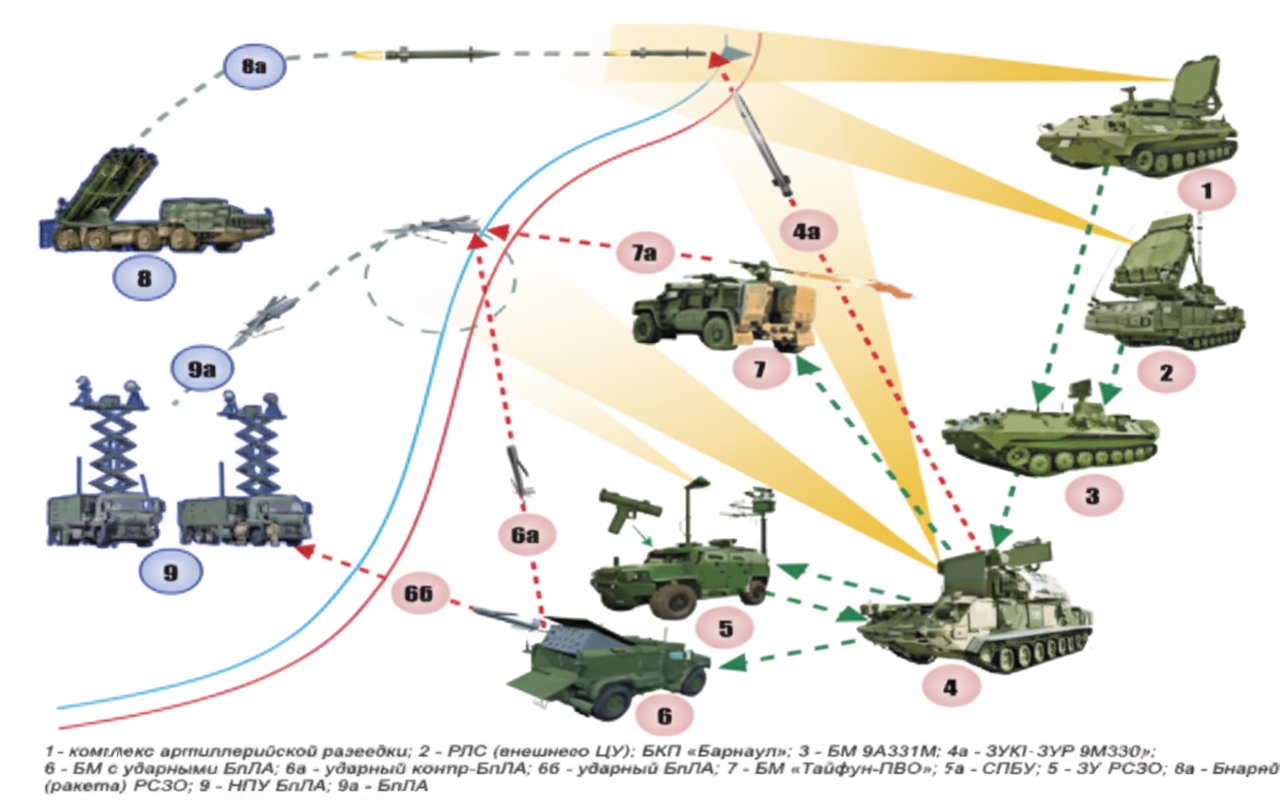
Thus, it is possible not only to comprehensively strike strike weapons themselves and their control points/launchers, but also to select the most effective weapons (including cost considerations) to engage specific types of strike systems.
The second issue, using air-defense weapons against artillery and MLRS, requires both technical and organizational solutions. Beyond ongoing engineering work to improve combat weapons and their capabilities, defense authorities must remove bureaucratic obstacles to introducing these weapons, creating favorable conditions and ensuring comprehensive support.
The third issue demands a fundamental change in air-defense tactics and employment, especially near mobile air-defense systems and areas threatened by high-precision projectiles and missiles. Only working on the move, including firing in motion, can negate the effect of precision-guided weapon elements on air-defense systems. These qualities are present in BM ZRK "Tor".
Finally, the fourth issue related to "hunting" adversary air-defense systems requires a comprehensive approach, from creation and use of individual protection systems and operational models and simulators to improvements in optical reconnaissance device performance.
The first year of the special operation raised substantive questions that require not only the efforts of air-defense developers and manufacturers but also prompt decisions by consumers and defense authorities. Work in these areas is progressing steadily. Design solutions have been found for many problems identified in the operational area, and the process continues. However, bureaucratic delays and occasional reluctance have slowed rapid implementation of new battlefield concepts.