Overview
Directed-energy weapons (DEWs), such as lasers, deliver energy at the speed of light. These weapons can produce effects ranging from deterrence to destruction. Many countries, including the United States, are studying their use. Because they use energy rather than bullets or missiles, the per-shot cost of DEWs can be lower and they can offer effectively unlimited ammunition as long as power is available. However, long-term health effects from exposure remain unclear. Their effective range is often shorter than that of conventional weapons, and weather conditions such as fog and storms can degrade the performance of some DEWs.
DEWs use high-energy beams transmitted along a defined direction to attack targets. Also called beam weapons, their advantages include high speed (attacks at or near the speed of light), flexible control with rapid retargeting, precision for striking critical components, and potential for nonlethal or "soft-kill" effects. DEWs can be applied in electronic warfare to disrupt or interrupt an adversary's communication and command functions, or used directly to damage or destroy tactical and strategic systems such as aircraft, satellites, missiles, and critical production equipment.
High-power Microwave Weapons
High-power microwave (HPM) weapons are expected to become a primary means for attacking an adversary's information links or nodes in information-centric conflicts. HPM systems can play a major role in space and information operations, offering all-weather, near-instantaneous effects, precise or area effects, abundant "ammo" at relatively low cost, and the ability to degrade electronic systems without necessarily causing personnel casualties. HPM weapons are primarily intended to disable electronic equipment, degrading or stopping its function and thereby undermining the adversary's operational capabilities.
Primary targets include radars, airborne early-warning platforms, communications electronics, military computers, tactical missiles, and stealth aircraft. At appropriate standoff ranges, the electromagnetic pulses from HPM weapons can damage electronic reconnaissance and surveillance systems, military networks, integrated information systems, data links, satellite ground stations, shipboard terminals, and satellite navigation receivers. HPM can reduce an adversary's ability to collect and distribute electronic information and to perform satellite-based navigation. It can also incapacitate important political or economic computer networks and damage broadcast signal relay nodes and wireless communications nodes, degrading or disabling communication networks. Aircraft-mounted microwave weapons can irradiate incoming missiles, causing guidance deviation or premature detonation, providing defensive protection for high-value aircraft.
During the Kosovo conflict, the use of microwave pulse munitions reportedly caused outages in some communications facilities for over three hours. When equipped with HPM warheads, certain cruise missiles could disable electronic devices over a wide area, producing effects many times greater than a conventional warhead of similar size. From a development perspective, HPM weapons could become a primary wartime means to destroy an adversary's defense information infrastructure, potentially changing battlefield dynamics and complementing nuclear and conventional deterrence.
Laser Weapons
Laser weapons have entered operational testing and are being integrated into air defense and missile defense systems. They can play roles in counter-satellite, air defense, missile defense, and counterterrorism operations. Laser weapons concentrate energy, transmit it at light speed, enable precise engagement, allow flexible beam steering, offer long reach, resist some forms of interference, and can be cost-effective for certain missions. Ground-, air-, and space-based laser platforms can be used for information operations to disrupt data links, counter medium- and long-range ballistic missiles for strategic deterrence, or intercept cruise missiles and unmanned aerial vehicles at closer ranges. Lasers can also dazzle or blind electro-optical sensors and protect critical ground infrastructure.
High-energy solid-state laser technologies aimed at tactical applications have been the focus of several military programs. Trials have demonstrated capabilities against rockets, unmanned aircraft, small boats, and improvised explosive devices. High-energy lasers typically have outputs in the hundreds of kilowatts or more and can engage aircraft, missiles, and satellites to meet a range of mission requirements. Physicists consider high-energy lasers, which fire at light speed without traditional munitions, a potentially transformative technology for future warfare.
Particle Beam Weapons
Particle beam weapons remain in feasibility and experimental stages but are expected to see applications in air defense, missile defense, anti-satellite roles, and short-range defense. High-energy particle beams deposit energy on target surfaces, potentially perforating metal skins or casings and causing structural failure. When penetrating into internal components, they can induce strong electric fields, thermal radiation, and shock waves that can detonate explosives, ignite flammable materials, damage electronic circuitry, or render insulating materials conductive. Particle beams also interact with the atmosphere to produce secondary radiation, which can cause soft-kill effects. Main characteristics include high penetration, high speed, large energy, and rapid response, with potential for all-weather operations in certain configurations. In high-technology conflicts, space-based neutral particle beams have been proposed for intercepting intercontinental ballistic missiles and identifying warheads during mid-course flight.
Types of Directed-Energy Weapons
DEWs include three major categories: electromagnetic pulse weapons (including high-power microwave guns, electromagnetic bombs, microwave munitions, electromagnetic "missiles", and nuclear-EMP weapons), high-power laser weapons (CO2 lasers, chemical lasers, excimer lasers, free-electron lasers, diode-phased systems, X-ray lasers, and gamma-ray lasers), and particle beam weapons (charged particle beams, neutral particle beams, and plasma jets). These systems attack targets with high-energy beams such as lasers, electromagnetic pulses, or high-energy particle streams, propagating at or near light speed. DEWs can be used in electronic warfare to disrupt or disable target functions or directly to damage or destroy targets like aircraft, satellites, and missiles.
Deployment and Historical Tests
HPM weapons can be carried on cruise missiles, stand-off missiles, and other air-to-ground munitions to suppress enemy air defenses, or mounted on aircraft to control electromagnetic information on the battlefield. The United States reportedly used microwave or electromagnetic pulse munitions during the Gulf War.
High-energy laser technology has matured in many respects. Strong-laser anti-satellite work dates to the late 1960s; programs in the Soviet era and later demonstrated capabilities to temporarily blind or disrupt satellites. The United States conducted on-orbit laser illumination tests in the late 1990s to characterize satellite vulnerabilities and to inform future laser development. The U.S. Army conducted experiments with high-power infrared chemical lasers against low Earth orbit targets, observing effects on infrared imaging sensors. The U.S. services are developing airborne laser systems capable of precise intercepts of ballistic missile boost phases at long ranges.
The United States and Russia are researching particle-beam DEWs. Particle beams, whether neutral or charged, experience scattering and absorption in the atmosphere and are therefore considered better suited for space-based deployment. However, generating and controlling particle beams from space-based platforms remains a significant technical challenge.
Demonstration laser weapon systems have been shown at facilities such as the White Sands Missile Range in New Mexico.
Recent Focus and Counter-UAS Applications
Interest in DEWs has surged globally, with several countries prioritizing directed-energy systems primarily for counter-unmanned aerial system missions. These weapons use electromagnetic energy to produce effects from deterrence to destruction. They offer capabilities that conventional weapons may not provide, but technical, operational, and ethical challenges have limited their widespread combat use to date.
Technology Details
DEWs use concentrated electromagnetic energy to counter threats and assets. They include high-energy lasers and other high-power electromagnetic systems such as millimeter-wave and high-power microwave weapons. Unlike ballistic or missile weapons, DEWs can address threats in multiple ways, for example by temporarily degrading electronics on a drone or by physically destroying it.
Each DEW type uses a different portion of the electromagnetic spectrum. The spectrum classifies all forms of light, including those invisible to the human eye, by wavelength. Different parts of the spectrum have different properties; for example, wavelength affects the material penetration of directed energy, whether on metal or biological tissue.
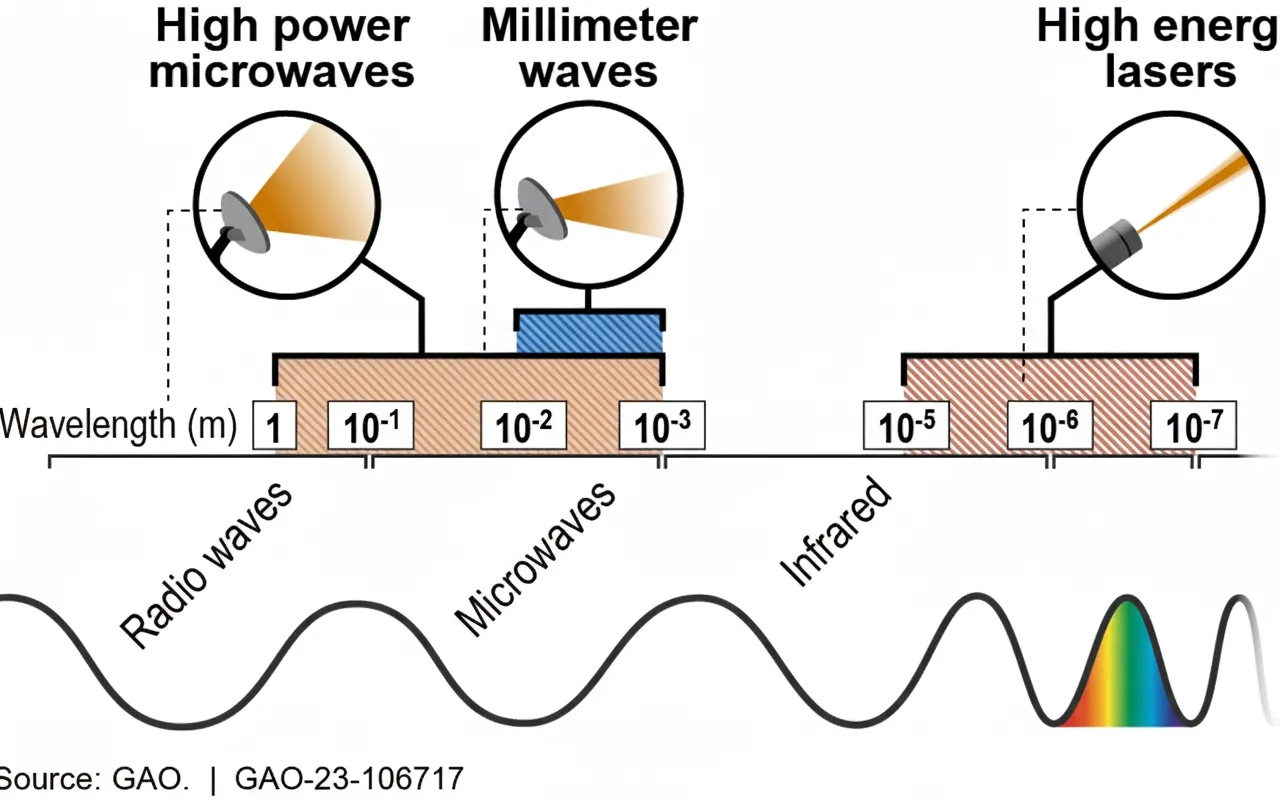
Figure 1. Position of directed-energy weapons in the electromagnetic spectrum.
All DEWs emit energy at light speed and are often discussed in terms of power output, the rate at which electromagnetic energy is delivered over time. Although DEWs use the same physical form of energy found in everyday devices such as microwave ovens, their power output is orders of magnitude greater.
High-energy lasers produce very narrow beams, typically in the infrared to visible range, and are usually used against one target at a time. Beams may be pulsed or continuous, with outputs starting at about 1 kW and above. Such power is many orders of magnitude greater than a typical laser pointer and can melt metal.
Millimeter-wave weapons operate at wavelengths between 1 and 10 millimeters and can produce more than 1 kW of power. Their beam size is larger than that of high-energy lasers, enabling effects on multiple targets simultaneously.
High-power microwave weapons use wavelengths longer than those of lasers and millimeter waves. These systems can generate power in excess of tens of megawatts, far exceeding household microwaves. Like millimeter-wave systems, HPM beams can affect multiple targets due to their larger beam footprint.
Each DEW can generate effects ranging from nonlethal to lethal depending on dwell time on the target, range, and the portion of the target illuminated. DEWs allow scalable responses: from temporary denial or area denial, escalating to physical damage or destruction when necessary. Progressive responses can start by preventing an asset from entering an area or temporarily disabling it, then escalate to damaging the asset if required.
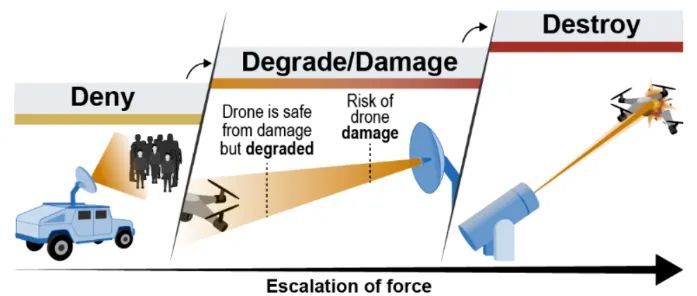
Figure 2. Example of graduated responses using directed-energy weapons.
DEWs can be used for area denial without causing lasting damage: once a threat leaves the area, systems or people may recover. For example, active denial systems use millimeter waves that interact with water and fat molecules in skin to produce a heating sensation that encourages individuals to leave an area. High-energy lasers can temporarily overwhelm human or sensor perception by producing glare, serving as a non-verbal warning prior to kinetic force. When greater force is required, lasers can deliver energy at wavelengths efficiently absorbed by the target material to melt or ignite components such as fuel tanks or batteries, or to damage sensors.
Maturity and Investment
DEW maturity ranges from research projects to prototypes undergoing field testing. The U.S. Department of Defense has identified DEWs as important to implementing recent defense strategies and has reported annual research spending on the order of hundreds of millions of dollars. Since the mid-2010s, U.S. forces have tested various DEW prototypes, many for counter-UAS missions. For example, the Air Force's Tactical High-power Microwave Operational Responder (THOR) completed multi-year testing. The department is researching methods to increase DEW power to engage more robust targets such as missiles. However, reports have noted challenges in bridging the gap between DEW development and acquisition, which could limit operational deployment.
Global interest in DEWs has grown due to technological advances and the desire to remain competitive on the battlefield. Innovations that make safer, smaller lasers have improved portability and practicality; for example, a four-wheeled all-terrain vehicle can now carry a laser capable of damaging a drone. By the early 2020s, many countries were reported to be developing DEWs, primarily for counter-UAS roles.
Opportunities
- Complement to conventional weapons: DEWs deliver energy at light speed, offering faster engagement than missiles and potentially lower per-shot cost. Some DEWs can provide effectively unlimited firing capability as long as power is available.
- Scalable responses: DEW effects can be tailored from nonlethal to lethal depending on mission needs. For example, longer laser dwell time on a target increases the degree of damage.
- Civilian spin-offs: DEW research can produce civilian benefits, such as advances in high-energy lasers for power beaming or other energy-transport applications.
Challenges
- Technical limits: DEW effectiveness typically degrades with range, and atmospheric conditions and cooling requirements can limit performance. Fog and storms reduce laser range and beam quality.
- Operational constraints: Decisions about when to use DEWs versus conventional force can be complex. Wide-beam DEWs like HPM or millimeter-wave systems can affect all assets within an area, including friendly systems.
- Ethical and health concerns: International law and norms do not always clearly define DEW use. Uncertainty about long-term health effects from intentional or accidental exposure raises ethical questions about DEW employment.
System Variants and Related Concepts
Kinetic weapons such as guns, missiles, and bombs destroy targets by dynamic effects including overpressure, projectiles, fragmentation, spall, and incendiary effects. Kinetic weapons use stored chemical energy in propellants and explosive warheads. DEWs direct stored energy at light speed to destroy or disable targets and include laser and microwave emitters. Major DEW classes include high-energy lasers (HEL), high-power microwaves (HPM), particle-beam weapons, and laser-induced plasma channel (LIPC) systems. Particle-beam weapons are often best characterized as projectile weapons that accelerate atomic or subatomic particles to relativistic speeds. LIPC systems use lasers to ionize a path to a target, creating a conductive channel for charge transfer to the target.
Systems such as continuous-wave lidar can measure distortions along a beam path. These systems use low-power lasers at wavelengths similar to HELs to illuminate a target; backscattered light is fed into a wavefront sensor that measures beam-path distortions over the beam cross-section.
High-Energy Laser Technology Demonstrator (HEL TD) efforts have sought mobile, solid-state laser approaches at the sub-megawatt level. Programs have aimed to develop 100 kW-class solid-state lasers for ground- and sea-based point defense and potential airborne applications. Development has included modular power and cooling designs, diode pump technologies, and ceramic gain media. Industry demonstrations have included multi-kilowatt laser modules and targets for continuous operation and specified power-conversion efficiencies.