Overview
The Space Force needs to upgrade existing weapon systems and platforms to accommodate the use of the M-code signal. M-code is a more robust, encrypted military GPS signal that provides more secure and reliable position, navigation, and timing (PNT) information. To meet this requirement, the military must procure and develop a large number of GPS receivers that support M-code. The Space Force is also developing second-generation M-code chips and handheld receivers. However, there is currently a lack of major customers, which could complicate development and procurement plans. The Space Force should reassess satellite and handheld device requirements and ensure a clear business case supports handheld development to avoid wasting resources. Handheld development should be driven by actual operational need and demonstrated value, not only by technical capability.
M-code technology and adoption challenges
The rollout of M-code technology is influenced by several factors. First, to satisfy user demands for accuracy, the Space Force must field more M-code-capable satellites. Building and maintaining a larger satellite constellation is a substantial effort, which means continuous satellite availability cannot be taken for granted. Second, the Space Force lacks a committed primary customer to buy the proposed handheld products. Without a viable commercial or operational case for handhelds, the risk is that substantial resources will be spent without delivering meaningful benefits to military users. The available reference material does not specify whether the Space Force has a plan to address these issues.
GPS satellite constellation evolution
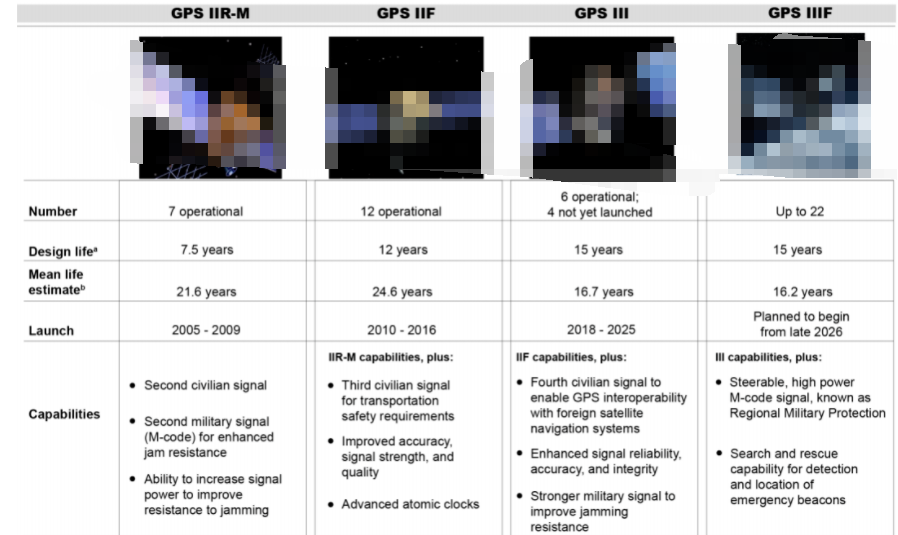
The GPS constellation comprises four generations of satellites with differing capabilities and design lifetimes. Since 2005, satellites capable of transmitting the M-code signal have been launched. Currently, 25 of the 31 satellites in the GPS constellation have M-code capability. To maintain and expand M-code coverage, additional M-code-capable satellites need to be launched. The Space Systems Command aims to replace satellites that are approaching their expected end of life through the GPS III and GPS IIIF programs. The following section describes the evolution of GPS satellites that support M-code, including estimates of capability and lifetime.
Ground control systems
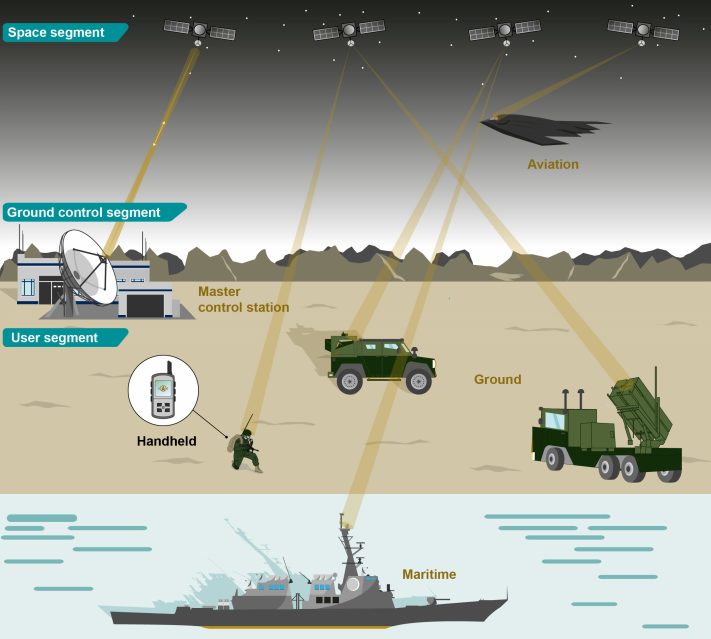
Developing the ground control segment is critical to GPS modernization. This segment is responsible for launching, commanding, and controlling both existing satellites and new, more capable satellites. Since 2010, the U.S. Department of Defense has worked on modernizing the ground control segment. In 2020, SSC implemented two modifications to the existing GPS ground control system, the Operational Control Segment (OCS), to enable control of a subset of M-code capabilities to support testing and deployment of M-code user devices. SSC has continued development with the objective of delivering full M-code capability.
The modernization work for the ground segment is managed through the Next Generation Operational Control System (OCX) program. OCX is intended to enable full M-code functionality and provide improved cybersecurity. SSC is responsible for OCX development and is building it via a sequence of incremental upgrades that are primarily software-based but also include new hardware and upgrades to monitoring stations worldwide. The OCX prime contractor is carrying out the OCX development work.
ASIC development and receiver integration
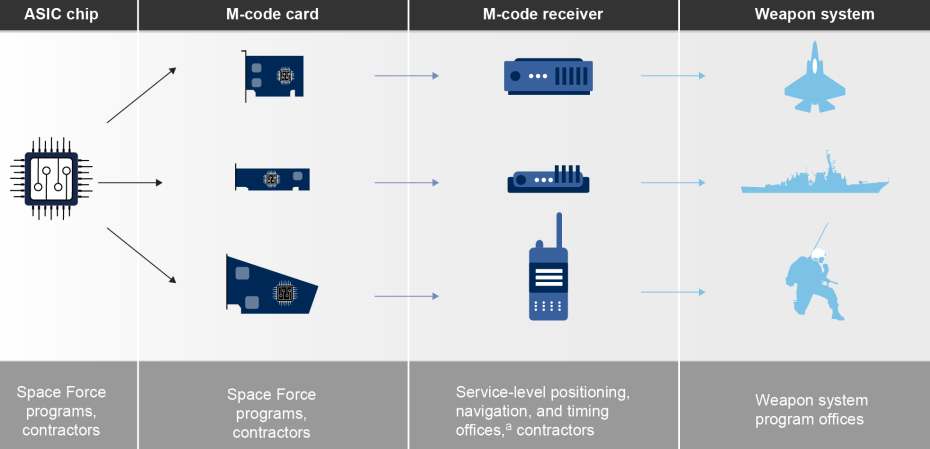
Dedicated integrated circuits are a key part of GPS modernization. ASICs are microelectronic components designed specifically to process and implement M-code functions. These chips are integrated onto cards that handle M-code signals and provide PNT information. The military integrates each dedicated M-code card into a receiver that interfaces with the host weapon system. In such a system, GPS satellites transmit M-code, the ground control segment and satellite receivers process the signal, and the dedicated ASICs execute complex algorithms to deliver high-precision PNT data. These data are then exchanged with the host weapon system to achieve improved positioning and navigation performance.
Using dedicated integrated circuits and related technologies enables GPS modernization to deliver stronger capabilities and better performance to meet military needs for accurate positioning and navigation. This has operational implications across military missions and other application areas.
Conclusion
Adapting to M-code signals requires the Space Force to upgrade weapon systems and platforms and to procure and develop M-code-capable GPS receivers. The Space Force should reevaluate satellite and handheld device requirements and ensure there is a clear business and operational case for handheld development to ensure efficient use of resources and to deliver stronger, more secure military PNT capability.