Introduction
Space has long been a key objective of human exploration. A silent competition in space has been unfolding for years. When we look up, thousands of artificial Earth satellites pass overhead.
From the 1957 launch of Sputnik 1, the world's first artificial satellite, to reaching about 1,261 satellites in orbit by 2014 took 57 years. Reaching nearly 10,000 in-orbit satellites by 2024 (9,770 as of May 2024) took only 10 years. Of these, 72% are communication satellites, and 91.5% of the nearly 10,000 satellites are in low Earth orbit.
This article is the first of a two-part overview summarizing satellite communication evolution and recent measurement approaches. This is Part 1.
1. Overview of Satellite Orbits
Satellite constellations are typically grouped into four orbit types based on altitude and orbital characteristics.
01 Geosynchronous Orbit (GSO)
Geosynchronous orbit satellites operate in circular orbits about 35,786 km above the Earth. With narrow beams, a beam footprint is roughly 200 km; with larger beams it can reach up to about 4,000 km. GSO satellites move at around 11,070 km/h, with an orbital period equal to one day. The round-trip time (RTT) for GEO satellites is about 544 ms. Based on the inclination to the equator, GSO satellites are further classified into three types.
Geostationary Orbit (GEO)
When a geosynchronous satellite has zero inclination, it orbits above the equator in the same direction as Earth's rotation. From the ground it appears fixed in the sky and is therefore called geostationary. GEO satellites historically supported most satellite services, including maritime communications, television broadcast, and other media services. For example, maritime communication satellites and TV broadcast satellites operate in GEO. China’s BeiDou third-generation system also includes three GEO satellites. Because GEO satellites occupy fixed positions above the equator at the same altitude, orbital capacity is limited; satellites are assigned longitudinal spacing to avoid interference. With 0.5° spacing, the theoretical capacity of the GEO ring is about 720 slots. As of August 2023, there were 563 geostationary satellites worldwide, 80 controlled by China.
Inclined Geosynchronous Orbit (IGSO)
An IGSO satellite has nonzero inclination, and its sub-satellite point traces a figure-eight path across the northern and southern hemispheres. GEO coverage is less effective at high latitudes; IGSO satellites can more easily provide regional coverage for specific areas.
Sun-synchronous Orbit (SSO)
Also called polar sun-synchronous orbit, the orbital plane maintains a fixed orientation relative to the Sun, with inclination near 90°. Satellites in SSO can pass over polar regions and cover virtually the entire globe over time. Meteorological, navigation, and Earth observation satellites often use these orbits. Inclined and polar synchronous satellites appear to move from the ground, but they pass specific regions daily, making them suitable for research, meteorology, intelligence collection, and communications for polar and high-latitude regions.
02 Medium Earth Orbit (MEO)
MEO satellites orbit between about 7,000 km and 25,000 km, with speeds near 13,800 km/h and orbital periods of roughly 6 to 12 hours. One well-known MEO constellation class is GNSS for positioning services. MEO beam footprints are similar to those of LEO constellations. MEO satellites must avoid the inner and outer Van Allen radiation belts, which contain high-energy particles that can damage electronics. The inner belt is around 3,700 km and contains a mix of protons and electrons; the outer belt is around 18,500 km and is primarily electrons.
03 Highly Elliptical Orbit (HEO)
HEO satellites travel in elliptical orbits. The elliptical shape enables longer dwell times over certain regions, which can be advantageous for providing coverage to high-latitude or polar areas. For example, some HEO designs spend about two-thirds of their orbit above the northern hemisphere. HEO advantages include extended coverage over remote regions; drawbacks include variable delay due to changing distance, frequency drift from orbital motion, and repeated crossings of the Van Allen belts, which can reduce electronic component lifetimes.
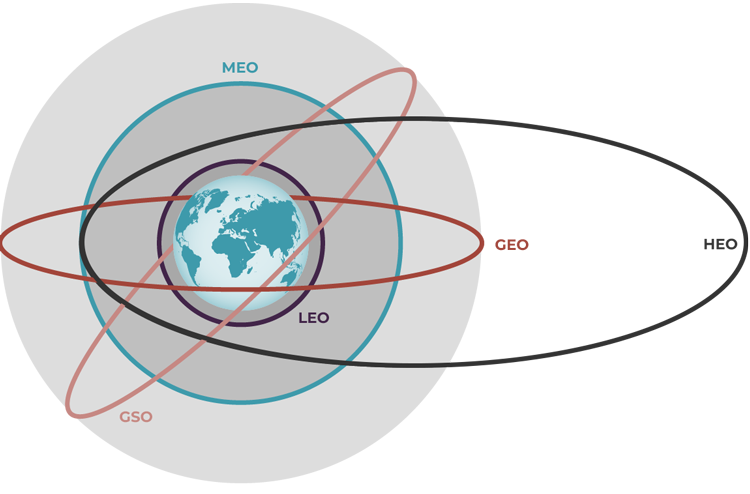
Figure 1: Satellite orbit illustration
04 Low Earth Orbit (LEO)
LEO satellites orbit between roughly 500 km and 2,000 km, with speeds near 28,000 km/h and orbital periods around 90 minutes. Lower altitude reduces launch energy requirements, making LEO deployments more cost-effective. Another clear advantage is lower RTT, typically under 30 ms. LEO satellites are generally small, with dimensions often under 1 m, some as small as tens of centimeters (nanosatellites), and masses under 500 kg. NTN (non-terrestrial network) assumptions often include on-board beamforming at satellite gateways. Typical LEO beam footprints range from about 100 km to 1,000 km. LEO’s operational environment is harsh, with residual atmospheric drag and other factors, so satellite lifetimes are often less than 10 years.
2. Evolution of Communication Satellites
Communication satellites have evolved through three main phases:
- Phase 1: Before the 1990s, geostationary satellites dominated for television broadcasting and fixed communications.
- Phase 2: From the 1990s to 2000s, lower-orbit approaches emerged alongside terrestrial mobile communications; GEO continued slow development.
- Phase 3: Since 2010, rapid LEO deployment and generational replacement in GEO and other orbits.
Different satellite types have seen corresponding capability evolution during these phases, driven not only by advances in launch systems and payload technologies, but also by continuous improvements in satellite PCB design, integration density, and reliability, which form the foundation of modern satellite electronics architectures.
In the mid-1990s, the ITU proposed the IMT-2000 vision for global wireless access in the 21st century. This coincided with the formation of 3GPP to advance international standardization of third-generation wireless systems. Notable RATs included WCDMA and TD-CDMA. IMT-2000 set design goals of flexibility and globalization, with peak hotspot rates of 2 Mbps and mobile average rates of 384 kbps as targets for public land mobile networks; both terrestrial and satellite systems were expected to support these goals. Commercial and cost constraints initially limited realization in satellite systems. Over the next two decades, advances in aerospace and wireless technology, along with improved small-satellite launch capabilities, made LEO constellations practical. Commercial and dedicated satellite systems continue to deploy and provide services. When 3GPP Release 17 formally considered non-terrestrial networks (NTN) within 5G, Release 17 provided the first standardized support for NTN connectivity, establishing a framework for long-term evolution and broader NTN use cases.
As of the end of 2023, there were 9,691 satellites in orbit; 625 were geostationary satellites, primarily used for communications. Starlink alone launched 1,961 satellites in 2023.
GEO satellites are evolving from broad C/Ku-band beams toward Ka-band and higher frequencies with many spot beams and high throughput. Broad beams provide wide-area coverage, while many spot beams increase capacity and per-user rates.
In mobile satellite communications, use of mobile bands, improved capabilities of ground terminals and satellite antennas, and 3GPP NTN standardization have enabled a shift from traditional satellite telephony toward direct-to-handset compatibility and integrated terrestrial-satellite solutions.
Satellite television, live satellite broadcast, and satellite radio have been major GEO services providing one-way transmission from ground stations to many users. Advances in on-board digital payloads are driving a convergence of broadcast and communications functions on the same satellites.
Data relay is another important area. Inter-satellite links now use dedicated RF bands and laser communications to provide links between spacecraft and ground stations. Providing low-cost data relay via commercial satellites is an emerging area. As on-board processing increases, the boundary between relay satellites and communications satellites is expected to blur.
Overall, communication satellites are accelerating from GEO toward LEO deployments. Many countries have LEO constellation plans. Globally, nearly 10,000 satellites are in orbit, of which 91.5% are LEO. The distribution of LEO satellites by altitude as of May 2024 shows about 60% above 580 km and about 40% below 580 km.