Overview
Sensors that operate in the electromagnetic spectrum convert incident radiant energy into electrical signals for subsequent electronic processing. Sensors are used to detect, track, identify, and locate targets. Some sensors have their own illumination sources, such as microwave, millimeter-wave, and lidar. These sensors are called active sensors. Other sensors rely on ambient illumination of the target, such as electro-optical (EO) and infrared (IR) systems, which use reflected light or thermal radiation from the background and engines. These are called passive sensors. Active sensors include both transmitters and receivers, while passive sensors have only receivers.
Missile guidance works by tracking a moving target’s position in space using specific methods, for example using radar or by tracking its thermal signal, pursuing it, and finally hitting it. Guidance systems in missiles come in various types for different operational purposes. There are many guidance approaches; this article focuses on seekers commonly used in naval and air-launched missiles.
Homing Guidance Basics
Homing guidance systems control the flight path by using devices that respond to prominent features of the target. Homers can be sensitive to various energy forms, including radio-frequency (RF), infrared, reflected laser, and visible light. To lock onto a target, a missile must determine the target's azimuth and elevation by at least one angular tracking method.
Active Radar Seekers
An active radar seeker is a missile guidance method where the missile contains a radar transceiver, as opposed to semi-active radar homing where the missile only has a receiver. The missile also includes the electronics required to autonomously search for and track its target.
Active radar seekers offer two main advantages: tracking can be more accurate, and the seeker is more resistant to electronic countermeasures. Missiles with active radar seekers generally achieve higher kill probabilities than comparable semi-active guided missiles.
In the terminal phase the missile can operate completely autonomously. The launch platform does not need to illuminate the target during this phase; a moving launch platform such as an aircraft can leave the area or perform other tasks while the missile homes. This capability, often called fire-and-forget, is a major advantage of modern air-to-air missiles compared with earlier designs.
Because an active seeker implements a full radar system, an active seeker will usually be more expensive than a semi-active one, all else being equal.
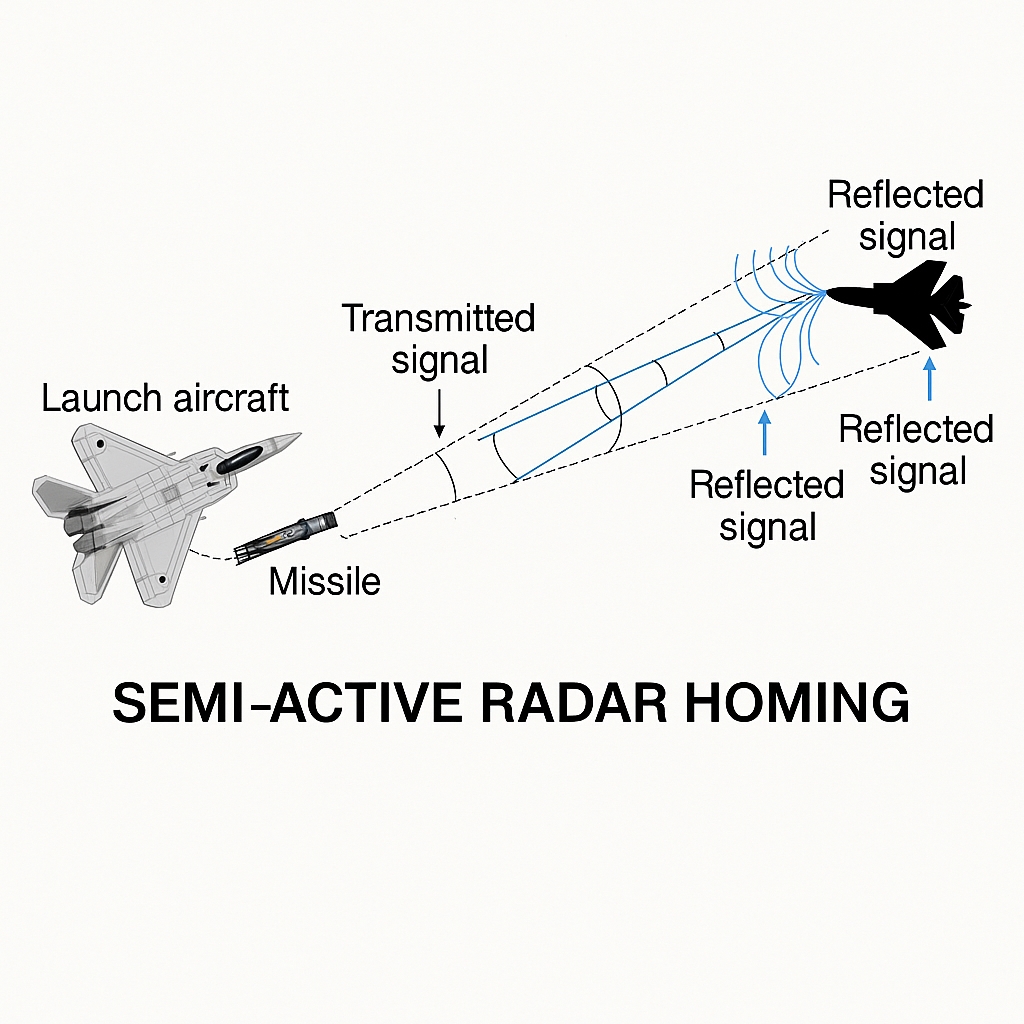
Semi-Active Radar Homing
Semi-active radar homing (SARH) is a common guidance approach and is perhaps the most common type for long-range air-to-air and surface-to-air missiles. The term indicates that the missile itself is a passive detector of radar signals provided by an external offboard source: it receives signals reflected from the target, rather than transmitting them as an active seeker does. Semi-active missile systems often use bistatic continuous-wave radar.
Passive Anti-Radiation Homing
An anti-radiation missile (ARM) is designed to detect and home in on enemy radio transmitters. These are typically intended to counter hostile radars and related emissions.
Many missiles include passive radiative homing as an additional capability. If a target attempts to jam with noise, a missile can switch to home-on-jam mode and passively home on the jamming radiation, making it effectively immune to noise jamming in that scenario.
Infrared Seekers
Infrared (IR) seekers are passive guidance systems that use a target's IR emissions to detect and track it. Missiles using IR seekers are commonly called heat-seeking missiles because hot bodies emit strongly in the infrared. Many objects such as people, vehicle engines, and aircraft generate and radiate heat, making them particularly visible in IR wavelengths compared with the background.
Infrared seeker heads are passive and do not reveal that they are tracking a target in the way a radar might. This makes them suitable for surprise attacks in visual encounters or for longer-range attacks when combined with forward-looking infrared systems. Heat seekers have been very effective historically: IR-guided missiles accounted for about 25% of U.S. aerial combat losses in the past 90 years. However, they are vulnerable to simple countermeasures, most notably flares that provide false heat sources. Such countermeasures are effective only if the pilot detects the missile and deploys them; modern seekers are increasingly complex and harder to deceive.
Contrary to popular media, heat-seeking missiles do not theatrically turn and weave to follow a target’s every movement. They have limited maneuverability and can be defeated if they are fired from sufficiently long range and the target maneuvers.
Imaging Infrared
Modern heat seekers use imaging infrared (IIR) sensors, where the IR detector is a focal-plane array that produces an infrared image, much like a CCD in a digital camera. This requires more signal processing but improves accuracy and resistance to decoys. Newer seekers are less likely to be spoofed into locking on the sun. By using advanced image processing, the seeker can identify target shapes and guide the missile toward the most vulnerable parts.
Laser Guidance
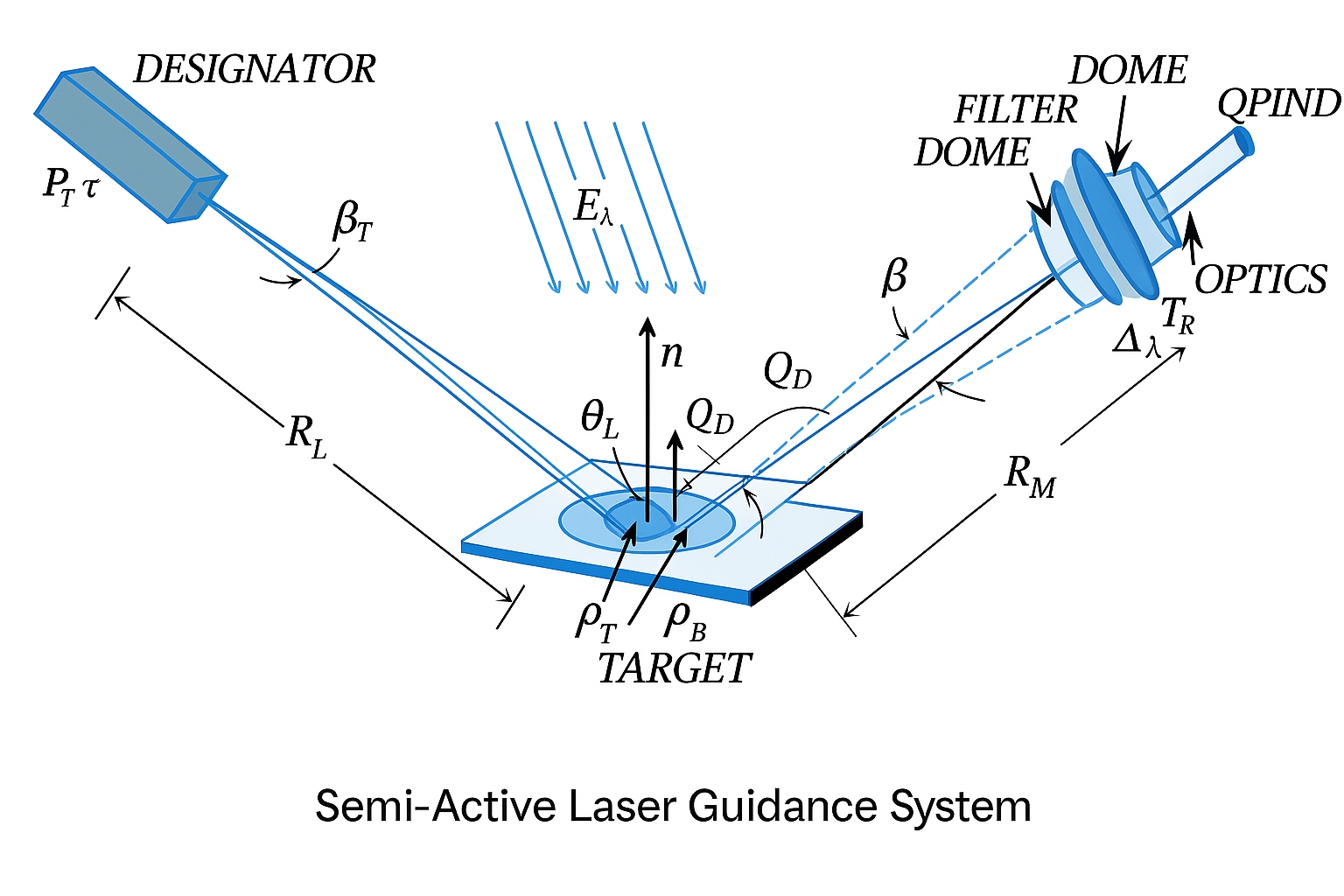
Laser guidance uses a laser beam (lidar) to guide a missile, projectile, or vehicle to a target, for example in beam-riding or semi-active laser homing (SALH). In SALH, a laser illuminator points at the target and laser radiation scatters from the target surface, a process known as "painting" the target.
Lidar is similar to microwave radar but operates at much higher frequencies. Higher frequency allows smaller components and finer angular resolution. However, atmospheric attenuation becomes significant at high frequencies, limiting detection range for ground-based lidar to about 10 km. Space-based lidar is not affected by atmospheric attenuation and can reach ranges of thousands of kilometers.
Because lidar beams are narrow, typically on the order of 1 mrad, lidar is not suitable for volumetric search; that role is better handled by passive IR systems that provide coarse bearing to cue the lidar for range and radial velocity measurements.
Considering atmospheric transmission windows and the availability of detectors and laser sources, lidar systems typically operate in two wavelength bands: solid-state semiconductor lasers near 1 μm and CO2 gas lasers near 9.2–10.8 μm.
The principal military lidar applications include:
- Designators: illuminate a target with a laser beam to guide a weapon;
- Rangefinders: accurately measure distance between target and observer;
- Seeker heads: integrated on a weapon for target identification and autonomous terminal guidance;
- Target velocity measurement: used in heterodyne receivers to determine Doppler shift and radial velocity;
- Differential absorption lidar (DIAL): measure concentrations of specific gases for nuclear, biological, and chemical (NBC) applications by comparing attenuation at two wavelengths, one tuned to an absorption line and one off it. CO2 lasers are often used for DIAL because they can be tuned across a broad band.
Laser designators are used in battlefield scenarios and in airborne systems such as low-altitude navigation and target-aiming infrared systems. They provide range and bearing information to weapons. Laser designators are relatively large and heavy systems, with ranges around 10 km. Some air-launched weapons such as the Maverick guided bomb and the Hellfire missile use laser seekers to locate and home on targets.
When a guided weapon is launched near the target, the seeker detects reflected laser energy and determines the direction of the source, adjusting its trajectory toward the laser spot. SALH is ineffective against targets that reflect little laser energy, for example those treated with special paints that absorb laser wavelengths. Such coatings are likely to be used on advanced military vehicles to make them harder to target with laser designators and laser-guided munitions. An obvious mitigation is to aim the laser near the target rather than directly at it. Countermeasures to laser guidance include laser warning receivers, smoke, and active counter-laser protection systems.
Laser rangefinders are smaller than designators and typically weigh about 3–4 lb. They use paired telescopes and have effective ranges around 1 km. Most current laser designators and rangefinders operate at 1.064 μm (Nd:YAG), though this wavelength is within the eye-sensitive range of 0.4–1.2 μm and therefore is not eye-safe.
Recent compact, rugged, uncooled mid-infrared semiconductor laser diodes have shifted usable bands beyond 1.4 μm, moving outside the most eye-sensitive range.
Typical solid-state laser materials include:
- Ho:YAG, emission near 2.09–2.10 μm;
- Tm:YAG, emission near 2.32 μm;
- Er:YAG, emission near 2.94 μm;
- Dy:YLF, emission near 4.34 μm.
In military lidar applications the system is generally used for target location, identification, and weapon guidance. Lidar accomplishes this through three principal image types:
- Range image: obtained by processing the backscattered signal from the target;
- Elevation image: outlines height contours within the field of view;
- Intensity image: formed from differences in reflectivity of objects within the field of view.
Direct and Heterodyne Receivers
There are two receiver types: direct receivers and heterodyne receivers. A direct receiver measures backscattered energy from the target and operates similarly to a photodetector. The diagram below illustrates a direct lidar receiver with imaging capability and a servomechanism that scans an optical assembly to capture targets within the field of view.
In a heterodyne receiver part of the transmitted beam is routed to a frequency shifter to create a local oscillator. The shifted local oscillator mixes with the received laser signal, converting the signal to a lower frequency for amplification and improving receiver sensitivity. The block diagram below shows a heterodyne lidar receiver. Coherent lidar processing not only yields intensity and range information but also provides Doppler shift proportional to the target’s radial velocity. Coherent lidar processing commonly uses 10.6 μm CO2 lasers, which can provide highly stable long-term frequencies.
Modern Missiles
Modern missiles often carry more than one seeker type. Missile technology continues to evolve, and the effectiveness of simple passive countermeasures is decreasing. Defense developers have introduced more advanced active systems to counter incoming threats.