What is 5G mmWave?
5G uses two frequency ranges, FR1 and FR2. FR1 covers 450 MHz to 6 GHz and is commonly called Sub-6GHz. FR2 covers 24.25 GHz to 52.6 GHz. Because most frequencies in FR2 correspond to wavelengths smaller than 10 millimeters, this band is commonly referred to as millimeter-wave, or mmWave. Although some frequencies between 24.25 GHz and 30 GHz have wavelengths larger than 10 millimeters, the term mmWave has become conventional. By the same naming convention, Sub-6GHz can be referred to as centimeter-wave.
At the 2019 ITU World Radiocommunication Conference (WRC-19), participants identified spectrum resources intended for 5G and future IMT development: 24.25 GHz–27.5 GHz, 37 GHz–43.5 GHz, and 66 GHz–71 GHz, totaling 14.75 GHz of bandwidth. Some countries also noted 45.5 GHz–47 GHz and, in Region 2, 47.2 GHz–48.2 GHz for potential IMT use. Although operators in the Chinese market have focused 5G expansion on Sub-6GHz, many operators abroad have deployed 5G using mmWave bands.
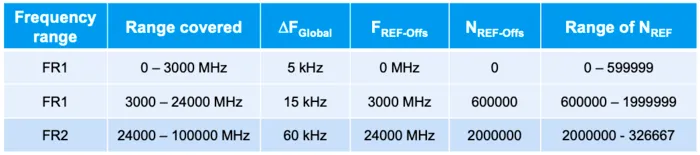
FR1 and FR2 Defined
FR1 and FR2 definitions are specified in 3GPP TS 38.101. FR1 spans 450 MHz to 6 GHz. FR2 spans 24.25 GHz to 52.6 GHz, and the higher frequencies in FR2 are commonly called millimeter-wave.
Disadvantages of 5G mmWave
Start with the drawbacks. Why do operators in the Chinese market primarily rely on Sub-6GHz for 5G? The main issue is signal propagation. Compared with typical 4G signals and Sub-6GHz 5G, mmWave signal strength and penetration are much weaker.
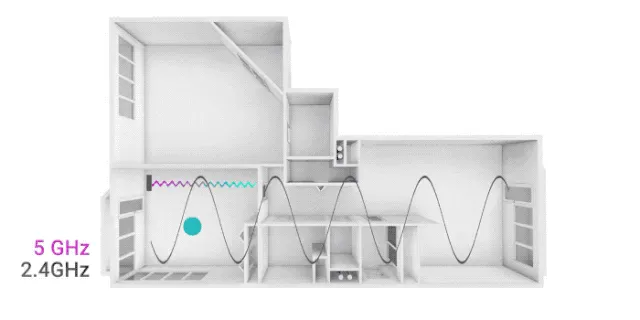
Higher frequency implies shorter wavelength and poorer penetration. Millimeter waves can be blocked by a leaf, a sheet of paper, or even a drop of water. In tests referenced by LinusTechTips, 5G phones relying on mmWave could lose connection behind simple obstructions such as a phone booth, a tree, glass, an umbrella, or even a change in orientation, causing the device to fall back to 4G if the mmWave link was blocked. Operators that combine Sub-6GHz and mmWave coverage did not exhibit the same rapid fallback.
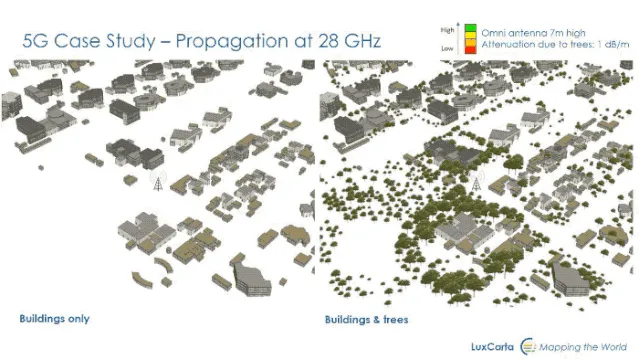
To provide reliable mmWave experience, a dense deployment of base stations is required. Without sufficiently dense coverage, mmWave links can be lost frequently, so many base stations are needed to maintain continuous coverage.
Advantages of 5G mmWave
Despite its propagation limitations, mmWave is valued because it provides much wider channel bandwidth and therefore much higher peak data rates. For example, the 60 GHz band can support channels with 2.16 GHz of bandwidth, while many LTE bands only offer around 100 MHz of usable bandwidth. In simple terms, mmWave networks can deliver higher speeds than Sub-6GHz. The ITU IMT-2020 requirements target peak data rates up to 20 Gbit/s, which are difficult to achieve with Sub-6GHz alone.
Additionally, mmWave bands generally face less interference than congested Sub-6GHz bands. The 1.9 GHz–6 GHz range is crowded with Wi?Fi, Bluetooth, satellite broadcasts, and other services, while mmWave spectrum is less occupied, offering lower latency, higher capacity, and the ability to connect more devices concurrently.
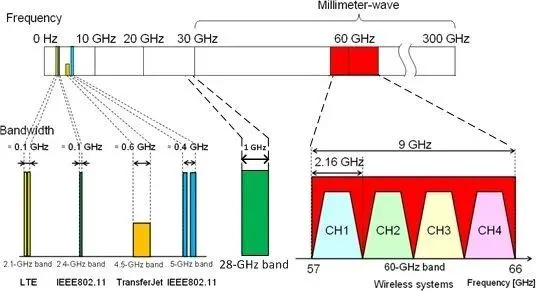
Use Cases and Complementarity
In daily scenarios, mmWave enables very fast downloads and high-capacity access in dense venues such as stadiums. In professional scenarios, mmWave can support remote control of industrial robots, autonomous material transport in factories, and remote medical applications.
Under 3GPP 5G standards, both Sub-6GHz and mmWave are part of 5G. They are complementary rather than successive technologies. Sub-6GHz offers wider coverage, stronger and more stable signals; mmWave offers much higher speeds and lower latency but is more sensitive to blockage and weather. Networks commonly use a mix of both to meet different deployment requirements, similar to how NSA and SA network architectures coexist; both are valid 5G approaches depending on operator and deployment needs.