Session overview
Session 2: 5G Networks
Mobility Management in 5G Cellular Networks
Authors: Ahmad Hassan (University of Minnesota), Shuowei Jin (University of Michigan), Arvind Narayanan (University of Minnesota), Ruiyang Zhu (University of Michigan), Anlan Zhang, Wei Ye (University of Minnesota), Jason Carpenter (University of Minnesota), Z. Morley Mao (University of Michigan and Google), Zhi-Li Zhang, Feng Qian (University of Minnesota)
Abstract
As 5G supports multiple bands and deployment modes such as SA and NSA, mobility management, and particularly handover handling, becomes more complex. Measurement results show that frequent handovers in high-frequency bands cause throughput oscillation and can even make service unavailable. The authors construct a dataset, present analysis, and design a prediction system called Prognos to improve QoE for 5G applications. The research materials are released.
Measurement platform and methods
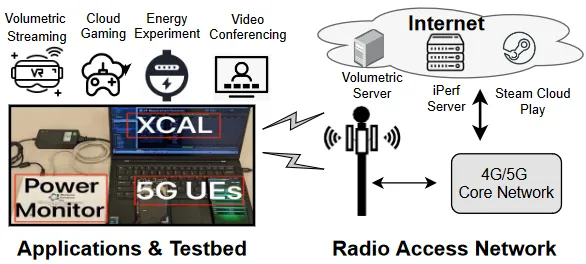
To address measurement challenges the authors built a platform with:
- Multiple 5G handsets with access to three major US carriers. Devices used were Samsung Galaxy S21 Ultra 5G (SM-G998U) and Samsung Galaxy S20 Ultra 5G (SM-G988U), with three S21U and one S20U.
- User-space software on unrooted phones to capture mobility-related information. Access to low-layer data required Qualcomm Diag access; the team used Accuver XCAL to read Qualcomm Diag and extract physical cell ID and other details.
- Extended 5G Tracker capabilities and Android APIs to capture key control-plane events such as physical cell ID, handovers, and frequency bandwidth. The TelephonyManager onDisplayInfoChanged() API was used to identify frequency bandwidths.
- External power monitoring to measure device energy consumption precisely. The Monsoon Power Monitor was used for energy measurements.
Analysis and findings
The collected data led to several findings:
- Impact on applications: 5G handovers significantly affect application-level experience, more so than 4G. Dual-mode NSA 5G can mitigate some negative effects of handovers.
- Handover characteristics: The authors examined handover frequency, duration, and device energy cost. NSA 5G shows higher handover frequency, especially on mmWave in NSA. Average NSA handover completion time is about 167 ms. The preparation phase of handovers consumes substantial time due to 5G complexity and immature techniques. Energy consumption during 5G handovers is roughly 10 times that of 4G and correlates with handover frequency.
- Operator implications: Cell footprint and handover behavior are tightly coupled. NSA 5G lacks direct inter-base-station handover in some cases, causing 5G-4G-5G transitions that degrade performance. When 4G and 5G cells share the same tower, handover latency is shorter.
- Predicting handovers to improve QoE: The authors propose Prognos, which uses observed signal strength, device measurement reports, and past handovers to predict future handovers and their types. Prognos uses a two-stage prediction pipeline: it first predicts future signal strength and measurement reports, then learns base station handover logic. Decoupling into two stages reduces model complexity and improves accuracy compared with a single model.
Prognos design details
Prognos contains three modules:
- Report predictor: predicts measurement reports by considering mobility configuration and signal quality.
- Decision learner: learns operator-specific handover policies using sequence pattern mining. Input is a continuous stream of measurement reports and handover commands; the stream is segmented into stages, each ending with a handover command. The learner uses an online modification of prefixSpan to support incremental pattern updates. Patterns are retained or discarded based on freshness thresholds to avoid unbounded growth.
- Handover predictor: uses the predicted measurement report sequence and learned decision logic to predict handover occurrence and type.
Evaluation shows Prognos achieves F1 scores of 0.92 to 0.94, outperforming prior methods by 1.9x to 3.8x. In a 16K panoramic video streaming test, Prognos reduced rebuffering delay by 34.6% to 58.6% versus a default throughput predictor; in live video streaming, it increased content quality by 15.1% to 36.2%.
Comments
The work highlights that 5G handover behavior depends on multiple interacting factors such as 4G/5G coexistence and SA/NSA modes. The authors collected extensive data and derived empirical insights and a prediction approach. Potential limitations include rapid technology evolution, which may make collected data less applicable in a few years, and that the prediction module is an incremental improvement over existing methods.
Understanding 5G performance for real-world services: a content provider's perspective
Authors: Xinjie Yuan, Mingzhou Wu, Zhi Wang (Tsinghua University), Yifei Zhu (Shanghai Jiao Tong University), Ming Ma, Junjian Guo (Kuaishou), Zhi-Li Zhang (University of Minnesota), Wenwu Zhu (Tsinghua University)
Background and goals
This study analyzes one year of traffic data from 23 million users of a major content platform to evaluate the benefits of SA 5G from a content provider perspective. The authors aim to quantify QoS/QoE improvements from 5G connections and to identify configuration strategies required to realize 5G performance gains.
Data collection and methods
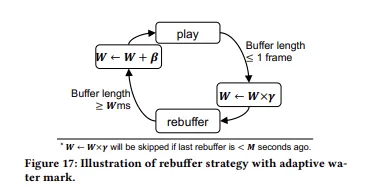
The study combines passive and active measurement techniques to address device and OS heterogeneity and third-party network influences. Passive collection involved sending user statistics and state information in 10 s windows to logging servers. To measure connection delays, the authors used connection establishment delays such as RTMP connection time rather than application startup delay. Active data collection included traceroute experiments to reveal core network characteristics. Based on observations, the authors also evaluated an experimental 5G-aware buffering strategy that reduces minimum rebuffer time after a rebuff and otherwise increases buffer size by a factor beta.
Key findings
- SA 5G can provide substantially lower application-layer latency. For streaming scenarios, SA 5G reduced link establishment delay by around 60% and reduced overall transmission time by 67% to 89% compared to 4G, while offering higher download speeds. SA 5G outperformed NSA 5G in the evaluated metrics.
- SA 5G is more sensitive to horizontal handovers; when user density increases, SA 5G download speeds may decrease due to handover effects.
- Contrary to conventional wisdom, using 5G is not always more power-hungry than 4G. SA 5G users are often routed through fewer core-network hops, though fewer hops do not always imply lower RTT to servers.
Comments
The study provides extensive, large-scale measurements and solid evidence that SA 5G can improve application latency and throughput in practice. The authors also propose a buffering strategy informed by their measurements; in a test with 9 million users, the strategy reduced rebuffering time by an average of 7%.
Mobile Access Bandwidth in Practice: Measurement, Analysis, and Implications
Authors: Xinlei Yang, Hao Lin, Zhenhua Li (Tsinghua University), Feng Qian (University of Minnesota), Xingyao Li, Zhiming He, Xudong Wu, Xianlong Wang, Yunhao Liu (Tsinghua University), Tianyin Xu (University of Illinois at Urbana-Champaign)
Overview
This work surveys mobile access bandwidth among a large user base, mainly in China, and uncovers surprising trends and root causes. The team also proposes Swiftest, a lightweight, fast bandwidth testing technique that reduces test time and operational cost. The study is based on the UUSpeedTest (BTS-APP) Android app, which has roughly 17 million users and about 200k daily tests, with most users in China.
Design and data
Under privacy constraints, the authors used BTS-APP for continuous lightweight collection of bandwidth tests and augmented the app to capture physical and link layer protocol data for fine-grained analysis. They also developed a UDP-based bursty fast bandwidth test to reduce test time and overhead.
Measurement results
Over four months, the dataset contains 23.63 million tests from approximately 3.54 million users, 99.7% of which are in China, covering WiFi, 3G, 4G, and 5G. Key observations:
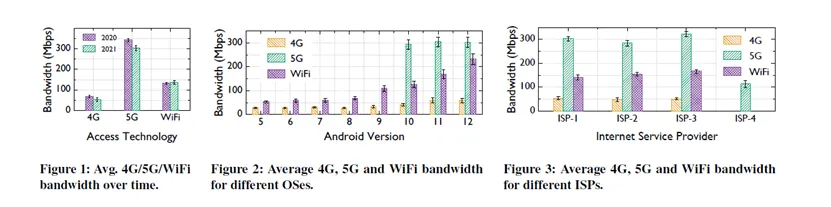
- Despite widespread deployment of 5G, cellular access bandwidth has not risen and in some cases has declined. One root cause is aggressive spectrum refarming from 4G to 5G.
- Urban areas exhibit higher cellular access bandwidth than rural areas, mainly due to infrastructure density differences.
- OS and software matter: newer Android versions often deliver higher access bandwidth due to improvements in wireless stack management. Given the same Android version, low-end and high-end devices show similar access bandwidth.
- Operator differences: Because 4G infrastructure is mature, average 4G access bandwidths across operators are similar. Operators that deployed 5G in lower bands show lower 5G bandwidth compared with those using more favorable bands.
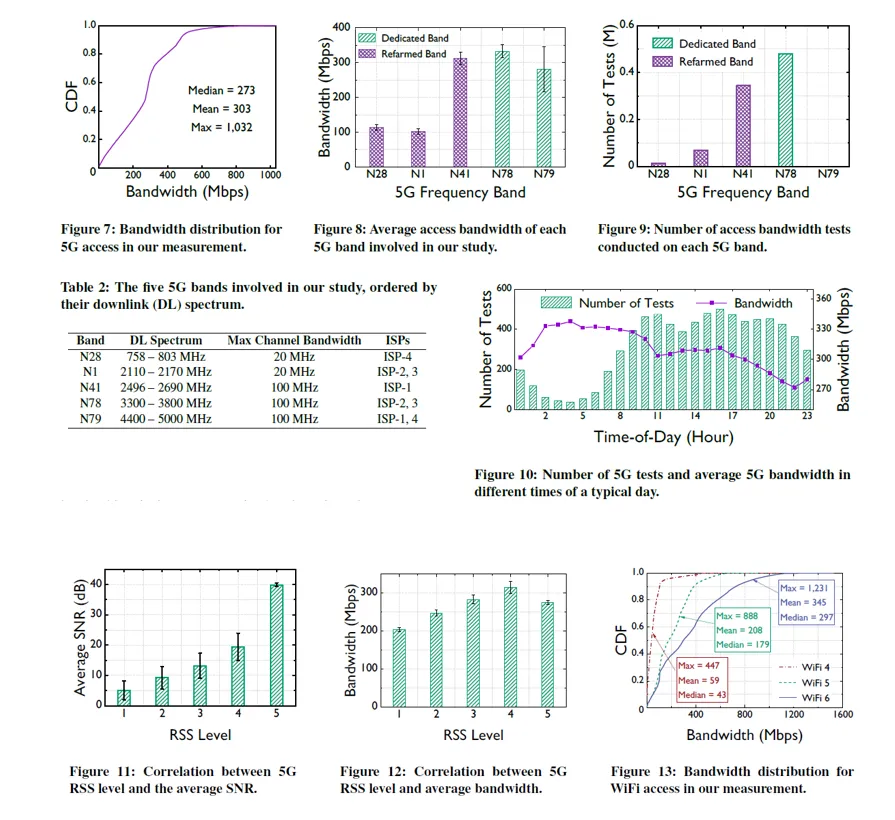
For 4G, higher frequency bands tend to provide higher bandwidth, but some high-frequency bands used in rural areas show lower bandwidth due to sparse deployment. LTE-Advanced techniques enable some 4G locations to achieve bandwidth comparable to commercial 5G. For 5G, three of five 5G bands are refarmed from 4G; refarmed bands generally offer lower bandwidth than native 5G bands. Time-of-day effects show lower average access bandwidth during peak usage; energy-saving strategies that put some 5G sites into sleep mode at night also affect observed bandwidth. Strong signal strength does not always imply higher bandwidth because dense deployments can cause interference, load imbalance, and cross-cell effects that reduce throughput.
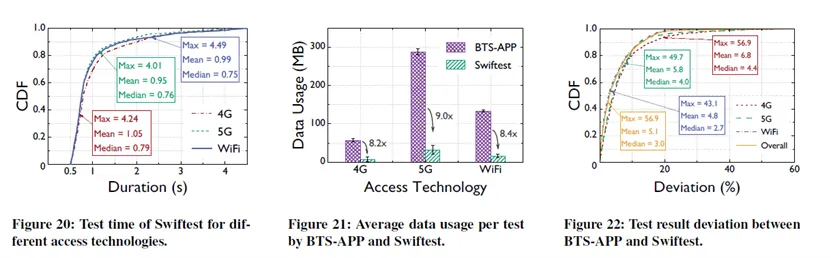
For WiFi, despite evolution to WiFi 5 and WiFi 6, average access bandwidth has stagnated. Upgrades from WiFi 4 to WiFi 5 benefited mainly from 5 GHz usage. The study infers that 64% of WiFi users still rely on capped fixed-line broadband around 200 Mbps, making fixed broadband the main bottleneck for achieving higher WiFi access bandwidth.
Swiftest: bandwidth testing improvement
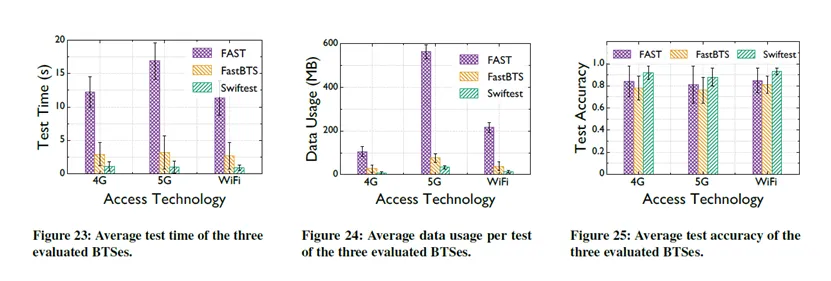
Most mainstream bandwidth tests use flooding-based TCP probes, which suffer from TCP slow-start bias and produce invalid initial samples. Observing that access bandwidth distributions across access technologies follow independent multimodal Gaussian mixtures, the authors propose Swiftest. Swiftest uses a probabilistic model to guide initial probe rate selection and switches to UDP to avoid TCP slow-start effects. In a month of online testing, Swiftest completed accurate bandwidth tests faster and with lower network capacity than BTS-APP and outperformed other state-of-the-art techniques in efficiency, capacity usage, and accuracy.
Comments
The paper produces important practical insights explaining why average access bandwidth has not kept pace with advances in wireless technology. The authors diagnose root causes and propose both infrastructure-focused recommendations and a practical, efficient bandwidth testing method. Future work could further validate Swiftest accuracy across broader environments and refine comparisons against measurement baselines.
SEED: A SIM-Based Solution to 5G Failures
Authors: Jinghao Zhao, Zhaowei Tan, Yifei Xu, Zhehui Zhang, Songwu Lu (UCLA)
Background
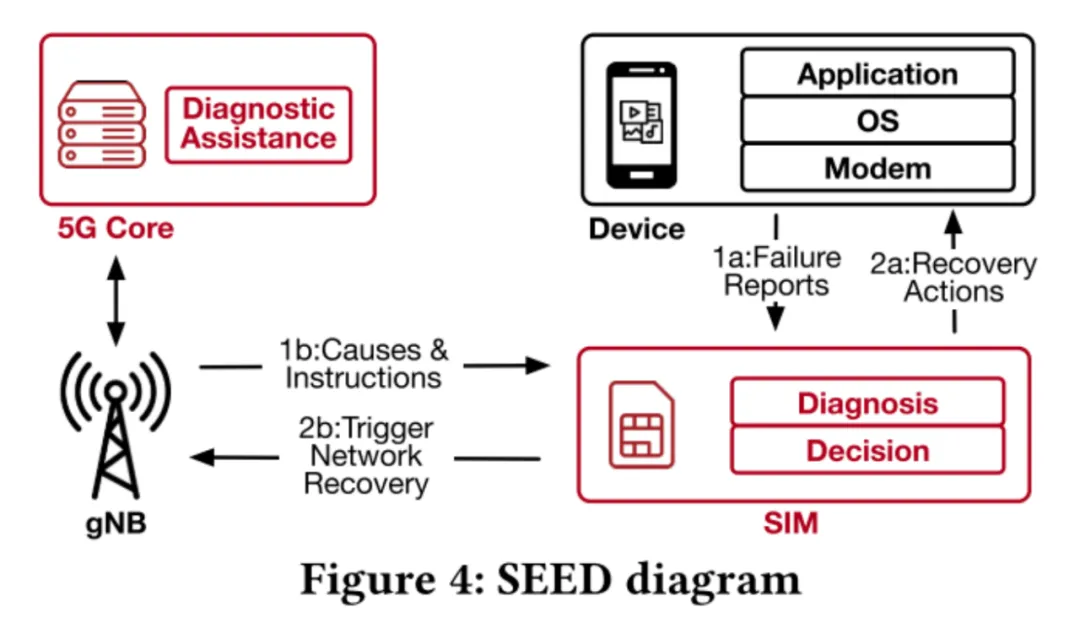
As 5G rolls out, failures are becoming common and can degrade user experience if left unmanaged. Existing device-side or OS-centered approaches provide coarse diagnostics and are insufficient for complex 5G failures. SEED is a SIM-based solution that uses standardized 5G error codes and a decision-tree/online learning approach to infer root causes and perform multi-layer recovery actions such as protocol resets, refreshing outdated configurations, and reloading profiles.
Design
SEED places diagnostic logic on the SIM. The SIM receives failure reports from applications and network elements and executes local diagnostics to decide recovery actions on the device or by signaling the network. SEED addresses three challenges:
- Low-overhead diagnosis on resource-constrained SIM hardware: SEED combines standardized failure reasons with infrastructure configuration and device-side OS/application failure reports to enable fine-grained diagnosis using limited SIM processing and storage.
- Handling failures at different stages: SEED implements multi-layer resets that can be executed without root access, such as reloading configuration files and applying updates; with root access, SEED can perform faster control/data plane resets.
- Collaboration with infrastructure when data-plane failures occur: SEED leverages existing signaling messages to exchange diagnostic information between SIM and network to enable runtime SIM-network information exchange even when control/data plane management or data delivery is degraded.
Evaluation and summary
Experiments show SEED detects and resolves 5G failures faster than traditional approaches while preserving standard SIM security properties. SEED infers root causes using standard 5G signaling error codes augmented by a domain-specific lightweight machine learning algorithm, then applies adaptive recovery actions.
Comments
SEED's novelty lies in a SIM-centric approach to 5G failure diagnosis and recovery and its integration of operator-side perspectives. Operators are well positioned to deploy SEED components during device activation and software updates.
L25GC: A Low-Latency 5G Core Network on High-Performance NFV Platforms
Authors: Vivek Jain (UC Riverside), Hao-Tse Chu (NYCU), Shixiong Qi (UC Riverside), Chia-An Lee (NYCU), Hung-Cheng Chang (NYCU), Cheng-Ying Hsieh (NYCU), K. K. Ramakrishnan (UC Riverside), Jyh-Cheng Chen (NYCU)
Background
Reducing latency in cellular networks requires improvements in both access and core network elements. Traditional core network implementations rely on complex hardware and protocols that add latency. Although 5G moves core functions to software, control-plane procedures and inter-NF communication can still cause substantial overhead due to kernel-based networking, TCP handling, serialization, and linear-search forwarding rule implementations.
Design
L25GC is an NFV-based 5G core built on free5GC that targets high performance while remaining 3GPP-compatible. Key techniques include:
- Co-locating control-plane and data-plane NFs on the same node to reduce inter-NF communication overhead while retaining per-NF modularity.
- Replacing kernel-based communication with a shared-memory zero-copy mechanism and eliminating extra serialization across service interfaces, N4, and the 5GC data plane to achieve low-latency inter-NF communication.
- Implementing intelligent buffering to hold packets for idle UEs during handovers to optimize switching and reduce chained routing delays.
- Replacing linear-search forwarding rules with a PartitionSort classifier after evaluating linear search, tuple-space search, and PartitionSort, improving data-plane throughput.
- Reducing NF failure recovery latency by maintaining lightweight CPU replicas that consume no CPU when idle and replicating NF state to avoid full UE reconnection procedures.
Performance
Compared with free5GC, L25GC reduces end-to-end event completion time by 51% and improves single message latency by 13x. Packet latency during paging and handover events is roughly halved. Web page load times improve by 12.5% in evaluated scenarios. L25GC data forwarding reaches line-rate on 10 Gbps links for 64-byte packets, achieving a 27x improvement over free5GC kernel-based forwarding.
Summary and comments
L25GC demonstrates that NFV-based shared-memory designs can substantially reduce inter-NF communication overhead and improve both control and data plane performance while preserving microservice-like modularity. The implementation is open source. A limitation is current support for only a limited number of concurrent sessions, which constrains immediate deployment at large scale.