End-to-end 5G network slicing
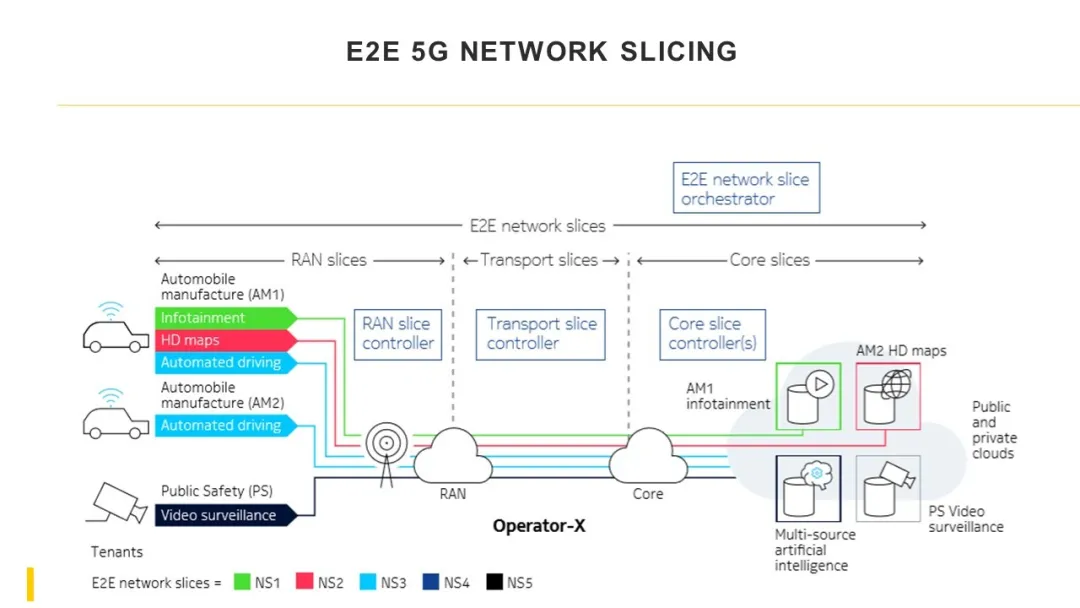
5G network slicing is fundamentally an end-to-end (E2E) concept that connects user equipment to tenant-specific applications. An E2E network slice comprises RAN slicing, core slicing, and transport slicing. Each network domain has its own slice controller to help meet the E2E SLA for the overall 5G network.
Soft and hard slicing
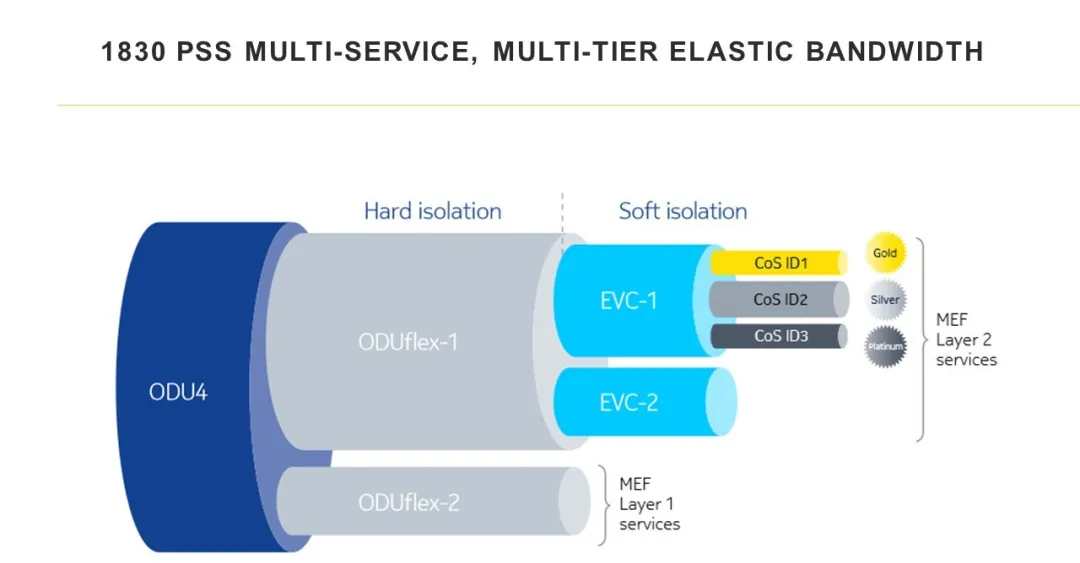
Operators must ensure that traffic on one slice does not interfere with another slice's performance. This requires traffic isolation mechanisms, which are typically divided into hard isolation and soft isolation, commonly referred to as hard slicing and soft slicing.
Soft slicing
Soft slicing means sharing the same physical infrastructure while creating logical partitions between customers, providing a lower level of traffic isolation. From an IP/MPLS network perspective, soft slicing is not a new concept. Traditional L3VPN can be seen as an example of soft slicing in MPLS networks. A VPN can be considered as a set of tunnels connecting customer sites; each site may have different QoS handling, and all traffic to and from the site is internal to the customer. In VPN services, the service provider configures routing policies on shared physical infrastructure to ensure logical separation of each customer's traffic.
At the MPLS level, network slicing can be implemented using mechanisms such as virtual routing and forwarding (VRF), which enables multiple routing instances over a shared MPLS transport network, and virtual switching instances (VSI), which enable multiple switching environments on the same shared infrastructure. Each physical router can host multiple VRFs and VSIs, effectively partitioning the device into multiple routing and switching environments assignable to different tenants or services.
Hard slicing
Hard slicing refers to providing dedicated resources for a specific network slice instance. The main difference between hard and soft slicing is that hard slicing dedicates resources exclusively to a single slice, while soft slicing allows shared use of resources. Allocating dedicated, non-shared resources to each network slice instance can guarantee the performance, availability, and reliability required by each application or customer. However, if these resources are not fully utilized they cannot be used by other slices, which may not be cost-effective. Soft slicing allows controllable overbooking of transport resources, enabling more economical use of network capacity for high-volume applications with looser constraints.
Key transport technologies: OTN and FlexE
OTN
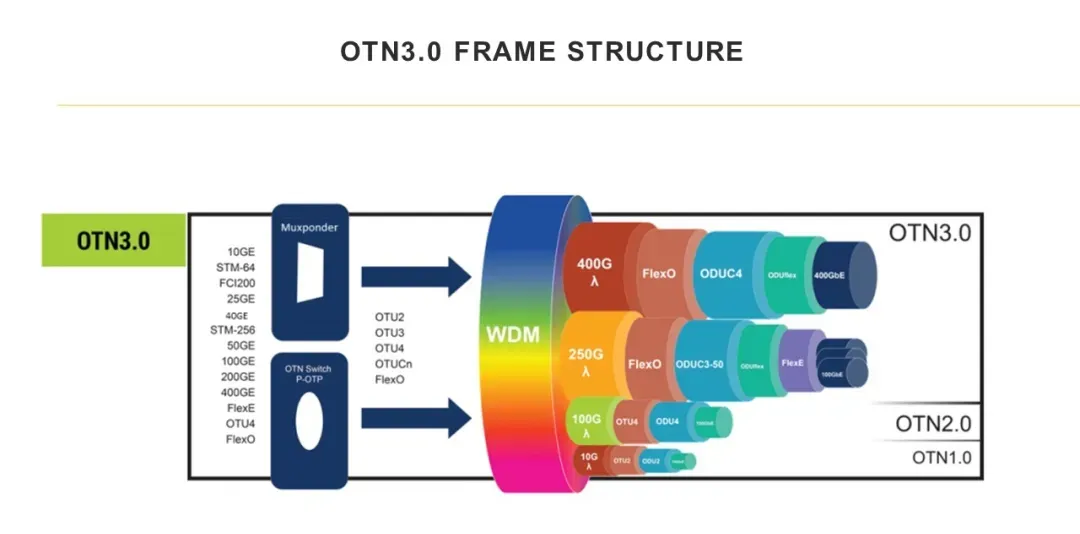
OTN has long played an important role in optical networks. Its transparent transport, comprehensive OAM, and protection capabilities can meet the quality requirements of new services. In addition, OTN provides an efficient way to multiplex different services onto optical paths. How to use OTN to carry FlexE is a relevant question for transport design.
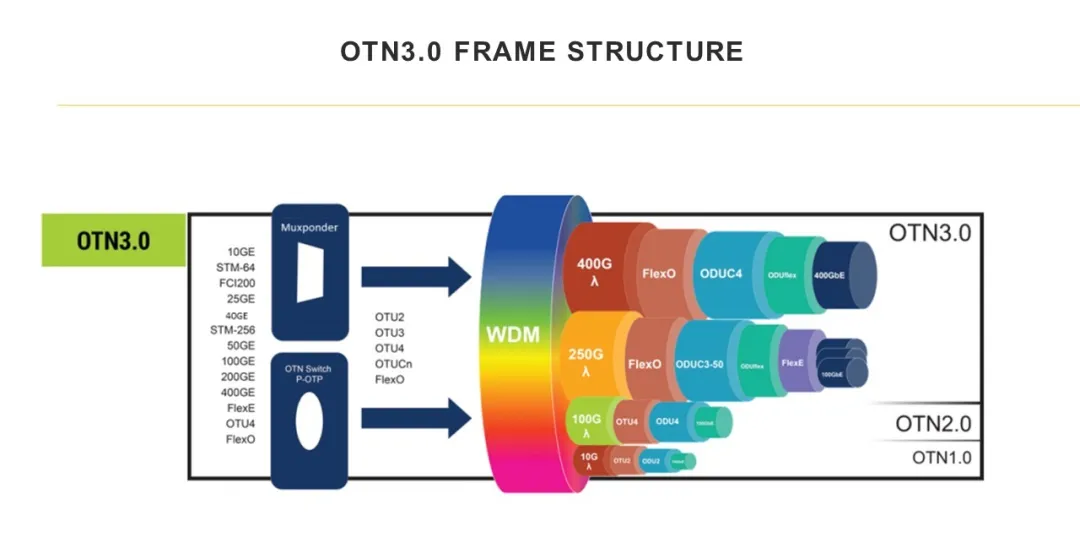
Today, many services and applications generate bursty and unpredictable traffic patterns, with widely varying and stricter requirements for bandwidth and data transport performance. OTN is an important part of the 5G network architecture. To enable customized services and fine-grained control of network resources that meet higher performance requirements for 5G services, resources must be allocated according to SLAs, thus enabling OTN network slicing.
OTN transparently encapsulates each client payload into a container for transport across the optical network while preserving the client's native structure, timing, and management information. OTN's enhanced multiplexing capability allows different traffic types to be carried within a single optical transport unit frame, including Ethernet, storage, and digital video, as well as SONET/SDH. Because OTN is fully transparent, it can be adapted to existing services with minimal impact.
FlexE
Ethernet, as a statistical multiplexing technology, allows services to share the full interface bandwidth, maximizing utilization and simplifying deployment. However, this characteristic makes strict isolation between services difficult and prevents reserving deterministic bandwidth for different services, so Ethernet alone cannot meet the requirements of traditional transport networks built with SDH/OTN technologies. As SDH development plateaued at STM-64 (40G) and OTN evolved toward high bandwidths, support for lower-granularity, lower-bandwidth enterprise transport needs lagged, creating a gap between these traditional leased-line demands and transport evolution.
FlexE was developed on top of Ethernet to meet requirements for high-rate transport and flexible bandwidth allocation. The adoption of FlexE has led some operators to consider separating traffic at the physical layer. Using strict time-division multiplexing channelization, FlexE enables physical-layer slicing with strong isolation. Today, Ethernet-based transport can separate different service types within the same transport path or port.
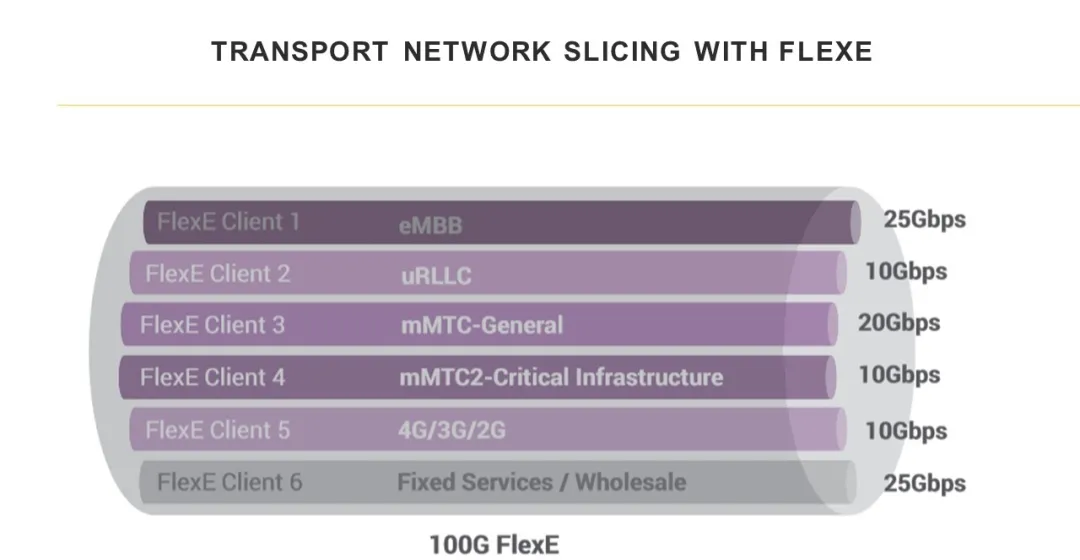
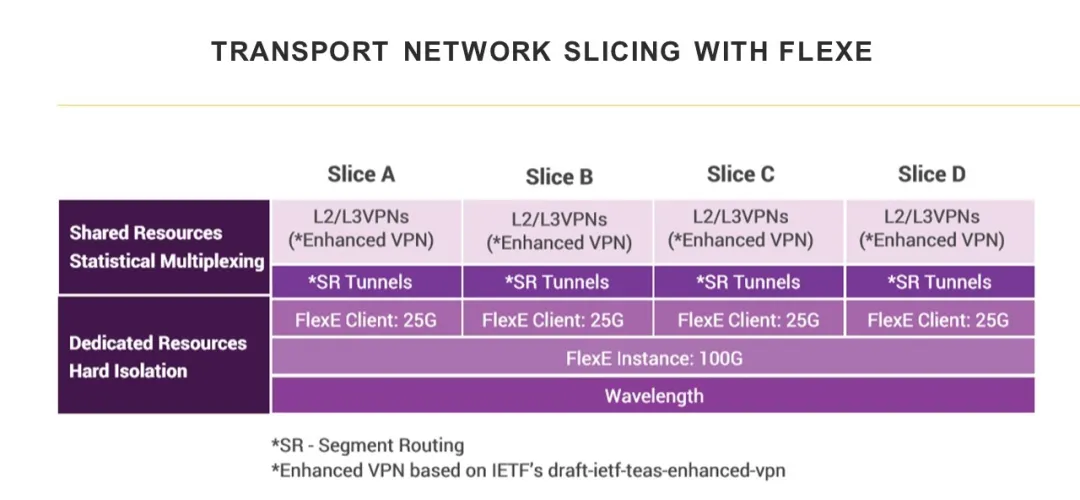
For example, a 100G FlexE group can be partitioned into six slices corresponding to six FlexE clients, each carrying a particular service type. FlexE can provide strong isolation of network resources, ensuring that traffic from one FlexE client does not affect others. By encapsulating more slices within FlexE, wavelength capacity can be optimized. When FlexE is coupled with higher-layer layer-2 and layer-3 overlay technologies, traffic engineering and QoS can achieve further optimization. The following example illustrates how a 100G FlexE instance on a wavelength can carry four network slices while balancing hard isolation and statistical multiplexing.
Conclusion
OTN (ITU-T G.709) standards and equipment have historically focused on providing absolute transport guarantees in networks. OTN, based on time-division multiplexing (TDM), can deliver zero packet loss and low-latency packet transport. However, OTN does not support statistical multiplexing and therefore cannot utilize capacity as efficiently as Ethernet.
FlexE, as a transport technology that enables hardware-level slicing, aligns with 5G requirements for large bandwidth, slicing, and physical isolation of services. It provides technical support for operators building transport infrastructure suited to long-term 5G service requirements. Major operators have identified FlexE as a foundational transport technology and included it in next-generation transport network specifications. Although FlexE currently meets high-bandwidth, coarse-granularity backbone needs, work continues to support lower-speed Ethernet interfaces and finer-grained slices.