Europe has taken a leading stance on the development of sixth-generation mobile communication (6G). Earlier this year, the CEA Leti announced a pan-European NEW-6G initiative intended to adopt a broad approach that integrates multiple technologies, domains, and disciplines to support next-generation wireless connectivity and lay the groundwork for future networks. NEW-6G will reassess nanotechnology roadmaps, encourage collaboration, and promote the emergence of new 6G innovations across the research community.
When will B5G/6G networks be deployed?
As part of demonstrations of scalable, intelligent wireless connectivity enabled by RIS, the pan-European project will address the design of key hardware building blocks and their integration into future B5G (beyond 5G)/6G networks. This work aims to create new service and business opportunities in the global B5G/6G competition and to help maintain technological leadership.
Deployment of B5G/6G networks is expected to begin toward the end of this decade, around 2030, providing the foundation for a human-centered intelligent society and vertical industries. To reach this goal, the network will transition sustainably to a distributed intelligent connectivity infrastructure, with new kinds of endpoints such as mirrors, signage, and walls embedded into the environment.
Beyond regulatory and specific user-, service-, and location-based requirements, targeted innovations will include highly flexible and dynamic end-to-end connectivity and computing systems to accommodate evolving and heterogeneous applications.
What can 6G provide?
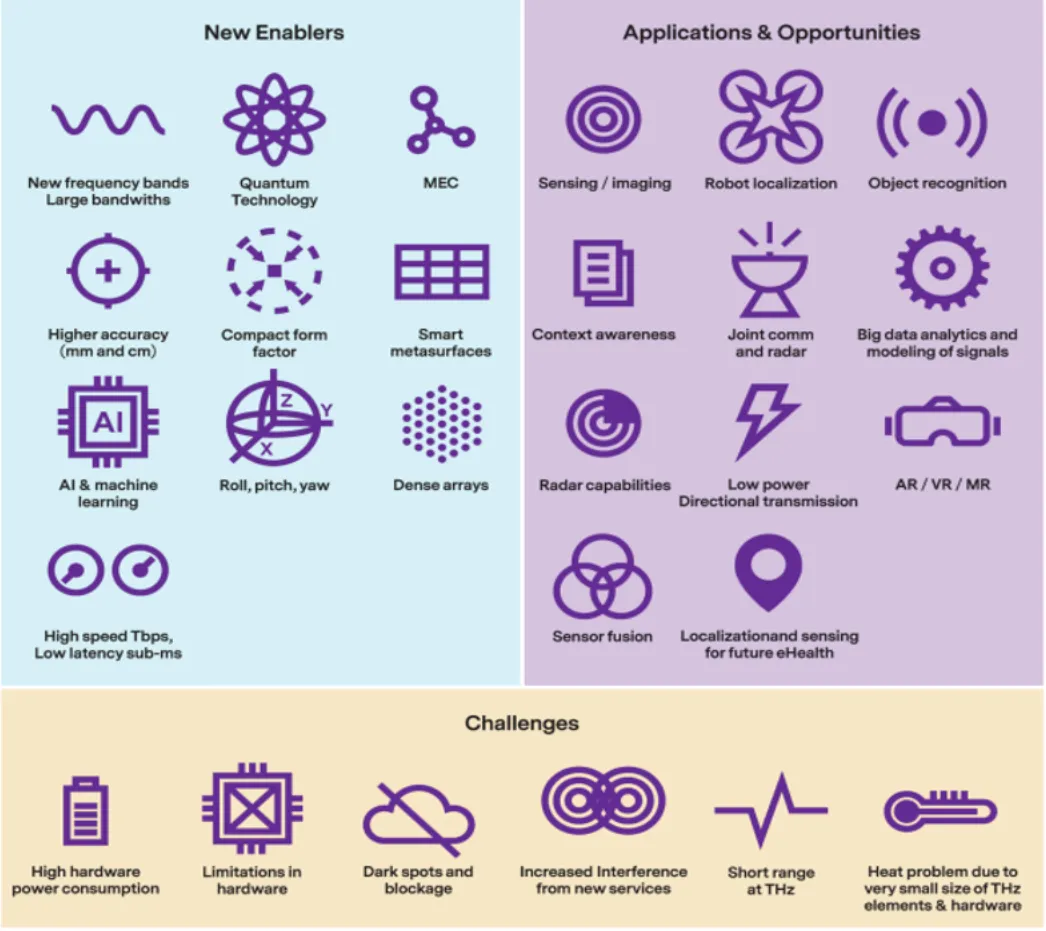
6G systems are expected to be truly intelligent wireless systems that not only deliver ubiquitous communication but also provide high-precision positioning and high-resolution sensing services. Positioning and sensing will coexist with communication, sharing available time, frequency, and spatial resources.
Applications such as THz imaging and spectroscopy could enable continuous, real-time physiological measurements through dynamic, noninvasive, noncontact sensing, supporting future digital health technologies. 6G synchronized localization and mapping (SLAM) methods can enable advanced extended reality (XR) applications and improve navigation for vehicles and drones.
In converged 6G radar and communication systems, passive and active radar will jointly use and share information to provide detailed and accurate virtual environment images. Intelligent, context-aware networks will be able to use positioning and sensing information to optimize deployment, operation, and energy use with little or no human intervention.
Positioning and sensing information from mobile communication systems has many applications, from improved emergency-call (911) localization to through-wall intruder detection, from personal navigation to personal radar, and from robot and drone tracking to social networking. Location-side information can also boost the design, operation, and optimization of communication networks.
6G sensing, enabling technologies, and challenges
Four emerging technology enablers will shape 6G communication, positioning, and sensing systems. In addition to artificial intelligence (AI) and machine learning (ML), these include new radio frequency bands, intelligent surfaces, and intelligent beamspace processing.
New positioning and sensing services
6G radios may allocate channel bandwidths at least five times larger than 5G to meet growing data rate and reliability demands and to support new services such as sensing and localization.
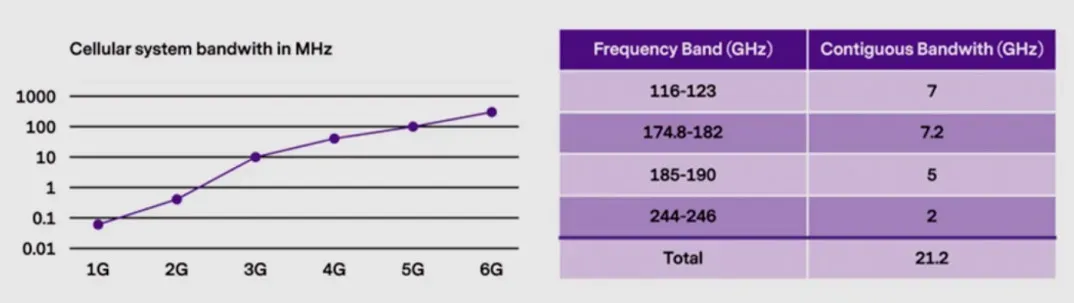
From a positioning and sensing viewpoint, moving to terahertz frequencies offers several benefits:
-Signals at these frequencies do not penetrate objects, producing a more direct relationship between propagation paths and environmental geometry.
-Greater absolute bandwidth at higher frequencies allows more resolvable multipath components in the delay domain, enabling finer temporal resolution.
-Shorter wavelengths mean smaller antennas, so compact devices can host dozens or hundreds of antenna elements, which aids angle estimation.
Chip technology challenges
The high-speed links offered by 6G will enable fast, reliable sharing of maps and location information between sensors, benefiting both active and passive sensing. To exploit these advantages, chip technology must support economies of scale. Appropriate channel models will also be required to describe 6G wave propagation in hardware and over-the-air environments for new solutions and algorithm development.
Initial 6G-related spectrum coverage spans roughly 0.3–3 THz, while regulators have begun to permit research up to 250 GHz. This creates integration challenges for chip technology.
Current radios operating in multiple 100 GHz bands typically include antennas and signal-processing equipment too large to integrate into typical user equipment (UE). As systems move beyond mmWave, silicon products for UE have matured, but mmWave frequencies add complexity to the air interface and require array techniques for UE-side beamforming.
Although 28 nm planar CMOS can achieve useful transition frequencies for 28 GHz and 39 GHz bands, it is unclear whether existing CMOS process technologies can efficiently operate at the higher frequencies expected for 6G. Even at 100 GHz, the same 28 nm CMOS processes cannot deliver the same signal amplification efficiency, so alternative technologies must be considered for cost-effective solutions. Research is exploring several technologies to achieve good output power and efficiency at higher frequencies, including GaAs, GaN, InP, CMOS, SiGe, and FD-SOI CMOS.
Reflection surfaces to enhance mapping and localization
Intelligent reflecting surfaces (IRS) are a disruptive technology that can enhance mapping and localization. Historically, the wireless propagation environment between transmitter and receiver has been considered a random, uncontrollable component of wireless systems. Reconfigurable intelligent surfaces offer a promising solution by controlling channel properties such as scattering, reflection, and refraction. IRS allows network operators to shape an object's electromagnetic response dynamically by adjusting parameters such as phase, amplitude, frequency, and polarization without complex decoding, encoding, or RF operations. In practice, IRS can be implemented with traditional reflector arrays, liquid-crystal layers, or software-defined metasurfaces. IRS-assisted communications have the potential to enable low-complexity, energy-efficient communication modes.
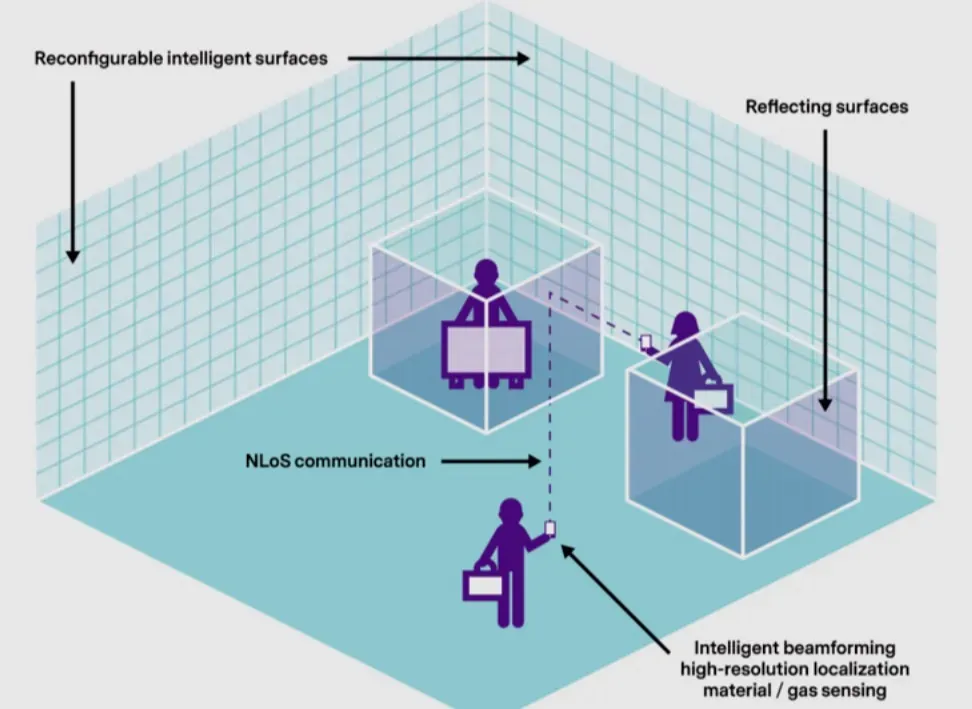
Challenges for IRS include the need for suitable models to describe the material properties of the composed surfaces and the propagation characteristics of incident waves. Practical realizations of reconfigurable metasurfaces, considering both hardware and software, are essential to quantify their potential benefits in wireless systems.
IRS also requires channel state information (CSI) between communication nodes to properly adjust the radio properties of reflected signals. New energy-efficient methods must be designed to estimate wireless-link channel characteristics. Deployment strategies are needed to determine appropriate IRS placement within a coverage area. Additionally, new signal-processing techniques are required to optimize joint communication, sensing, and localization performance assisted by IRS. These challenges are particularly acute at high frequencies, where channels tend to be low-rank and carry less information.
Beamspace processing for precise localization
Beamspace processing is a promising enabler for 6G localization and sensing. Beamforming in the millimeter and submillimeter bands transmits coherent signals concentrated in a direction to create a focused field, increasing signal-to-noise ratio or throughput through beamforming gain. Enhanced 3D beamforming helps overcome high path loss in mmWave and submillimeter bands and mitigates interference by forming very narrow beams. Beamspace channel responses collected by single or multiple transmitters and receivers contain spatial information about the endpoints and about interacting objects or people; processing these responses can support localization and sensing.
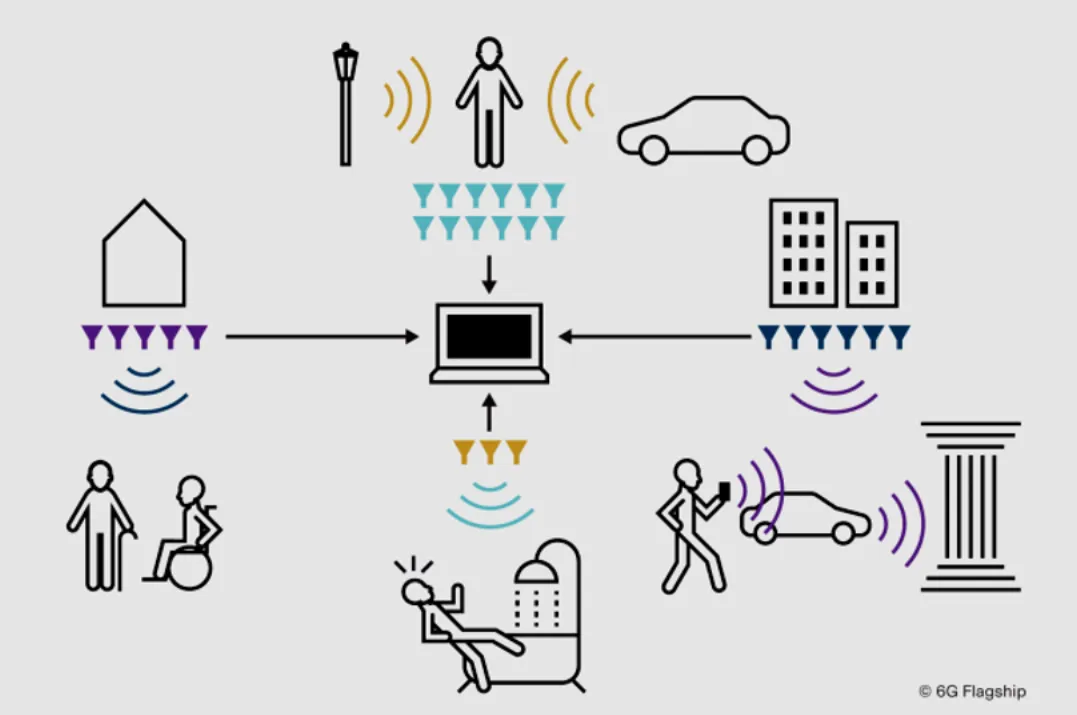
An important challenge in beamspace processing is blockage. In distributed topologies, cooperative multi-antenna systems manage mixed beamspace and locate passive and active targets. Links between multi-antenna systems and active targets can be LOS or NLOS and can be blocked by moving background objects.
For example, deep fades caused by high-mobility background objects can degrade localization accuracy. Under deep fading, mobile anchor services may temporarily switch localization and sensing functions to another anchor. To coordinate available resources for real-time localization and tracking across a target area, it is necessary to prevent sharp drops in beamspace signal quality triggered by movable background-object blockage. This can be addressed through image-based motion prediction, geometric environment recognition, and wireless channel simulation, ideally operating within millisecond timescales.
In high-mobility scenarios, observing moving background objects that might block beamspace—using depth cameras, for example—can enable real-time learning and prediction of their trajectories. Ray-tracing simulations or hybrid methods that combine ray tracing with propagation graphs can then predict potential impacts on the beamspace channel.
ML-based intelligent localization and sensing
AI techniques are increasingly important for the data-rich 6G era. A broad research area concerns how to build intelligent systems that achieve goals under uncertainty using logical and probabilistic reasoning, planning, and optimization.
Modern AI systems are often based on machine learning and use data-driven, multidisciplinary methods to learn models beyond explicit programming rules. 6G systems will rely on such data-driven algorithms not only for wireless communications but also to enable advanced localization and sensing techniques across mmWave and submillimeter frequency ranges.
In localization, ML methods have focused on fingerprinting and regression/classification approaches. In data-rich and complex positioning applications, especially where GNSS performs poorly in indoor and dense urban channels, the use of ML is expected to expand.
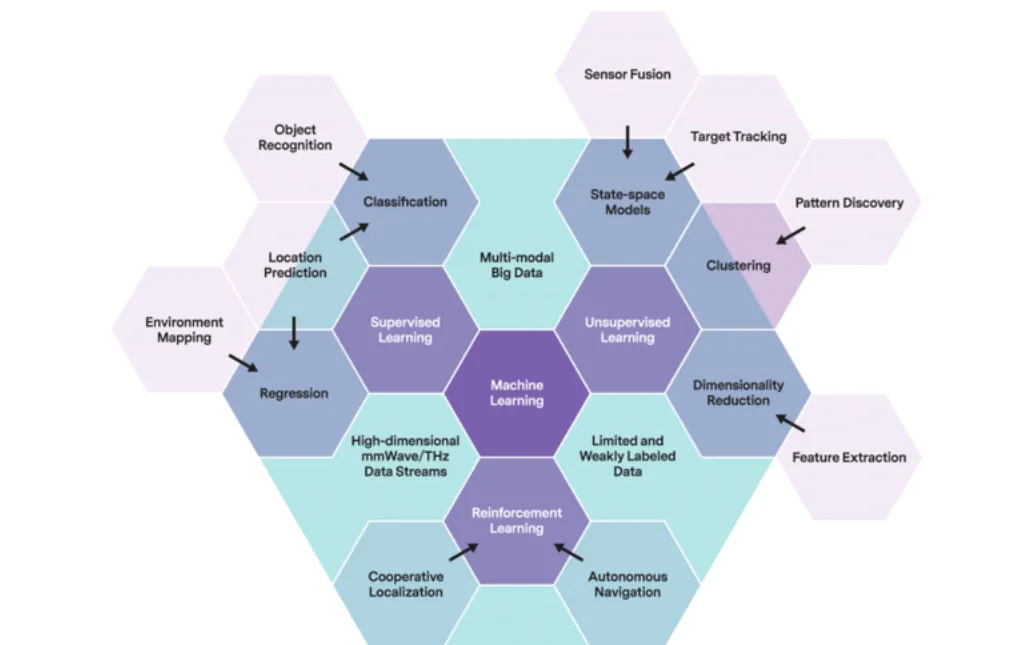
For sensing, RF-based techniques at high carrier frequencies can provide more precise measurements of the environment and better object detection and identification. Wider spectral coverage will enable sensing and recognition of new types of objects and variables that are undetectable in currently used bands.
Conclusion
Advanced beamspace processing in 6G can track users and objects and build environmental maps. Broad application of AI can leverage unprecedented data and compute resources to address fundamental problems in wireless systems. Advances in signal processing can support new converged communication and radar applications.
Achieving these goals will be more challenging than for any previous generation of mobile communications and will require collaborative efforts across many scientific disciplines.