Introduction
Surface-mount technology (SMT) has revolutionized electronics manufacturing with its compact, high-density assemblies. However, defects or failures in components like BGAs and QFNs often require precise rework to restore functionality. Advanced SMT rework techniques enable engineers to remove, repair, and replace these components without compromising board integrity. This guide delves into key processes such as the BGA rework process, QFN rework techniques, component removal and replacement, solder paste application for rework, and rework station calibration. Mastering these methods ensures compliance with industry standards and minimizes downtime in production environments. Professional engineers rely on these skills to handle complex assemblies in prototypes, repairs, and high-reliability applications.
Understanding SMT Rework and Its Critical Role
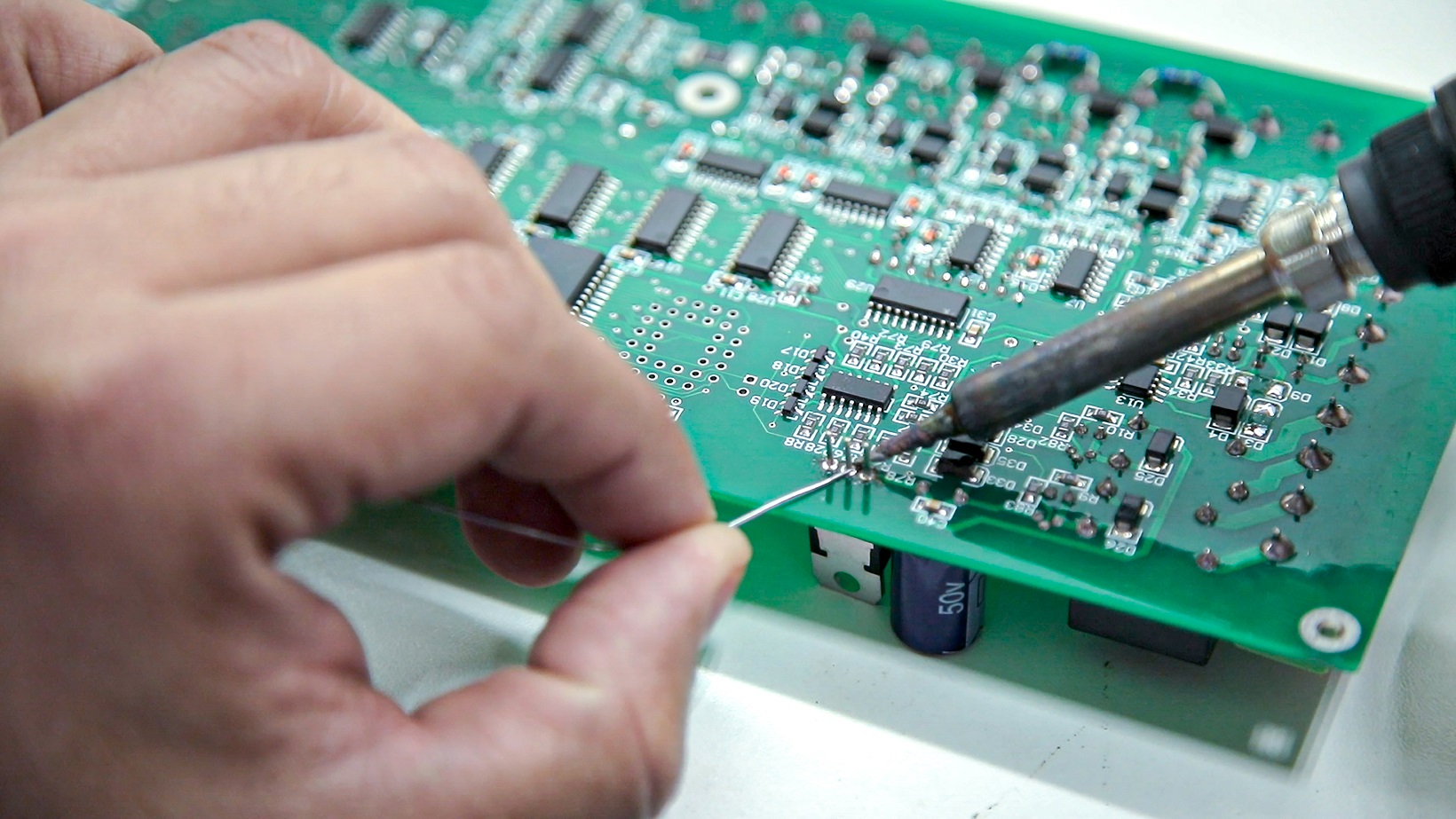
SMT rework involves the selective heating, removal, cleaning, and reinstallation of surface-mount devices on printed circuit boards. It addresses issues like solder joint cracks, component shifts, or bridging that arise during initial assembly or from operational stresses. In high-volume manufacturing, rework prevents costly scrapping of entire boards, especially for multilayer PCBs with fine-pitch parts. Engineers must consider thermal management to avoid damaging nearby components or warping the substrate. This process aligns with requirements in standards like IPC J-STD-001 for soldered assemblies, emphasizing controlled heating and material compatibility. Ultimately, effective rework extends product life cycles and supports iterative design improvements.
The relevance of SMT rework grows with shrinking component sizes and lead-free solders, which demand tighter process windows. Failures in BGAs or QFNs can stem from reflow profile mismatches or handling errors, making rework indispensable for yield optimization. Professional engineers use it in failure analysis, where root causes like voids or delamination are identified post-removal. Proper execution reduces risks of pad lifting or trace damage, preserving electrical performance. By integrating rework into quality control, teams achieve higher first-pass yields and faster time-to-market.
Core Technical Principles of SMT Rework
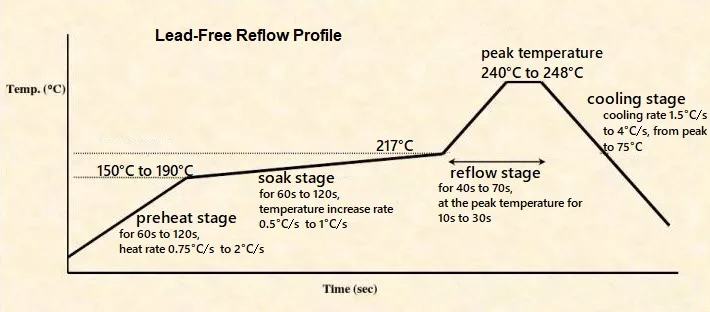
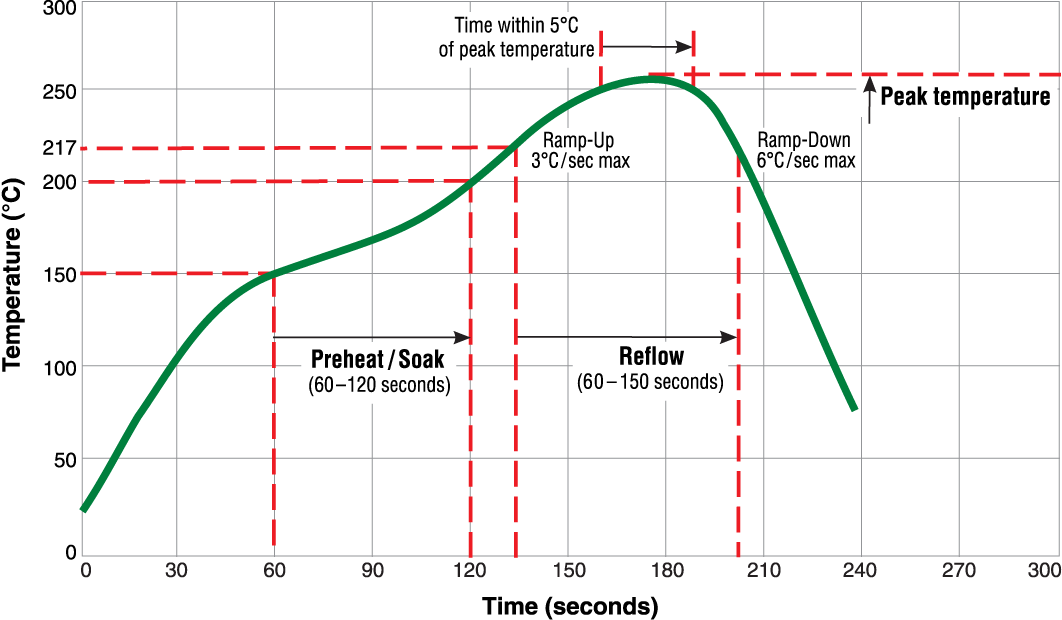
Effective SMT rework hinges on understanding heat transfer mechanisms, primarily convection and conduction, to achieve uniform reflow without overheating. Preheat stages stabilize the board temperature, reducing thermal shock to components and preventing popcorn effects in moisture-sensitive devices. Reflow then melts solder joints precisely, while post-cooling controls contraction to minimize stresses. Engineers profile these stages using thermocouples placed at critical sites, such as under the component and on adjacent parts. Adherence to guidelines in IPC-7711/7721 ensures procedures for procedures like component removal maintain pad integrity. These principles apply universally to BGA and QFN packages, where bottom-side terminations complicate access.
Material interactions play a key role, with flux activating surfaces for oxide removal and solder paste providing fresh alloy for joints. Thermal gradients must stay below thresholds to avoid intermetallic growth or brittleness in lead-free systems. Board warpage, influenced by copper imbalance or CTE mismatches, requires monitoring during heating. Engineers select nozzles and airflow patterns to localize heat, protecting sensitive ICs nearby. Cooling rates influence microstructure formation, affecting long-term reliability under vibration or thermal cycling. Mastering these fundamentals enables consistent results across diverse assemblies.
The BGA Rework Process: Step-by-Step Engineering Approach
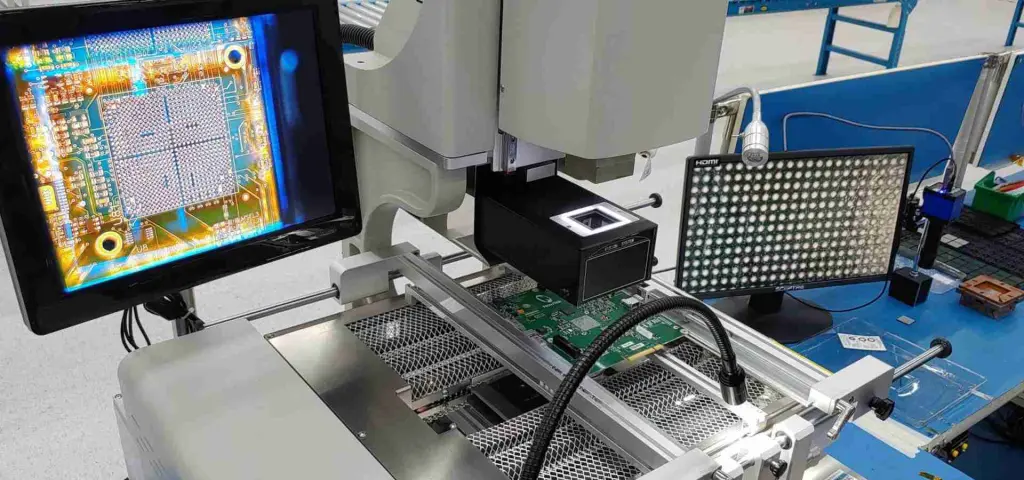
The BGA rework process begins with site preparation, inspecting the ball grid array for defects like head-in-pillow or voids via X-ray or endoscopy. Engineers apply flux to the underside, then use a top-heater aligned with bottom preheating for controlled removal. Lifting the BGA reveals pads for cleaning with braid or hot air to remove residual solder without eroding copper. Reballing the component, if needed, involves stencil printing of solder spheres, followed by reflow to form uniform balls. Replacement requires precise alignment using vision systems, with solder paste or preforms applied to pads before final reflow. Post-rework inspection verifies joint fillet formation and coplanarity.
Challenges in BGA rework include maintaining ball shear strength and minimizing underfill voids during subsequent encapsulation. Thermal profiling ensures peak temperatures align with alloy melting points, typically managed through multi-zone stations. Engineers adjust dwell times to liquify solder fully without bridging to adjacent balls. Handling warpage involves fixturing the board flat, especially for large panels. This process demands iterative validation to match original assembly conditions. Success metrics focus on void percentages and electrical continuity tests.
QFN Rework Techniques for Precision Handling
QFN rework techniques address the leadless design's exposed pad, which integrates thermal and ground connections prone to tombstoning or insufficient solder volume. Initial removal uses focused hot air or IR to reflow peripheral leads and central pad simultaneously, avoiding pad delamination. Post-removal, the site demands meticulous cleaning of the large thermal pad residue using specialized wicks or vacuums. Solder paste application for rework targets both perimeter lands and exposed pad, often with stencils for uniform deposit. Alignment during replacement accounts for self-centering via surface tension, but vision aids prevent offsets. Cooling under controlled nitrogen flow reduces oxidation on the pad.
Unique to QFNs, techniques emphasize paddle solder flow to ensure void-free central joints, critical for heat dissipation. Engineers profile bottom heaters to match the pad's larger thermal mass, preventing overheating of fine-pitch leads. IPC-7711/7721 outlines specific procedures, such as procedure 5.7 for leadless components, guiding flux selection and heat application. Troubleshooting incomplete reflow involves adjusting standoff heights or paste viscosity. These methods enhance reliability in power management circuits where QFNs prevail. Validation includes dye-and-peel tests for void quantification.
Component Removal and Replacement Best Practices
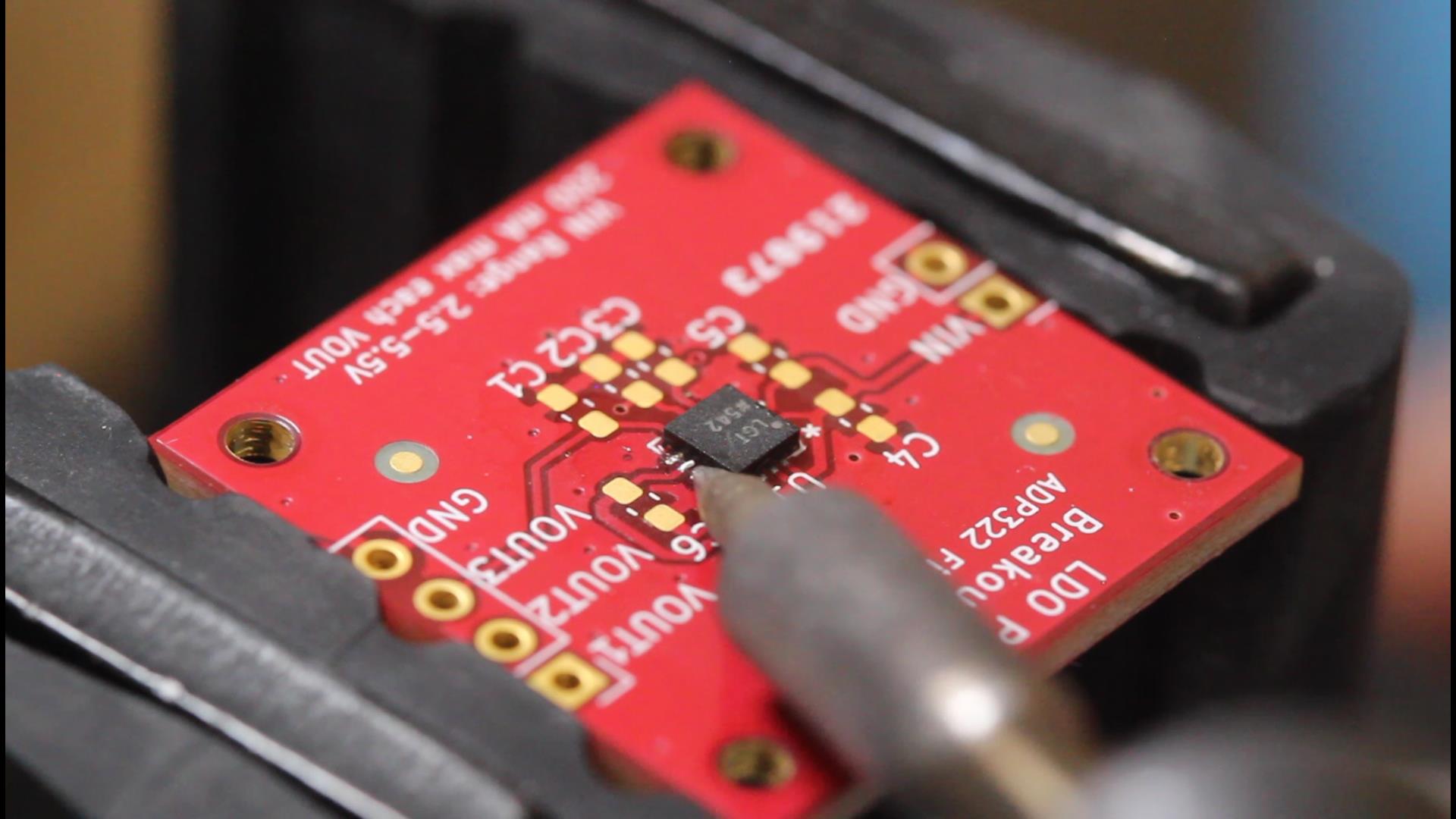
Component removal starts with fluxing to enhance wetting, followed by localized heating to melt joints without disturbing neighbors. For diverse packages, engineers select nozzle sizes matching footprint, applying vacuum pickup post-reflow. Board support jigs prevent flexing during lift-off, crucial for thin flex circuits. Cleaning employs desoldering braid dragged under controlled temperature to preserve pad flatness. Replacement begins with site redressment, ensuring coplanarity via profilometers if available. Placement uses split-vision optics for micron-level accuracy before reflow.
Replacement success relies on matching original process parameters, including ramp rates and peak exposures. Solder paste application for rework employs mini-stencils or needles for precise volume control, avoiding excess that causes bridging. Engineers verify standoff post-placement to promote fillet formation. Nitrogen atmospheres during reflow suppress dross and improve wetting on oxidized surfaces. Post-process shear testing confirms joint integrity. These practices scale from prototypes to high-mix production.
Solder Paste Application for Rework: Optimization Strategies
Solder paste application for rework requires type-specific selection, favoring no-clean formulations with fine particle sizes for mini-pads. Stencil printing ensures consistent volume, with apertures designed per pad geometry to prevent starving or bridging. For irregular sites, pneumatic dispensers deposit paste uniformly, followed by leveling with blades. Engineers inspect deposits via shadow moire for height uniformity before placement. Reflow profiles activate the paste flux, promoting alloy flow into vias or under components. Inspection post-reflow checks for consistent meniscus shapes.
Challenges include paste slump on large pads, mitigated by lower-temperature preheats. Viscosity matching to alloy type prevents separation during application. In QFN cases, central pad printing demands higher volumes without overflow to leads. Documentation of paste lot and stencil wear aids repeatability. These strategies align with J-STD-001 cleanliness criteria, reducing ionic residues. Optimized application boosts first-time yield in rework cycles.
Rework Station Calibration: Ensuring Process Control
Rework station calibration verifies heater uniformity, airflow rates, and thermocouple accuracy to maintain profile fidelity. Engineers use daisy-chain boards with embedded sensors to map temperature deltas across zones. Nozzle alignment checks via laser targets prevent offsets during placement. Vacuum levels calibrate for secure component hold without crushing. Software validation confirms ramp, soak, and peak timings per recipe. Periodic fiducial recognition tests ensure vision system precision.
Calibration intervals tie to usage, with daily offsets and quarterly full profiles. Air velocity probes quantify convection efficiency, adjusting for orifice wear. Firmware updates incorporate lead-free profiles. Documentation logs serial numbers and test data for traceability. Proper calibration underpins compliance with IPC standards, minimizing variability. Stations thus deliver repeatable results for BGA rework processes and beyond.
Troubleshooting Common Rework Challenges
Warpage during rework manifests as non-planar joints, addressed by symmetric fixturing and lower peak temps. Bridging from excess paste resolves via selective drag soldering post-reflow. Insufficient wetting on QFN pads indicates flux incompatibility, remedied by higher activation types. Voids in BGA balls trace to trapped flux, mitigated by extended reflow dwells. Pad lifting signals excessive bottom heating, requiring zone isolation. Systematic logging of failures refines profiles iteratively.
Lift-off of peripheral leads in QFNs stems from uneven heating, countered by multi-orifice nozzles. Electrical opens post-rework prompt continuity mapping before disassembly. Contamination from unclean sites causes dewetting, emphasizing IPA wipes. Engineers correlate defects to profiles using K-type thermocouples. Root cause analysis via cross-sections reveals intermetallics or cracks. Proactive measures like moisture baking prevent latent failures.
Conclusion
Advanced SMT rework techniques empower engineers to tackle complex assemblies with confidence. From the BGA rework process to QFN rework techniques, each step demands precision in heat control, material handling, and inspection. Component removal and replacement, paired with solder paste application for rework and meticulous station calibration, form the backbone of reliable outcomes. Adhering to standards like IPC-7711/7721 elevates practices from reactive to predictive. These methods not only salvage boards but enhance overall process maturity. Engineers applying this guide achieve superior yields and durability in demanding applications.
FAQs
Q1: What are the key steps in the BGA rework process?
A1: The BGA rework process includes site inspection, flux application, controlled heating for removal, pad cleaning, reballing or paste application, precise alignment, reflow, and final verification. Engineers profile temperatures to protect adjacent components and ensure uniform melting. Post-process X-ray checks voids and alignment. This sequence, guided by IPC procedures, minimizes risks like warpage. Overall, it restores functionality efficiently.
Q2: How do QFN rework techniques differ from standard SMT removal?
A2: QFN rework techniques focus on the exposed thermal pad, requiring simultaneous heating of perimeter leads and center ground plane to avoid delamination. Cleaning demands specialized tools for residue removal without pad erosion. Solder paste volumes balance pad and lead wetting. Alignment leverages surface tension but needs vision aids. These steps ensure void-free joints critical for thermal performance, per industry rework guidelines.
Q3: Why is rework station calibration essential for component removal and replacement?
A3: Rework station calibration maintains thermal uniformity and placement accuracy, preventing defects like bridging or offsets during component removal and replacement. It verifies airflow, vacuum, and profiles against baselines. Inconsistent calibration leads to variable joint quality. Regular checks support traceability and compliance. Engineers gain confidence in scaling processes for high-density boards.
Q4: What factors optimize solder paste application for rework?
A4: Solder paste application for rework optimizes through stencil design matching pad geometry, correct viscosity for no slump, and volume control via inspection. Flux activation during reflow ensures wetting. Fine particles suit mini-pads in QFNs and BGAs. Pre- and post-deposit checks prevent issues like starving. This yields reliable fillets and minimizes rework cycles.
References
IPC-7711C/7721C — Rework, Modification and Repair of Electronic Assemblies. IPC, 2018
IPC J-STD-001J — Requirements for Soldered Electrical and Electronic Assemblies. IPC, 2024
IPC-A-610H — Acceptability of Electronic Assemblies. IPC, 2019