Introduction
OLED displays have become the preferred choice in wearable display technology due to their superior contrast ratios and flexibility, making them ideal for devices like smartwatches. However, optimizing OLED power consumption remains a critical challenge, as these displays can significantly impact OLED battery life in power-constrained environments. Engineers must balance high image quality with energy efficiency to ensure prolonged usage without frequent recharging. Factors such as pixel luminance, content type, and driving circuitry all influence performance. In wearable devices, where battery capacity is limited, even small improvements in power management can extend operational time substantially. This article explores technical strategies for enhancing both power efficiency and visual fidelity in OLED implementations.
Understanding OLED Technology in Wearable Devices
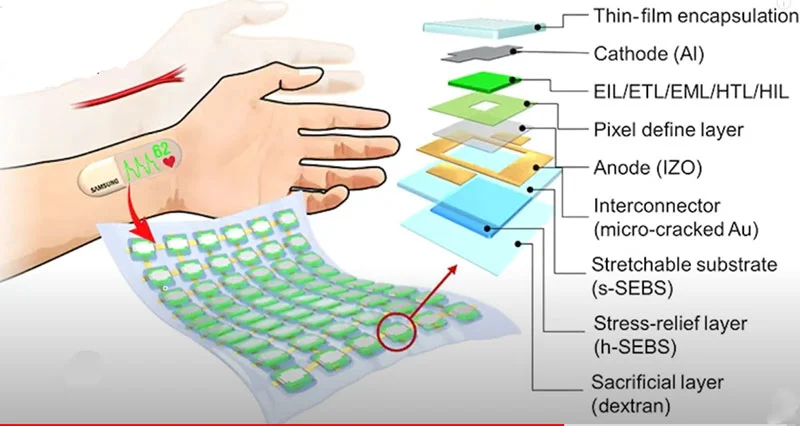
OLED technology relies on organic compounds that emit light when an electric current passes through them, enabling self-emissive pixels without backlights. This structure allows for true blacks by turning off individual pixels, a key advantage in wearable display technology over LCD alternatives. In smartwatches, OLED panels are often implemented as active-matrix OLED (AMOLED), where thin-film transistors control each pixel for faster response times. The thin, lightweight nature of OLED suits curved and flexible form factors common in wearables. However, variability in subpixel efficiency, particularly lower performance in blue emitters, poses challenges for uniform brightness and longevity. Engineers designing for these devices must consider how PCB integration supports stable signal and power delivery to the display driver ICs.
Power consumption in OLED displays scales directly with the number of lit pixels and their brightness levels. Dark-themed interfaces consume less energy since black pixels draw no power, aligning well with always-on display features in smartwatches. Image quality benefits from infinite contrast and wide viewing angles, but burn-in risks arise from static content like watch faces. Wearable OLEDs typically operate at resolutions balancing visibility and efficiency, often around 300-500 pixels per inch. PCB layout plays a role here, ensuring minimal voltage drops that could degrade pixel uniformity. Adhering to standards like IPC-6013 for flexible printed boards helps maintain reliability in compact assemblies.
Key Factors Influencing OLED Power Consumption
OLED power consumption varies significantly based on displayed content, with bright, saturated images drawing more current than subdued ones. For instance, white or full-screen bright content activates all subpixels, leading to higher overall draw compared to dark backgrounds. Brightness levels, controlled via pulse-width modulation or DC dimming, directly affect energy use, as higher luminance requires greater drive currents. In wearables, ambient light sensors enable adaptive brightness, but improper calibration can lead to unnecessary power spikes. Resolution also impacts consumption; higher OLED screen resolution means more pixels to drive, increasing gate line loading and capacitive power losses. Refresh rates further contribute, with standard 60Hz modes consuming more than low-frequency options suited for static watch interfaces.
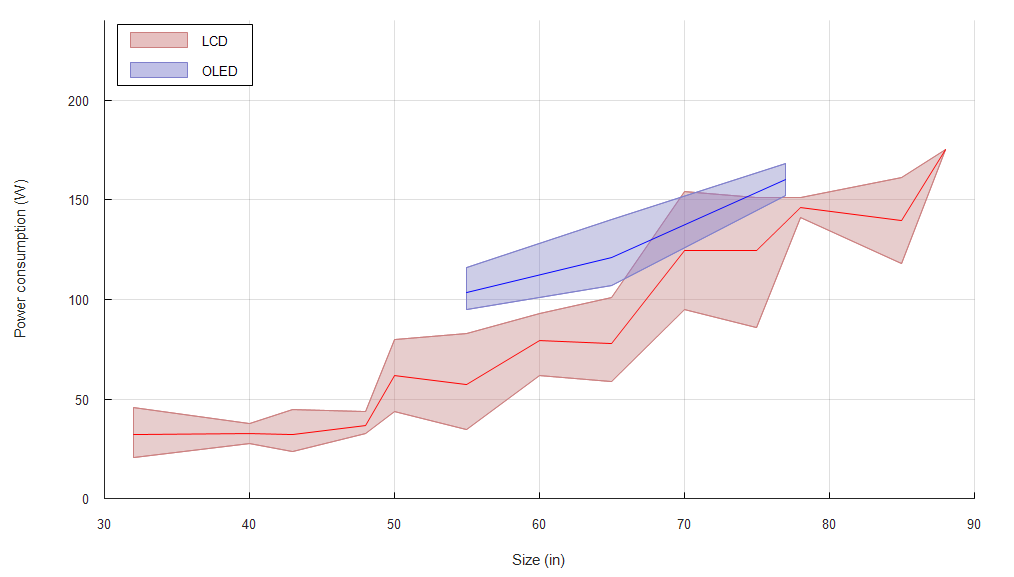
Signal integrity from the PCB to the display interface, such as MIPI D-PHY, influences efficiency by preventing data errors that force retries and extra power. Voltage stability is crucial, as fluctuations can cause overcompensation in pixel circuits, wasting energy. Temperature effects exacerbate this, as OLED efficiency drops at higher operating temperatures common in body-worn devices. JEDEC J-STD-020 guidelines for moisture sensitivity ensure component reliability under wearable stress conditions. Engineers must model these factors during design to predict real-world OLED power consumption accurately.
Strategies for Optimizing Power Efficiency
To improve OLED battery life, low-temperature polycrystalline oxide (LTPO) thin-film transistors enable variable refresh rates, dropping to 1Hz for always-on modes while ramping up for animations. Pixel compensation circuits, integrated into display drivers, adjust for threshold voltage shifts and mitigate degradation, maintaining efficiency over time. Software optimizations like dynamic dimming and content-aware power allocation reduce average consumption without compromising usability. Dark mode enforcement in user interfaces leverages OLED's pixel-off capability for blacks, significantly extending battery in smartwatches. Hardware-level techniques, such as efficient charge pumps in drivers, minimize conversion losses from battery voltage to pixel VDD.
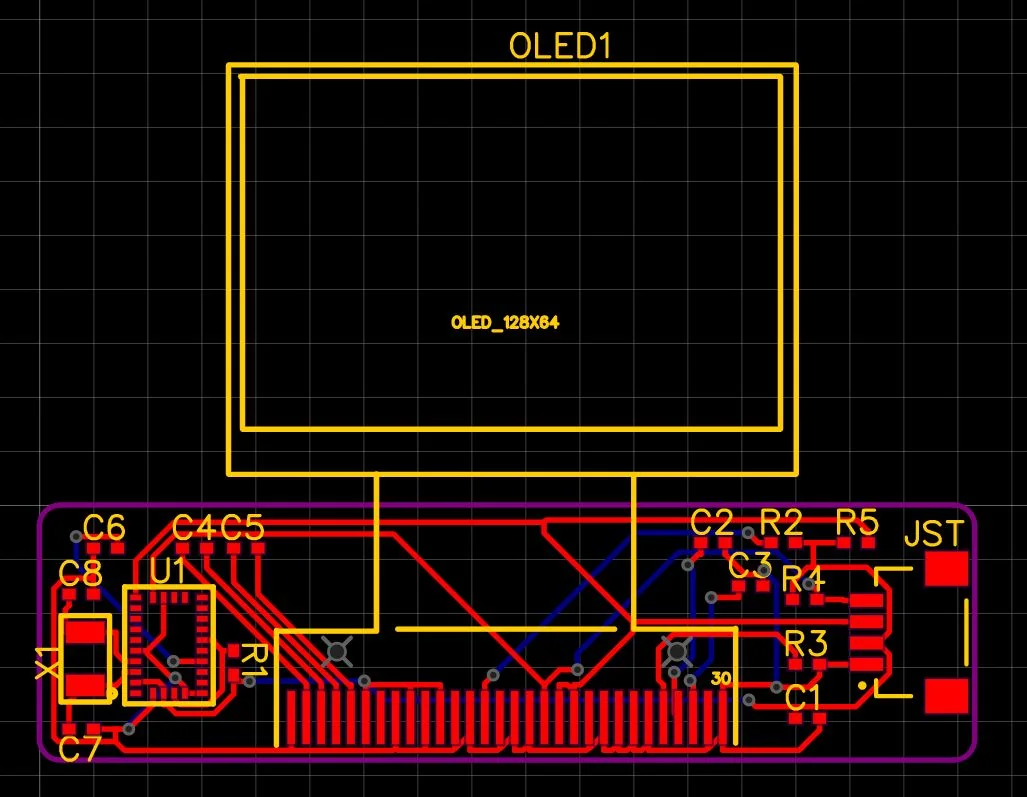
PCB design contributes substantially by optimizing power distribution networks with low-impedance planes and decoupling capacitors near the display connector. This reduces ripple and ensures clean supply rails, preventing efficiency losses from noise-induced current spikes. Flexible PCBs, qualified under IPC-6013, allow tight integration in curved housings, minimizing trace lengths for lower resistance. Advanced materials with low dielectric loss support high-frequency signals without added power draw. Thermal management vias on the PCB dissipate heat from driver ICs, preserving OLED efficiency. Combining these yields measurable gains in wearable OLED battery life.
Balancing Image Quality with Efficiency
High OLED screen resolution enhances sharpness for notifications and fitness data, but demands careful power budgeting due to increased pixel count. Engineers optimize pixel density for viewing distances in wearables, typically prioritizing 300-400 PPI over ultra-high definitions that yield diminishing returns. Uniformity compensation maps correct luminance variations across the panel, ensuring consistent image quality. Anti-burn-in algorithms shift static elements and limit peak brightness for prolonged logos or icons. Color gamut management, using wide-angle compensation, maintains vibrancy without excess blue subpixel drive.
IEC 62341 series standards define performance metrics for OLED modules, guiding measurements of luminance uniformity and power efficiency. These ensure displays meet reliability thresholds in dynamic wearable environments. Resolution scaling, where low-power modes render at reduced effective PPI, preserves battery while delivering acceptable visuals. Integration with touch layers adds minimal power overhead if driven efficiently via shared circuitry. PCB impedance matching for display data lines prevents reflections that degrade signal quality and force power-hungry error correction.
Best Practices for PCB Integration in OLED Wearables
Select flexible or rigid-flex PCBs to accommodate form factors, following IPC-6013 for qualification to withstand bending cycles. Route high-speed MIPI lanes with controlled impedance, typically 100 ohms differential, to maintain data integrity at high OLED screen resolutions. Place power regulators close to the display for minimal distribution losses, using multi-layer stacks for separated analog and digital grounds. Incorporate ESD protection diodes aligned with IEC standards for handling touch interactions. Simulate power integrity early to identify hotspots affecting OLED power consumption. These practices ensure robust performance in production wearables.
Conclusion
Optimizing OLED displays in wearables requires a holistic approach integrating display technology, software algorithms, and precise PCB engineering. Key gains come from content-adaptive power management, efficient driving schemes, and stable hardware platforms. By addressing OLED power consumption and image quality trade-offs, engineers can deliver devices with superior OLED battery life and user satisfaction. Adopting industry standards reinforces reliability across the supply chain.
FAQs
Q1: How does OLED power consumption affect battery life in smartwatches?
A1: OLED power consumption in smartwatches depends on brightness, content, and resolution, with dark interfaces consuming far less due to pixel shutoff. Higher brightness or white-heavy UIs increase draw, potentially halving battery life. Optimization via LTPO and adaptive refresh rates can extend usage by reducing average power. PCB power stability further minimizes waste, aligning with wearable display technology demands.
Q2: What role does OLED screen resolution play in wearable power efficiency?
A2: Higher OLED screen resolution improves image sharpness but raises power needs from more driven pixels and higher capacitive loads. In wearables, balancing 300-400 PPI optimizes visibility without excessive consumption. Lower effective resolution in low-power modes preserves OLED battery life. Engineers model trade-offs during design for efficient wearable display technology.
Q3: Why is PCB design critical for OLED performance in wearables?
A3: PCB design ensures voltage stability and signal integrity, preventing power losses that degrade OLED efficiency. Flexible layouts per IPC-6013 support compact integration, while low-impedance paths reduce drops. Proper decoupling curbs noise, aiding uniform image quality. This foundation enhances overall OLED power consumption management.
Q4: How can engineers improve image quality without sacrificing power in OLED for smartwatches?
A4: Use compensation circuits for uniformity and burn-in prevention, maintaining high contrast at lower drives. Adaptive algorithms adjust gamut and brightness per ambient light. IEC 62341 metrics guide optimization. Combined with efficient PCBs, these yield vibrant visuals and better OLED battery life.
References
IPC-6013E — Qualification and Performance Specification for Flexible and Rigid-Flex Printed Boards. IPC, 2014
IEC 62341 — Series of standards for organic light emitting diode (OLED) displays. IEC, 2017
JEDEC J-STD-020E — Moisture/Reflow Sensitivity Classification for Nonhermetic Surface Mount Devices. JEDEC, 2014