Introduction
Lead-free assembly certification ensures that PCB assembly processes meet stringent requirements for soldering without lead, addressing environmental regulations and enhancing product reliability. For electrical engineers managing production lines, understanding the economic implications is crucial, as certification involves upfront investments in equipment, training, and materials that must yield measurable returns. This article breaks down the lead-free assembly certification cost breakdown, explores lead-free assembly equipment cost, lead-free assembly training cost, and lead-free assembly material cost, while calculating potential ROI. By examining these factors through a practical lens, engineers can troubleshoot transition challenges and optimize budgets effectively. Ultimately, certification not only complies with industry standards but also opens doors to broader markets and reduces long-term liabilities.
What Is Lead-Free Assembly Certification and Why It Matters
Lead-free assembly certification validates that an organization's soldering processes, from reflow to rework, produce reliable joints without lead-based alloys, typically using tin-silver-copper compositions like SAC305. It encompasses training personnel, upgrading equipment for higher melting points around 217 to 220 degrees Celsius, and verifying material compliance through audits or internal validations. Standards such as IPC J-STD-001 outline requirements for soldered assemblies, including lead-free criteria for wire preparation, through-hole, and surface mount technology. For electrical engineers, certification matters because it minimizes defects like voids or tombstoning that arise from poor wettability in lead-free processes. Economically, it drives lead-free assembly certification ROI by cutting rework rates and qualifying products for high-volume contracts. Without it, production risks field failures, warranty claims, and exclusion from regulated sectors.
Technical Challenges in Lead-Free Assembly
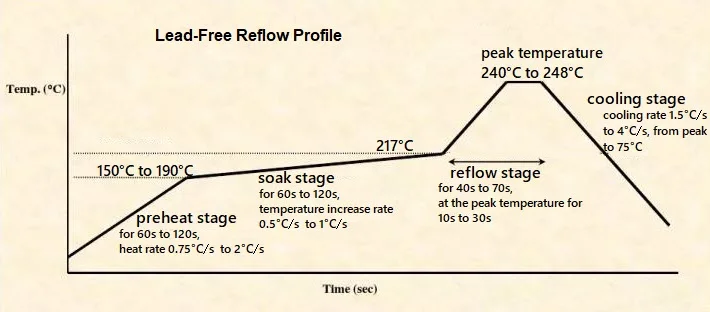
Lead-free soldering demands peak reflow temperatures of 245 to 260 degrees Celsius, compared to lower profiles in tin-lead processes, stressing components and boards with risks of delamination or cracking. Wave soldering pots operate near 265 degrees Celsius, increasing dross formation by 30 to 50 percent and requiring precise flux and conveyor control to avoid bridging. Hand soldering irons must reach 300 to 350 degrees Celsius, but engineers troubleshoot by minimizing dwell times to prevent overheating. IPC-A-610 provides acceptability criteria for these joints, distinguishing acceptable fillet formations from defects like insufficient wetting. Moisture sensitivity heightens, as higher dwells exacerbate popcorn effects in components. Practical mitigation involves thermal profiling and X-ray inspections to catch voids early.
Engineers often face brittle joints prone to mechanical fatigue, addressed by selecting ENIG surface finishes over HASL for better compatibility. Process validation kits help simulate runs, revealing warpage or head-in-pillow defects before full production. Optimizing nitrogen atmospheres in reflow reduces oxidation, ensuring consistent IMC growth. These mechanisms demand a shift from legacy setups, but certification standardizes troubleshooting for repeatable quality.
Lead-Free Assembly Certification Cost Breakdown
Transitioning to lead-free requires dissecting costs across categories, starting with certification audits that range from 2,000 to 10,000 dollars depending on facility scale. [1] These cover third-party reviews of documentation, process demos, and compliance records. Testing adds 1,000 to 5,000 dollars for lab validations like XRF analysis on materials. Engineers budget holistically, as piecemeal upgrades amplify expenses.
Lead-Free Assembly Equipment Cost
Reflow ovens and soldering stations must withstand sustained high temperatures, with upgrades costing 5,000 to 50,000 dollars for models supporting 260 degrees Celsius peaks. [1] Wave solder machines, including titanium fingers for corrosion resistance, fall in similar ranges for small to mid-scale operations. Rework stations run 500 to 5,000 dollars, essential for precise hot air or IR repairs. Engineers evaluate conveyor speeds and flux recovery to minimize dross-related downtime. Total equipment outlay often hits six figures for full lines, but modular upgrades allow phased implementation.
Lead-Free Assembly Training Cost
Personnel certification via IPC programs is pivotal, with J-STD-001 CIS training at 850 to 1,500 dollars per specialist, covering hands-on lead-free soldering over 2 to 4 days. [3] CIT trainer levels escalate to 2,200 to 3,000 dollars for 4 to 7 days, enabling in-house programs. Online options cut costs to 100 to 500 dollars but limit practical demos. Group on-site sessions offer 30 to 40 percent discounts, recertifying every two years at 60 to 70 percent of initial fees. For a team of six, expect 12,000 dollars upfront, yielding process control gains.
Lead-Free Assembly Material Cost
SAC305 solder paste or wire costs 20 to 30 dollars per kilogram, 10 to 30 percent above tin-lead equivalents due to silver content. Fluxes formulated for poor wettability add premiums, while RoHS components demand verified MSDS. Bar solder for waves scales similarly per volume. Engineers track per-board impacts, often 20 percent material hikes, offset by bulk sourcing. Storage in dry cabinets prevents degradation, avoiding scrap losses.
Calculating Lead-Free Assembly Certification ROI
ROI emerges from quality lifts: certified teams cut defects 15 to 30 percent, slashing rework by 10,000 to 50,000 dollars yearly. [3] Individuals gain 5,000 to 8,000 dollars annual salary boosts, recouping certification in months. A practical case saw a mid-sized assembler invest 12,000 dollars in six J-STD-001 and A-610 certifications, achieving 27 percent rework reduction, 18 percent yield improvement, and 300 percent first-year ROI via contract wins. [3] Formula: (Benefits - Costs) / Costs x 100, factoring saved labor at 15 to 50 dollars per hour.
Long-term, certification hedges risks like tin whiskers or fatigue failures, extending product lifecycles. Market access amplifies: compliant assemblies fetch premiums in automotive or medical sectors. Engineers model scenarios, projecting 100 to 400 percent ROI within year one through standardized IPC-7711/7721 rework protocols. Troubleshooting focuses on yield tracking post-certification.
Best Practices for Implementation and Troubleshooting
Start with process audits against J-STD-001 to baseline gaps, then pilot small batches with thermal profiling. Select SAC305 for balanced reliability, verifying components via XRF. Train iteratively, emphasizing visual cues for cold joints. For wave issues, tune pot temps to 265 degrees Celsius and fluxes for dross control. AOI catches early defects, while nitrogen reflow curbs oxidation. Document everything for audits, refreshing certifications biennially.
Conclusion
Lead-free assembly certification delivers strong economic impact through structured cost management and ROI gains, despite initial hurdles in equipment, training, and materials. Electrical engineers benefit from reduced defects and enhanced market positioning, guided by IPC standards. By dissecting the lead-free assembly certification cost breakdown and prioritizing high-ROI investments, teams achieve sustainable operations. Proactive troubleshooting ensures reliability, turning compliance into competitive advantage.
FAQs
Q1: What factors influence lead-free assembly certification ROI?
A1: Certification boosts ROI via 15 to 30 percent defect reductions and salary premiums of 5,000 to 8,000 dollars annually for technicians. Investments in training and audits recoup through yield gains and contracts, often hitting 300 percent in year one. Engineers track rework savings and compliance premiums for precise calculations.
Q2: How does lead-free assembly certification cost breakdown vary by operation size?
A2: Small operations face 2,000 to 5,000 dollars in audit fees, scaling to 10,000 dollars for larger facilities. Add equipment at 5,000 to 50,000 dollars, training 500 to 2,000 dollars per employee. Materials rise 10 to 30 percent. Prioritize phased upgrades for cost control.
Q3: What is the typical lead-free assembly equipment cost for upgrades?
A3: Reflow ovens and wave machines range 5,000 to 50,000 dollars to handle 260 degrees Celsius. Rework stations add 500 to 5,000 dollars. Engineers assess throughput needs, opting for titanium components to resist corrosion and extend life.
Q4: Why invest in lead-free assembly training cost despite upfront expenses?
A4: Training at 850 to 1,500 dollars per specialist equips teams for higher temps, cutting voids and brittleness. Recertification every two years maintains skills, driving 18 percent yield improvements. Hands-on IPC programs prevent costly defects.
References
IPC J-STD-001 — Requirements for Soldered Electrical and Electronic Assemblies. IPC
IPC-A-610 — Acceptability of Electronic Assemblies. IPC
IPC-7711/7721 — Rework, Modification and Repair of Electronic Assemblies. IPC