Introduction
Depaneling represents a critical final step in printed circuit board manufacturing, where individual boards are separated from larger production panels. This process ensures high throughput while maintaining board integrity for subsequent assembly and use. Engineers in PCB production must select appropriate depaneling methods to minimize mechanical stress, preserve edge quality, and meet production demands. This guide explores types of depaneling machines, key depaneling machine features, and depaneling applications, providing factory-driven insights for optimal implementation. Understanding these elements helps achieve reliable outcomes aligned with industry expectations.
What Is a Depaneling Machine and Why It Matters
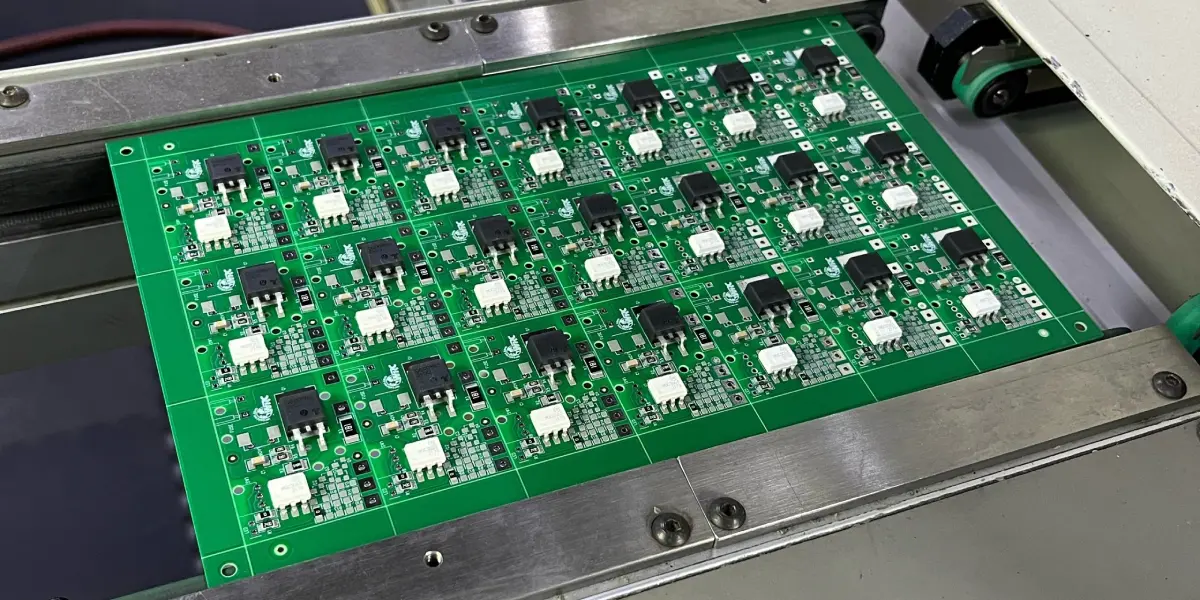
A depaneling machine automates the separation of individual printed circuit boards from a panelized array, which is used to streamline fabrication and surface mount technology processes. Panels allow multiple boards to be processed simultaneously, reducing handling and setup times in high-volume production. Without proper depaneling, boards risk damage from excessive stress, such as cracked components or delaminated layers, impacting yield and reliability. These machines vary from manual fixtures to fully automated systems, each suited to specific board designs and tolerances. In modern factories, selecting the right depaneling machine ensures compliance with quality standards and supports efficient workflows. Ultimately, effective depaneling preserves board performance from fabrication through final assembly.
The importance of depaneling machines lies in their ability to control mechanical forces that could otherwise compromise trace integrity or solder joint stability. For instance, populated boards require low-stress methods to avoid fracturing sensitive components near edges. Factory operations benefit from machines that offer repeatability, reducing operator variability and scrap rates. As production scales, automated depaneling integrates seamlessly into inline systems, boosting overall equipment effectiveness. Engineers prioritize these machines to align with process control requirements, ensuring panels transition smoothly to assembly lines.
Types of Depaneling Machines
Depaneling machines fall into several categories based on cutting mechanisms, each balancing speed, precision, and stress application. Common types of depaneling machines include mechanical, routing, punching, sawing, and laser systems, with selection driven by board geometry, thickness, and component density. Mechanical methods suit simple panels, while advanced options handle complex high-density interconnect boards. Understanding these types enables engineers to match processes to production needs without compromising quality.
V-Scoring Machines (Pizza Cutter or Rolling Blade)
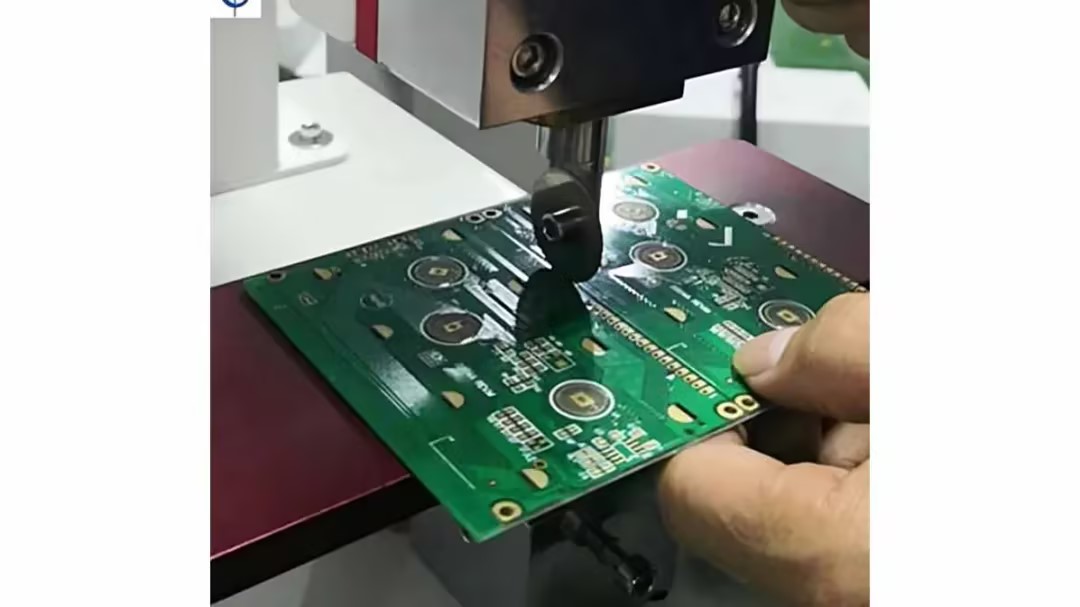
V-scoring machines use rotary or linear blades to separate boards along pre-scored V-grooves, typically cut to one-third of board thickness during fabrication. These systems, often semi-automated, roll along the groove to shear the remaining material cleanly. They excel in high-volume runs for rectangular panels, providing straight, flat edges suitable for thick rigid boards. Stress levels remain moderate, decreasing rapidly from the cut line, but require careful component placement away from edges. Maintenance involves blade sharpening and alignment to prevent burrs. Factories favor them for cost-effectiveness in mass production of standard designs.
Router Depaneling Machines
Router machines employ high-speed spindles with milling bits to cut tabs or routed outlines connecting boards in the panel. They handle irregular shapes and curves precisely, generating low mechanical stress compared to shearing methods. Vacuum systems extract dust to maintain cleanliness, while programmable paths ensure repeatability. Bit wear necessitates regular replacement, and feed rates must balance speed with vibration control. These machines suit medium to high volumes, especially for boards with nearby components. Edge quality meets stringent criteria when parameters are optimized.
Punching and Die-Cutting Machines
Punching machines use custom fixtures with blades and supports to press individual boards from the panel in a single stroke. They achieve high throughput for standardized layouts, minimizing handling time. Stress concentrates at the cut but dissipates with proper support, lower than hand methods. Fixtures demand specificity per panel design, increasing upfront costs. Suitable for rigid boards in dedicated production lines, they produce clean separations when dies stay sharp. Engineers design panels around fixture constraints for optimal results.
Laser Depaneling Machines
Laser systems, particularly UV wavelength models, ablate material in a non-contact process using focused beams for contour following. They offer the lowest stress and highest precision, ideal for thin, flexible, or densely populated boards up to 1 mm thick. Galvanometer scanners enable tight tolerances under 25 microns, with minimal heat-affected zones. Processing suits high-mix, low-volume scenarios or high-reliability applications. Initial investment is higher, but flexibility reduces tooling needs. Clean cuts avoid burrs, aligning with demanding edge requirements.
Other Methods: Sawing and Manual Fixtures
Sawing machines cut linearly at high speeds, suitable for V-grooved or full-material panels with low dust generation. They apply higher stress than routing but process quickly. Manual fixtures, including hand-break tools, serve prototypes or low volumes where cost trumps automation. Perforation or stamp hole methods pair with these for flexible separations. Each type demands evaluation against board specifics.
Key Depaneling Machine Features
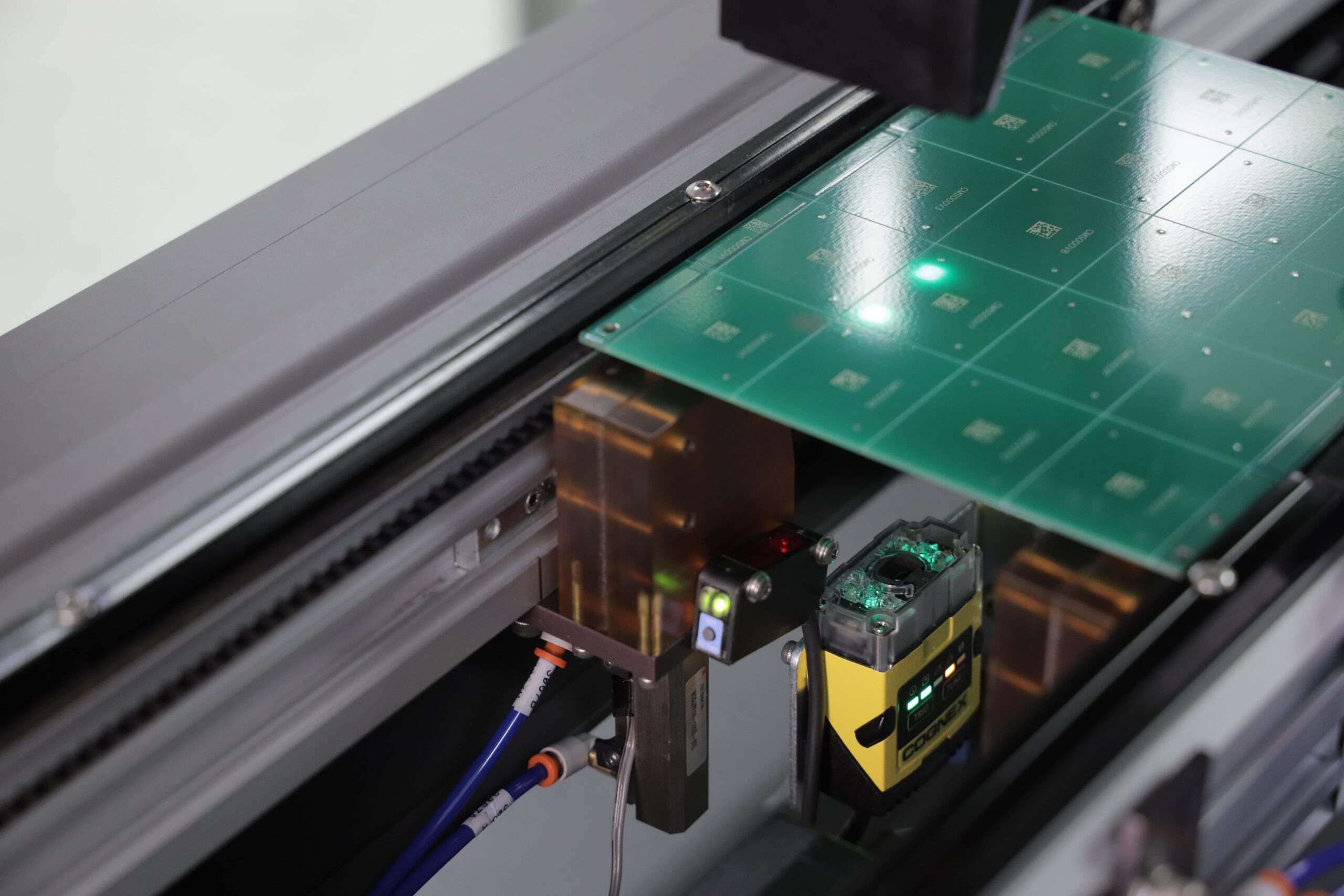
Modern depaneling machine features focus on precision, safety, and integration. Vision systems align panels automatically, compensating for minor misregistrations. Dust extraction and ESD-safe vacuums prevent contamination in routing setups. Programmable controls allow recipe storage for multiple panel types, enhancing flexibility. Safety interlocks and sensors enable hands-free operation in inline configurations. Stress monitoring, though emerging, aids process validation.
Automation levels range from offline semi-auto to fully inline systems with loaders and unloaders. Spindle speeds, feed rates, and laser parameters adjust for materials like FR4 or ceramics. Edge inspection capabilities verify smoothness post-cut. These features collectively reduce defects and support traceability in factories.
Depaneling Applications in PCB Manufacturing
Depaneling applications span consumer electronics to aerospace, tailored to board complexity and volume. High-volume rigid boards use V-scoring for efficiency, while HDI panels require laser for micro-features. Populated assemblies post-SMT demand low-stress routing to protect ball grid arrays. Flexible circuits benefit from laser's contour capability. Prototyping favors manual methods for speed.
In automotive sectors, punching supports standardized high-reliability panels. Factories time depaneling after testing to catch defects early. Component proximity dictates method, with clearances exceeding 1 mm from edges recommended. These applications underscore depaneling's role in yield optimization.
Best Practices for Depaneling
Panel design influences success: incorporate tabs, V-grooves, or perforations per layout needs, ensuring components stay clear of cut lines. Select machines based on stress tolerance, with router or laser for sensitive boards. Validate edges against IPC-A-600 acceptability criteria for smoothness and burr-free finishes. Maintain fixtures and bits regularly to sustain performance. Integrate inline monitoring for real-time adjustments. Collaborate on design rules like IPC-2221 to facilitate depaneling without rework.
Conclusion
Depaneling machines enable precise panel separation, critical for PCB manufacturing integrity. From V-scoring to laser types, each offers unique benefits in stress control and throughput. Key features like automation and vision enhance factory efficiency. Applications across volumes and board types demand method matching. Adhering to best practices, including IPC standards, ensures quality outcomes. Engineers gain reliability by prioritizing these principles.
FAQs
Q1: What is a depaneling machine?
A1: A depaneling machine separates individual PCBs from production panels using methods like routing or laser cutting. It minimizes stress to protect components and traces, supporting high-volume manufacturing. Factories use them post-fabrication or assembly for clean edges and repeatability, aligning with quality processes. This step boosts throughput while preserving board performance.
Q2: What are the main types of depaneling machines?
A2: Types of depaneling machines include V-scoring (rolling blade), router (milling tabs), punching (die fixtures), sawing, and laser systems. V-scoring suits straight high-volume panels, routers handle curves with low stress, and lasers provide precision for complex boards. Selection depends on shape, thickness, and stress sensitivity. Each type optimizes specific factory workflows.
Q3: What are key depaneling machine features for engineers?
A3: Depaneling machine features encompass vision alignment, dust extraction, programmable controls, and low-stress cutting. Automation levels support inline integration, while parameters adjust for materials. Safety sensors and edge verification ensure compliance. These enhance precision and reduce defects in production.
Q4: What are common depaneling applications?
A4: Depaneling applications cover rigid FR4 boards in consumer products, HDI in telecom, and flex circuits in wearables. High-volume uses V-scoring, while populated boards favor routing or laser. Timing varies from pre-assembly to post-test, minimizing risks. Factories apply them to achieve reliable separations across sectors.
References
IPC-A-600K — Acceptability of Printed Boards. IPC, 2020
IPC-2221B — Generic Standard on Printed Board Design. IPC, 2012
IPC-6012E — Qualification and Performance Specification for Rigid Printed Boards. IPC, 2017