Introduction
Thermal profiling plays a pivotal role in PCB assembly, particularly during reflow soldering processes where temperature control directly impacts solder joint quality and component reliability. Traditional methods relying on wired thermocouples can introduce variables such as cable drag, interference with conveyor movement, and potential safety hazards in high-heat environments. Wireless thermal profiling equipment emerges as a transformative technology, utilizing wireless thermocouple data loggers to capture accurate temperature data without physical tethers. This advancement facilitates real-time thermal profiling and remote PCB temperature monitoring, streamlining operations in modern SMT lines. By integrating seamlessly with Industry 4.0 electronics frameworks, it empowers engineers to optimize processes proactively. As assembly complexities grow with denser boards and lead-free solders, such tools become indispensable for achieving consistent yields.
What Is Wireless Thermal Profiling Equipment?
Wireless thermal profiling equipment consists of compact, battery-powered devices equipped with thermocouple sensors that transmit temperature data wirelessly to a receiver or cloud platform. These systems, often called wireless thermocouple data loggers, record profiles at multiple points on the PCB as it travels through ovens or wave soldering machines. Unlike wired alternatives, they eliminate mechanical stress on assemblies and allow for multi-channel monitoring without obstructing production flow. Data is typically sampled at high frequencies, enabling detailed analysis of ramp-up, soak, reflow, and cool-down phases. Engineers can access live streams or historical logs via software interfaces, supporting immediate adjustments to oven settings. This equipment adheres to core principles of precision measurement, making it suitable for high-volume SMT assembly data acquisition.
The core components include the logger pod with integrated radio frequency transmission, attachable thermocouples, and a base station for data aggregation. Thermocouples, usually Type K for their wide range and stability, are soldered or clipped to critical locations like component bodies, board undersides, and solder joints. Transmission protocols such as Wi-Fi, Bluetooth, or proprietary RF ensure robust connectivity even in shielded oven environments. Storage capacities allow for thousands of profiles per run, with export options for statistical process control. Calibration traceability maintains accuracy within tight tolerances required for modern electronics. Overall, this setup revolutionizes how thermal data informs assembly decisions.
Why It Matters in Modern PCB Assembly
In today's competitive electronics manufacturing, deviations in thermal profiles can lead to defects like tombstoning, voiding, or head-in-pillow, compromising product reliability. Wireless systems provide real-time thermal profiling that reveals variations across board zones, enabling targeted oven zoning adjustments. Remote PCB temperature monitoring reduces operator exposure to heat zones, enhancing workplace safety while minimizing downtime between profiles. For SMT assembly data acquisition, these tools capture granular data that supports process validation and Six Sigma initiatives. Integration with Industry 4.0 electronics allows automated alerts for out-of-spec conditions, predictive maintenance, and data-driven yield improvements. Ultimately, adopting wireless profiling elevates assembly from reactive troubleshooting to proactive optimization.
Consider the scale of high-mix, low-volume production where frequent changeovers demand rapid profiling. Wired setups often slow lines due to attachment and detachment routines, whereas wireless loggers deploy in seconds. This efficiency translates to higher throughput without sacrificing precision. Moreover, archived profiles serve as digital twins for simulations, aiding design-for-manufacturability reviews. In lead-free processes with narrower process windows, the ability to monitor multiple assemblies simultaneously proves invaluable. Engineers gain confidence that every board meets thermal requirements, reducing field failures and warranty costs.
Technical Principles Behind Wireless Thermal Profilers
Wireless thermocouple data loggers operate on the Seebeck effect, where temperature differences generate voltage proportional to the gradient across dissimilar metals in the thermocouple junction. The logger amplifies, digitizes, and timestamps this signal before wireless transmission, compensating for cold junction variations via onboard reference sensors. Sampling rates up to 10 Hz capture transient peaks, essential for validating reflow peaks against guidelines in IPC-7530. RF modules modulate data onto carrier frequencies, often in the 2.4 GHz ISM band, with error-checking protocols like CRC to ensure integrity amid oven noise. Power management via low-duty-cycle transmission extends battery life to hundreds of profiles per charge. Antenna design optimizes signal penetration through metal conveyor belts and insulation.
Data processing involves filtering noise from vibration or EMI, applying algorithms for profile smoothing and peak detection. Receivers synchronize multiple loggers, overlaying traces for comparative analysis. Software visualizes ramps in degrees per second, time above liquidus, and total integrated heat, flagging excursions. For remote PCB temperature monitoring, cloud connectivity pushes data to dashboards, enabling multi-site oversight. Security features like encryption protect intellectual property in shared networks. These principles ensure profiles mirror actual component exposures, aligning with J-STD-020 reflow classifications.
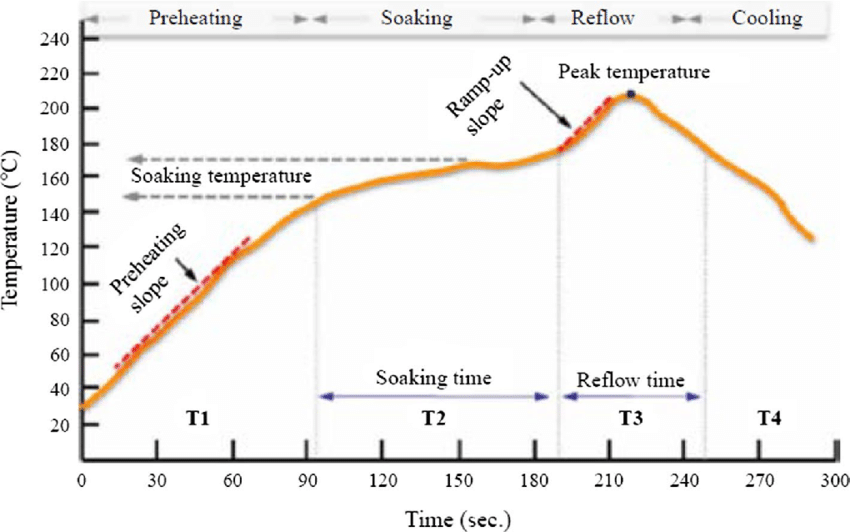
Firmware handles cold junction compensation dynamically, using thermistors for ambient reference, achieving accuracies better than 1°C across automotive-grade ranges. Transmission range extends 10-50 meters line-of-sight, sufficient for most conveyor lengths. Synchronization beacons from the base prevent drift in multi-logger runs. Post-run analysis computes statistics like CpK for process capability, integrating with MES systems for Industry 4.0 electronics. Robust enclosures withstand 260°C peaks and condensation, with IP ratings for washdown compatibility.
Implementing Real-Time Thermal Profiling in SMT Lines
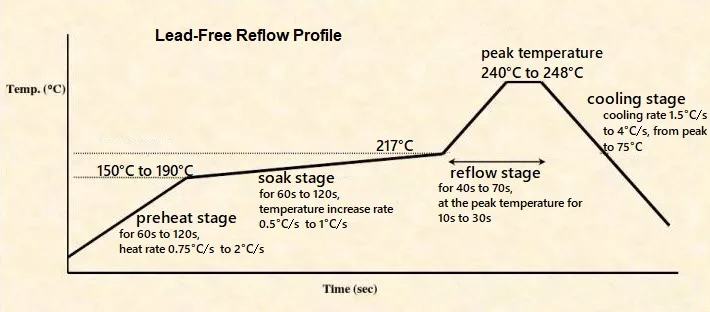
Deployment begins with strategic sensor placement: one on the largest component, one under the board, and others at thermal shadows or high-mass areas. Preheat loggers to stabilize junctions, then attach via high-temperature adhesive or flux-compatible clips. Calibrate against traceable standards before runs, verifying linearity from 25°C to 260°C. Launch profiles synchronized to conveyor entry, monitoring via receiver software for live curves. Post-run, retrieve loggers, download data, and compare against golden profiles derived from oven mapping. Adjust setpoints iteratively, focusing on ramp rates below 2-3°C/s to avoid warping.
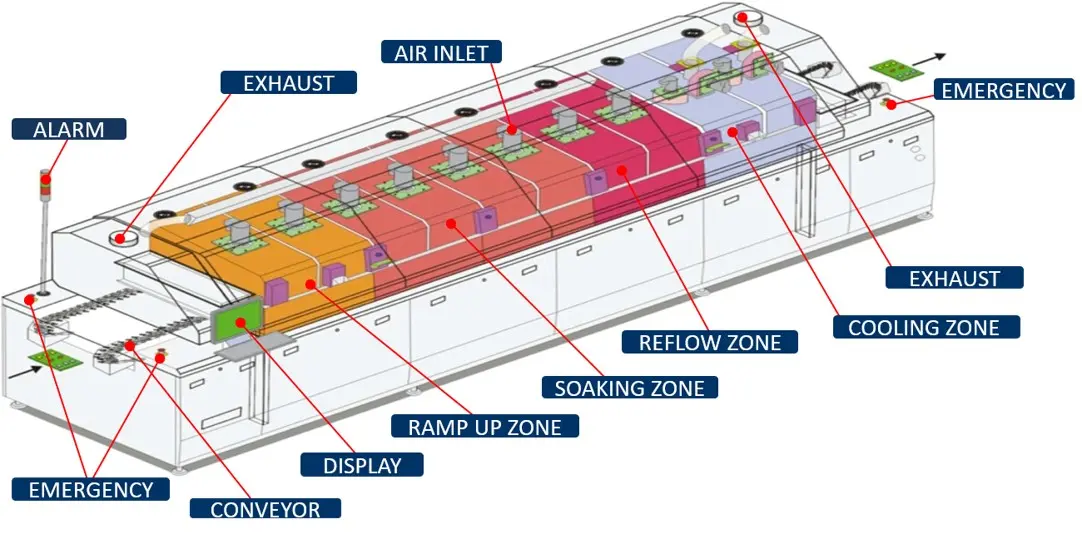
In practice, multi-zone reflow ovens benefit most, as wireless thermocouple data loggers reveal imbalances from fan speeds or exhaust. For wave soldering, profile preheaters and solder pot exposures to control dross and bridging. Integrate with line controls for closed-loop adjustments, where profile deviations trigger nitrogen flow tweaks. Train operators on attachment consistency to minimize variance. Document profiles for PPAP submissions, linking to specific alloy and stencil designs. This methodical approach ensures SMT assembly data acquisition drives continuous improvement.
Best Practices for Remote PCB Temperature Monitoring
Select loggers with at least 8 channels for comprehensive coverage on complex boards. Perform oven mapping quarterly to baseline zones, using arrays of loggers at grid points. Implement automated reporting templates that overlay current profiles on historical means, highlighting trends. For remote access, secure VPN tunnels to factory clouds, enabling off-shift reviews. Pair with video logging for correlating thermal data to visual defects. Regularly validate thermocouples by ice-point checks, discarding any with drift over 1°C.
Troubleshoot connectivity drops by elevating antennas or adding repeaters. In high-volume lines, use disposable thermocouples to avoid reuse fatigue. Archive data in standardized formats for ERP integration, supporting Industry 4.0 electronics traceability. Collaborate with suppliers on component-specific profiles, sharing anonymized data for mutual optimization. These practices maximize ROI by preventing defects upstream.
Troubleshooting Common Issues in Wireless Profiling
Signal loss often stems from battery depletion or metallic shielding; mitigate with fresh cells and external antennas. Erratic readings indicate loose junctions or decalibration; inspect attachments and recalibrate post-50 runs. Profile mismatches versus oven TC may arise from thermocouple lag; use fine-wire types for faster response. Overheating loggers trigger auto-shutdowns; limit exposure times per IPC-7530 guidelines. Data sync failures require beacon resets; firmware updates address most. Systematic logging of issues refines protocols over time.
Conclusion
Wireless thermal profiling equipment redefines PCB assembly by delivering precise, untethered insights into thermal behaviors. Wireless thermocouple data loggers enable real-time thermal profiling and remote PCB temperature monitoring, critical for defect-free SMT processes. Embracing this technology within Industry 4.0 electronics frameworks unlocks efficiency gains and reliability boosts. Engineers equipped with these tools troubleshoot proactively, validate rigorously, and innovate confidently. As assembly demands intensify, wireless profiling stands as a cornerstone of advanced manufacturing.
FAQs
Q1: What advantages does a wireless thermocouple data logger offer over wired systems in PCB assembly?
A1: Wireless thermocouple data loggers eliminate cable interference, allowing seamless conveyor movement and multi-board profiling in reflow ovens. They support real-time thermal profiling with remote access, reducing setup time from minutes to seconds. Safety improves by minimizing hot-zone handling, and data integrity holds via robust RF links. This setup enhances SMT assembly data acquisition without production halts, ideal for dynamic lines.
Q2: How does real-time thermal profiling improve remote PCB temperature monitoring?
A2: Real-time thermal profiling streams live data from multiple points, revealing zone variations instantly for oven tweaks. Remote PCB temperature monitoring via Wi-Fi or cloud dashboards enables oversight from control rooms, cutting response times to excursions. Engineers analyze ramps and peaks on-the-fly, preventing defects like insufficient reflow. Integration with alerts automates corrections, aligning with Industry 4.0 electronics for predictive control.
Q3: What role does wireless profiling play in Industry 4.0 electronics manufacturing?
A3: Wireless profiling feeds granular thermal data into MES and AI analytics, enabling automated process optimization and digital twins. It supports smt assembly data acquisition across factories, fostering data lakes for yield prediction. Remote capabilities allow global teams to collaborate on profiles, standardizing quality. This connectivity drives closed-loop systems, reducing variability and accelerating innovation in electronics production.
Q4: How to ensure accurate data from wireless thermal profilers during reflow?
A4: Position sensors at critical sites like BGA balls and board edges, securing with thermal tape. Calibrate pre-run against references, sampling at 1-10 Hz for transients. Verify transmissions post-profile, cross-checking with oven sensors. Follow standards for ramp limits to validate usability. Consistent practices yield reliable insights for process control.
References
IPC-7530B - Guidelines for Temperature Profiling for Mass Soldering Processes. IPC, 2025
IPC/JEDEC J-STD-020F - Moisture/Reflow Sensitivity Classification for Nonhermetic Surface Mount Devices. IPC/JEDEC, 2021