Introduction
High-speed digital PCBs power modern electronics, from data centers to telecommunications equipment. Engineers face mounting challenges in maintaining signal integrity as operating frequencies climb into the gigahertz range. Material selection emerges as a foundational decision that influences insertion loss, impedance control, and crosstalk. Poor choices lead to degraded performance, increased bit error rates, and design respins. This guide explores high-speed PCB materials, focusing on critical properties like dielectric constant and dissipation factor. By understanding these elements, electric engineers can optimize board layouts for reliable, high-performance operation.
Selecting the right substrate balances electrical, thermal, and mechanical demands. Traditional materials suffice for lower speeds, but high-speed applications demand specialized laminates. Factors such as signal propagation delay and attenuation become pronounced at elevated frequencies. Engineers must evaluate options beyond standard substrates to meet stringent requirements. This article provides logical, structured insights into properties, limitations, and best practices for material selection.
Why Material Selection Matters for High-Speed Digital PCBs
In high-speed digital designs, signals travel as electromagnetic waves through the dielectric between copper layers. Variations in material properties distort waveforms, causing timing skew and eye diagram closure. High-speed PCB materials directly impact the speed of signal propagation and energy efficiency. As data rates exceed 10 Gbps, even minor losses accumulate over long traces, compromising system margins. Proper selection ensures compliance with design goals for rise times and bandwidth.
Material choices also affect power distribution and thermal management. High-frequency operation generates heat from dielectric losses and conductor resistance. Substrates with inadequate thermal conductivity exacerbate hotspots, leading to reliability failures. Engineers prioritize low loss tangent PCB options to minimize attenuation. Furthermore, mechanical stability prevents warpage during assembly, preserving trace integrity. Overall, informed decisions reduce development costs and accelerate time-to-market.
Key Material Properties for High-Speed Performance
Dielectric Constant (Dk)
The dielectric constant measures a material's ability to store electrical energy in an electric field. Lower Dk values enable faster signal propagation by increasing the effective speed of light in the substrate. In high-speed PCB materials, stable Dk across frequencies prevents length tuning mismatches in differential pairs. Variations with temperature or moisture absorption introduce phase shifts, degrading timing budgets. Engineers seek low Dk PCB laminates for applications above 1 GHz to maintain predictable impedance.
IPC-4101 outlines specifications for base materials, including Dk requirements for various laminate types. Consistent Dk supports symmetric stackups, essential for multilayer boards. Designers model propagation delay using Dk to optimize routing lengths. Materials with minimal Dk frequency dependence excel in broadband signals.
Dissipation Factor (Df) or Loss Tangent
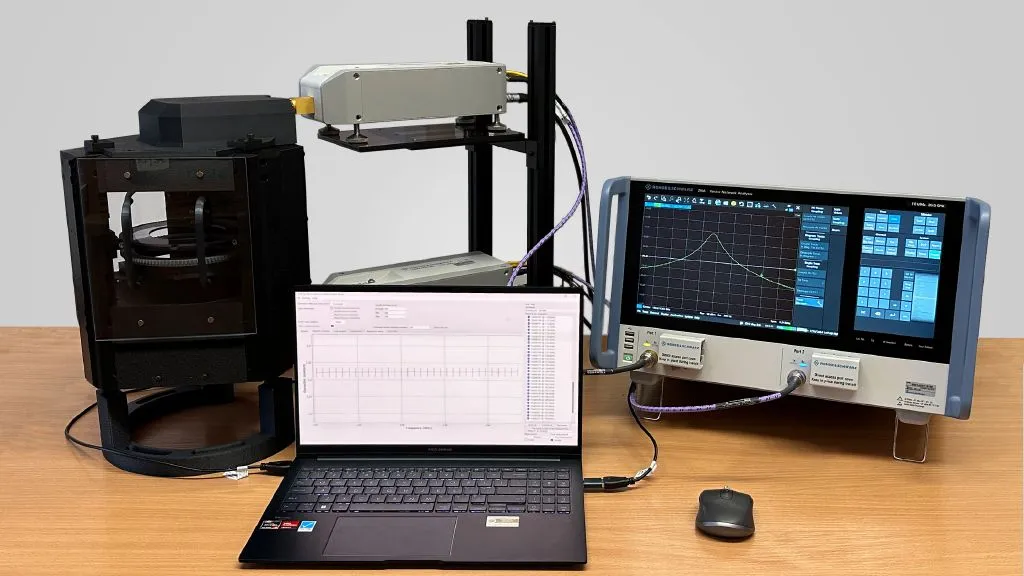
Dissipation factor, also known as loss tangent, quantifies energy lost as heat in the dielectric during signal transit. Low dissipation factor materials are crucial for high-speed PCB materials to reduce insertion loss per unit length. At elevated frequencies, higher Df causes exponential attenuation, closing the eye pattern. Engineers specify low loss tangent PCB substrates for long traces or high data rates. This property directly correlates with bit error rates in serial links.
Test methods in IPC-TM-650 evaluate Df under controlled conditions, guiding qualification. Balancing Df with other properties ensures holistic performance. Excessive loss demands equalization, complicating designs.
Thermal Conductivity and Other Properties
Thermal conductivity governs heat spreading from active components and dielectrics. High-speed designs with dense ICs benefit from materials that efficiently transfer heat to planes or heatsinks. Poor conductivity leads to thermal runaway, shifting Dk and accelerating aging. Engineers integrate this with CTE for via reliability and component solder joint integrity.
Coefficient of thermal expansion (CTE) matching minimizes stress in assemblies. Glass transition temperature (Tg) indicates stability under reflow. Low moisture absorption prevents Dk drift in humid environments. Comprehensive evaluation per IPC-4101 ensures robustness.
Limitations of FR-4 for High-Speed Applications
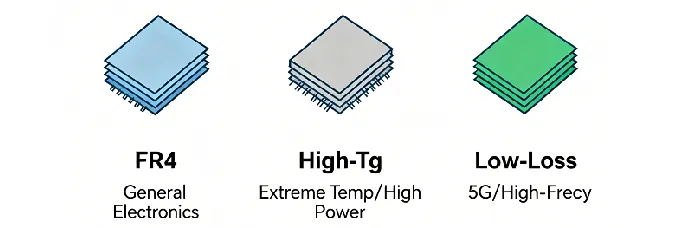
FR-4 dominates general-purpose PCBs due to cost and availability. However, standard FR-4 exhibits higher dielectric constant and dissipation factor, limiting its use in high-speed scenarios. Signal attenuation rises rapidly beyond moderate frequencies, necessitating shorter traces or active compensation. Variations in resin content cause inconsistent electrical performance across batches. For FR-4 for high speed attempts, low-loss variants offer improvements, but they fall short for ultra-high data rates.
Mechanical properties like higher CTE mismatch with copper, promoting warpage in thick multilayers. Thermal conductivity remains modest, challenging power-heavy designs. Moisture sensitivity alters Dk, affecting impedance control. While viable for mid-range speeds with careful layout, FR-4 demands compromises in routing freedom and density.
Exploring High-Speed PCB Materials and Alternatives
High-speed PCB materials encompass resin systems optimized for electrical excellence. PTFE-based laminates provide ultra-low Dk and Df, ideal for microwave and mmWave. Ceramic-filled hydrocarbons offer process compatibility with FR-4 lines while delivering superior loss performance. Polyphenylene ether (PPE) and cyanate ester blends balance cost and high-frequency traits. These serve as effective Rogers PCB alternatives for demanding applications.
Low Dk PCB options prioritize signal speed and minimal crosstalk. Low loss tangent PCB materials extend reach in backplanes and SerDes channels. Hybrid stackups combine FR-4 cores with low-loss skins for cost efficiency. Engineers select based on frequency, loss budget, and fabricability. IPC-1758 classifies these for high-speed qualification.
Advanced fillers enhance thermal conductivity without compromising dielectrics. Liquid crystal polymer (LCP) suits flexible high-speed interconnects. Each category addresses specific pain points in digital designs.
Best Practices for Material Selection and Implementation
Begin with frequency and loss requirements to narrow candidates. Model stackups using field solvers to predict Dk effects on impedance. Prioritize materials per IPC-4101 slash sheets for consistent specs. Verify supplier data sheets against application needs, focusing on Df at operating frequencies.
Ensure CTE alignment with components to avoid reliability issues per IPC-6012 performance specs. Incorporate thermal vias and planes for conductivity leveraging. Prototype and characterize with TDR for validation. Hybrid constructions optimize cost-performance ratios.
Consider fabricability: drillability, plating adhesion, and laser via support. Qualify via IPC class 3A for high-reliability high-speed boards. Document rationale for procurement teams.
Conclusion
Material selection unlocks peak performance in high-speed digital PCBs. Prioritizing low dielectric constant, dissipation factor, and thermal conductivity mitigates signal degradation. While FR-4 suits many designs, low Dk and low loss tangent alternatives excel in demanding regimes. Adhering to standards like IPC-4101 and IPC-6012 ensures quality. Engineers armed with these insights deliver robust, efficient boards.
FAQs
Q1: What is the dielectric constant in high-speed PCB materials?
A1: Dielectric constant (Dk) defines how a substrate stores electric field energy relative to air. Lower, stable Dk in high-speed PCB materials accelerates signal speed and aids impedance control. Variations impact propagation delay and crosstalk. Select per frequency needs for optimal routing. IPC-4101 specs guide choices.
Q2: Why choose low loss tangent PCB materials?
A2: Low loss tangent, or dissipation factor, minimizes energy dissipation as heat in high-speed traces. This preserves signal amplitude over distance, vital for high data rates. Higher Df causes eye closure and equalization demands. Low loss tangent PCB options extend channel lengths reliably.
Q3: Can FR-4 be used for high-speed PCBs?
A3: FR-4 for high speed works in moderate applications with low-loss grades. Standard versions suffer higher Df and Dk variability at gigahertz frequencies. Use for cost-sensitive mid-range designs with layout mitigations. Transition to alternatives for superior performance.
Q4: How does thermal conductivity affect high-speed PCB materials?
A4: Thermal conductivity spreads heat from losses and components, stabilizing Dk and preventing hotspots. In high-speed PCB materials, it supports power integrity alongside electrical traits. Pair with planes for effective dissipation. Essential for dense, multilayer boards.
References
IPC-4101E — Specification for Base Materials for Rigid and Multilayer Printed Boards. IPC, 2017
IPC-6012E — Qualification and Performance Specification for Rigid Printed Boards. IPC, 2018
IPC-1758 — High-Speed PCB Base Materials Specification. IPC, 2020