Introduction
In the evolving landscape of electronic manufacturing, effective thermal management is no longer a luxury but a fundamental necessity, particularly for high-power density applications. Traditional FR-4 printed circuit boards (PCBs) often struggle to dissipate the significant heat generated by modern components, leading to reduced efficiency and compromised reliability. This critical demand has driven the widespread adoption of metal core PCBs (MCPCBs), primarily featuring either aluminum or copper as their base material. While both aluminum PCB and copper PCB technologies are designed to enhance thermal performance, they possess distinct characteristics that make them suitable for different application requirements. Understanding the core differences between copper vs aluminum MCPCBs is essential for designers and engineers to make informed decisions that optimize both functionality and cost.
What is an Aluminum PCB?
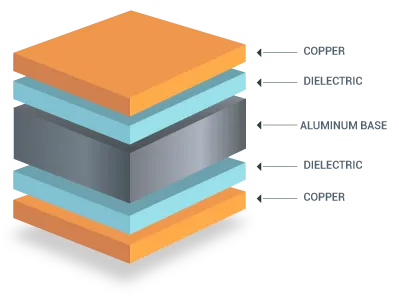
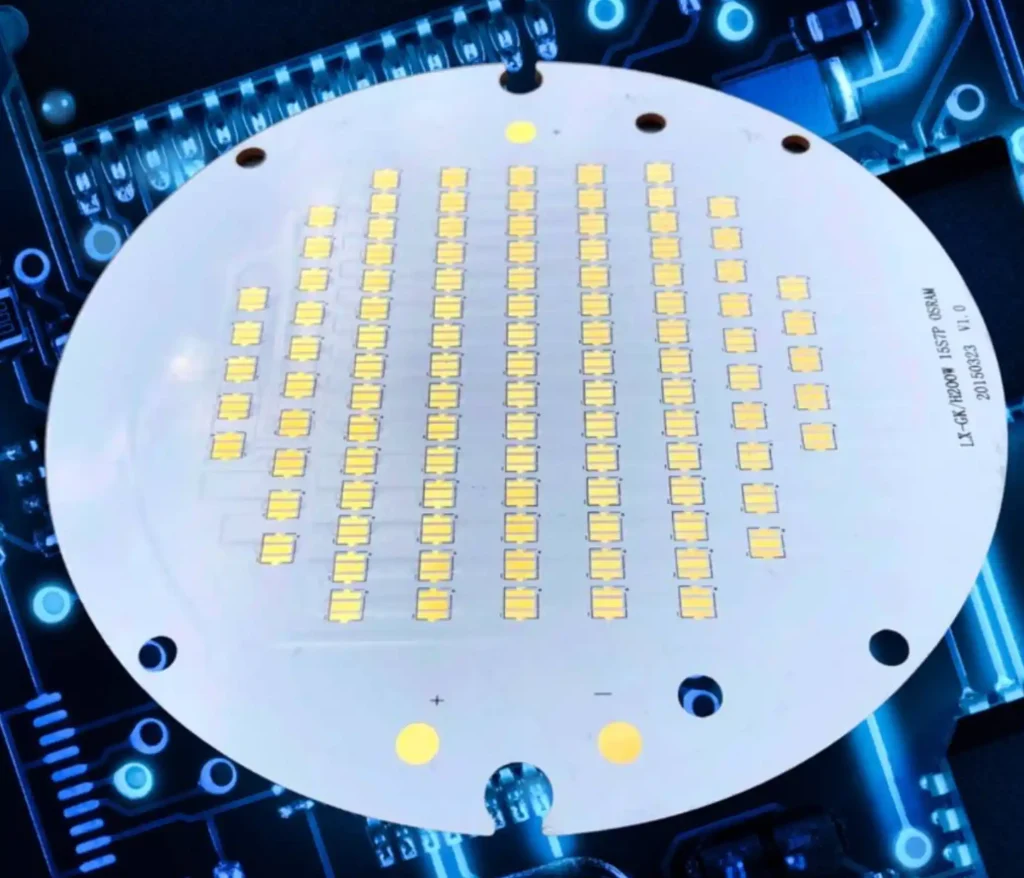
An aluminum PCB is a type of metal core PCB where the base material is aluminum. Its typical structure consists of three main layers:
- Circuit Layer: A thin layer of copper foil (usually 1 oz to 3 oz) where the electronic circuit is etched.
- Dielectric Layer: A thin insulating layer, often referred to as the thermal interface material (TIM). This dielectric provides electrical isolation between the copper circuit and the aluminum base while acting as a thermal conductor to transfer heat efficiently. Its thermal conductivity typically ranges from 1.0 to 9.0 W/m·K.
- Aluminum Base Layer: The thickest part of the PCB, made of an aluminum alloy (e.g., 1000, 5000, or 6000 series). This layer provides mechanical rigidity, acts as a heat spreader, and often serves as a heat sink.
The primary advantage of aluminum PCB lies in its excellent thermal dissipation capabilities combined with relatively lower cost and lighter weight. It is widely used in applications like LED lighting, automotive power modules, and power converters where efficient heat extraction is crucial.
Related Reading: Aluminum PCBs: An Essential Solution for High-Performance Electronics
What is a Copper PCB?
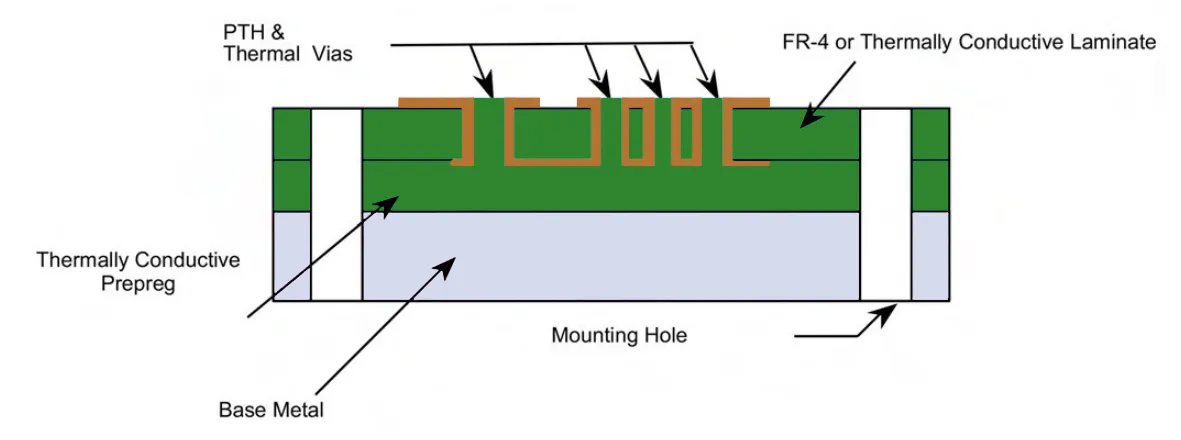
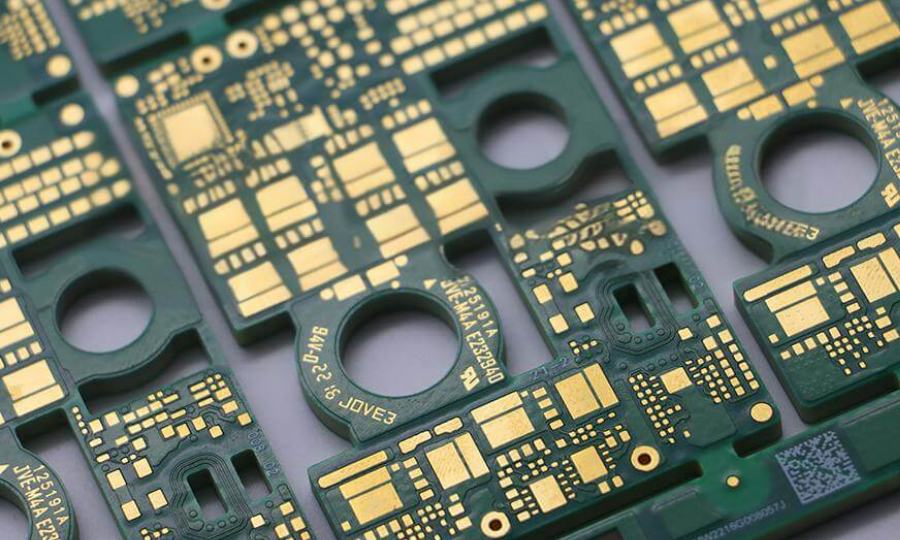
A copper PCB is also a metal core PCB, but its base material is pure copper or a copper alloy. Similar to aluminum PCBs, its structure generally comprises:
- Circuit Layer: Copper foil for the circuit traces.
- Dielectric Layer: A thermally conductive and electrically insulating layer.
- Copper Base Layer: The foundational layer made of copper.
Copper PCB offers superior thermal conductivity compared to aluminum, along with higher current carrying capacity and greater mechanical strength. Due to its premium performance, copper PCB is typically chosen for very high-power applications or those requiring extremely rapid heat transfer in critical scenarios, such as high-frequency communication systems, military equipment, and advanced power electronics.
Key Comparison Factors
To determine whether an aluminum PCB or a copper PCB is more suitable for a specific application, several key factors must be evaluated.
Thermal Conductivity and Heat Dissipation
This is arguably the most critical differentiator between copper vs aluminum MCPCBs.
- Aluminum PCB: Aluminum alloys typically have a thermal conductivity ranging from 150 to 200 W/m·K. When combined with a high-performance thermal dielectric, aluminum PCB thermal dissipation is significantly better than FR-4 (around 0.25 W/m·K). This makes them highly effective for many power applications.
- Copper PCB: Copper boasts even higher thermal conductivity, typically ranging from 380 to 400 W/m·K for pure copper. This nearly doubles the intrinsic heat spreading capability compared to aluminum, allowing for even faster heat transfer away from components. For applications generating extreme heat or requiring very tight thermal budgets, copper PCB offers superior heat management.
Related Reading: Aluminum PCBs: Thermal Management for High Power Electronics
Cost-Effectiveness
Cost is a major consideration in PCB manufacturing.
- Aluminum PCB: Aluminum is generally more abundant and less expensive than copper. The fabrication process for aluminum PCB is also often simpler and more mature, contributing to a lower overall manufacturing cost. This makes them a more economical choice for many thermal management applications.
- Copper PCB: The higher raw material cost of copper and the more specialized manufacturing processes (e.g., for etching thicker copper layers or managing its density) typically make copper PCB more expensive than aluminum alternatives.
Mechanical Properties and Durability
The physical strength and characteristics of the base metal are also important.
- Aluminum PCB: Aluminum is relatively lightweight and offers good mechanical strength. It is less dense than copper, making aluminum PCB a lighter option, which is beneficial for weight-sensitive applications.
- Copper PCB: Copper is denser and significantly stronger than aluminum. This superior mechanical strength makes copper PCB more durable and resistant to bending or deformation, which can be an advantage in rugged environments or for supporting heavier components. However, its higher density also means a heavier board.
Electrical Performance
While both are used for thermal management, their electrical properties can also differ.
- Aluminum PCB: The aluminum base provides an excellent electrical ground plane, contributing to good signal integrity for non-RF applications. For high-frequency designs, the dielectric properties of the insulating layer become critical, as discussed in previous articles.
- Copper PCB: Copper has lower electrical resistance than aluminum, meaning better current carrying capacity and less resistive power loss within the base layer itself if used for ground or power planes. This can be beneficial in extremely high-current applications.
Manufacturing Process and Challenges
PCB manufacturing for metal core boards involves specialized processes.
- Aluminum PCB: The manufacturing process for aluminum PCB is well established. Aluminum is relatively easy to drill and etch, which contributes to its lower manufacturing cost.
- Copper PCB: Due to copper's higher hardness and density, drilling can be more challenging, potentially leading to increased tool wear. Etching thicker copper layers also requires more precise control. These factors can add to the complexity and cost of copper PCB fabrication.
Weight and Density
The density of the base material directly impacts the final weight of the PCB.
- Aluminum PCB: Aluminum is approximately one-third the density of copper (aluminum density ~2.7 g/cm³, copper density ~8.96 g/cm³). This makes aluminum PCB a significantly lighter option, which is a key advantage for portable devices, aerospace, and automotive applications where weight reduction is crucial.
- Copper PCB: The high density of copper results in a heavier board. While not an issue for all applications, it can be a disadvantage in weight-sensitive designs.
Advantages and Disadvantages of Aluminum PCBs
Advantages of Aluminum PCBs
- Excellent Thermal Dissipation: Highly effective at moving heat away from components.
- Cost-Effective: Generally less expensive to manufacture than copper PCB.
- Lightweight: Significantly lighter than copper PCB, ideal for weight-sensitive products.
- Good Mechanical Strength: Provides robust support for components.
- Environmentally Friendly: Aluminum is readily recyclable.
- EMI Shielding: The aluminum base can offer some degree of electromagnetic interference shielding.
Disadvantages of Aluminum PCBs
- Lower Thermal Conductivity than Copper: While superior to FR-4, it cannot match pure copper's intrinsic thermal conductivity.
- Limited High-Frequency Performance: Dielectric materials in standard aluminum PCBs may not be optimized for RF, impacting signal integrity for microwave applications.
- Drilling Challenges: Can be prone to burring during drilling if not properly managed, although generally easier to process than copper.
Advantages and Disadvantages of Copper PCBs
Advantages of Copper PCBs
- Superior Thermal Conductivity: Offers the best possible thermal performance among common MCPCB bases.
- Higher Current Carrying Capacity: Lower electrical resistance of copper allows for handling very high currents with minimal loss.
- Excellent Mechanical Strength: Very durable and resistant to deformation, suitable for rugged environments.
- Better Dimensional Stability: Resists warping and twisting better under thermal cycling.
Disadvantages of Copper PCBs
- Higher Cost: Significantly more expensive due to raw material cost and complex manufacturing.
- Heavier Weight: High density makes it less suitable for weight-sensitive applications.
- More Challenging Manufacturing: Harder to drill and etch, requiring specialized equipment and processes.
- Corrosion Risk: Copper is more susceptible to oxidation and corrosion than aluminum if not properly protected.
When to Choose Which
The choice between an aluminum PCB and a copper PCB ultimately depends on the specific requirements of the application.
Choose Aluminum PCB when:
- Cost is a major factor: For applications where effective thermal management is needed without a premium price point.
- Weight reduction is critical: In portable devices, aerospace, or automotive electronics.
- Moderate to high heat dissipation is required: Suitable for many LED lighting, mid-range power converters, and general automotive applications.
- Standard manufacturing processes are preferred: To leverage existing infrastructure and reduce complexity.
Choose Copper PCB when:
- Maximum thermal performance is paramount: For extremely high-power applications, very compact designs, or situations with stringent thermal budgets.
- Extreme durability and mechanical strength are required: In rugged industrial or military environments.
- Very high current densities are involved: Where copper's lower electrical resistance is advantageous.
- High-frequency signal integrity is critical and requires the most stable thermal environment: For advanced RF and microwave systems where even minor temperature fluctuations can impact performance.
Conclusion
Both aluminum PCB and copper PCB represent significant advancements over traditional FR-4 for applications demanding robust thermal management. The selection between copper vs aluminum hinges on a careful evaluation of the application's unique needs, balancing thermal performance, cost, weight, mechanical strength, and electrical characteristics. Aluminum PCBs offer a cost-effective, lightweight solution for a wide range of power applications, providing excellent aluminum PCB thermal dissipation. Copper PCBs, while more expensive and heavier, deliver unparalleled thermal conductivity and mechanical robustness for the most demanding high-power and high-reliability scenarios. By understanding these fundamental advantages and disadvantages, designers can strategically choose the appropriate metal core PCB, thereby optimizing their electronic systems for efficiency, reliability, and manufacturability.
FAQs
Q1: What is the primary advantage of an aluminum PCB over an FR-4 PCB?
A1: The primary advantage of an aluminum PCB over an FR-4 PCB is its significantly superior thermal dissipation capability. The aluminum base efficiently conducts heat away from components, preventing hot spots, extending component lifespan, and improving the overall power supply reliability.
Q2: When would a copper PCB be preferred over an aluminum PCB despite its higher cost?
A2: A copper PCB would be preferred over an aluminum PCB when extreme thermal performance is paramount, such as in ultra-high power applications or highly compact designs where even aluminum's thermal conductivity is insufficient. Its superior current carrying capacity and mechanical strength are also factors.
Q3: What are the main disadvantages of using copper as a PCB base material?
A3: The main disadvantages of using copper as a PCB base material include its higher cost, significantly heavier weight compared to aluminum, and more challenging manufacturing processes (drilling and etching due to hardness and density).
Q4: How does the weight difference between aluminum and copper PCBs impact design choices?
A4: The weight difference between aluminum PCB and copper PCB significantly impacts design choices for weight-sensitive applications. Aluminum's lower density makes it ideal for portable devices, aerospace, and automotive industries, where weight reduction is a key design objective.
References
IPC-2152 — Standard for Determining Current-carrying Capacity in Printed Board Design. IPC, 2009.
IPC-2221A — Generic Standard on Printed Board Design. IPC, 2003.
IPC-6012E — Qualification and Performance Specification for Rigid Printed Boards. IPC, 2017.