Introduction
In the demanding world of modern electronics, power supply units are critical components responsible for converting and regulating electrical energy. As devices become smaller, more powerful, and operate in harsher environments, the challenges of managing heat within power supplies intensify. Excessive heat is a primary factor leading to component degradation, reduced efficiency, and ultimately, system failure. This is where aluminum printed circuit boards (PCBs), also known as metal core PCBs (MCPCBs), play a pivotal role. Traditionally recognized for their superior thermal management capabilities, aluminum PCBs are becoming indispensable in power supply PCB design, directly contributing to power supply efficiency and power supply reliability by effectively addressing heat dissipation.
What is an Aluminum PCB and Its Significance for Power Supplies
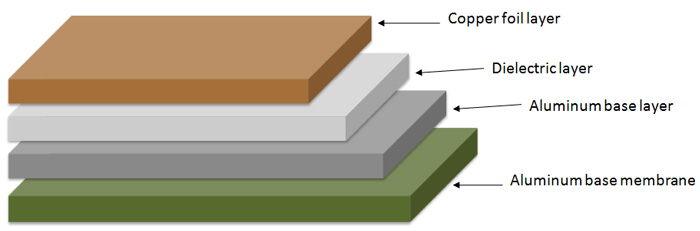
An aluminum PCB is a type of metal core PCB composed of a copper circuit layer, a dielectric insulating layer, and a strong aluminum base layer. The copper layer carries the electrical signals and currents, similar to a conventional PCB. The dielectric layer provides electrical isolation between the copper circuit and the aluminum base while acting as a thermal conductor. The aluminum base serves as a robust mechanical foundation and, crucially, as an integrated heat spreader and sink.
For power supply design, the significance of this structure is profound. Power supplies often contain high-power components such as MOSFETs, IGBTs, diodes, and inductors that generate substantial amounts of heat during operation. In traditional FR-4 PCBs, dissipating this heat effectively often requires large external heat sinks, fans, or extensive thermal vias, which add to the size, weight, and cost of the unit. Aluminum PCBs offer an intrinsic solution, enabling more compact, efficient, and reliable power supply units by efficiently extracting and spreading heat away from critical components.
Related Reading: Aluminum PCBs: An Essential Solution for High-Performance Electronics
Challenges in Power Supply Design Without Aluminum PCBs
Designing power supplies using conventional FR-4 PCBs, especially for high-power or compact applications, presents several inherent challenges related to thermal management.
- Localized Hot Spots: FR-4 has a relatively low thermal conductivity (around 0.25 W/m·K), which means heat struggles to spread efficiently across the board. This often leads to localized hot spots around power components, where temperatures can exceed their maximum junction limits.
- Reduced Component Lifespan: Prolonged exposure to high temperatures accelerates the degradation of semiconductor junctions, electrolytic capacitors, and other temperature-sensitive components. This directly shortens the operational lifespan of the power supply and reduces its overall power supply reliability.
- Performance Degradation: High operating temperatures can alter the electrical characteristics of components, leading to voltage and current drift, increased noise, and reduced efficiency. For example, the forward voltage drop of diodes or the on-resistance of MOSFETs can increase with temperature, leading to further power losses.
- Bulky External Heat Sinks: To compensate for FR-4's poor thermal performance, designers must often incorporate bulky external heat sinks, fans, or complex airflow systems. These solutions consume valuable space, add weight, increase manufacturing complexity, and can generate acoustic noise.
- Design Complexity: Managing heat with FR-4 often involves intricate designs with numerous thermal vias, heavy copper planes, and careful component spacing, which can complicate routing and increase board size.
Key Advantages of Aluminum PCBs in Power Supply Design
The unique construction of aluminum PCBs directly addresses the thermal limitations of FR-4, offering significant advantages for power supply design and manufacturing.
1. Superior Thermal Dissipation
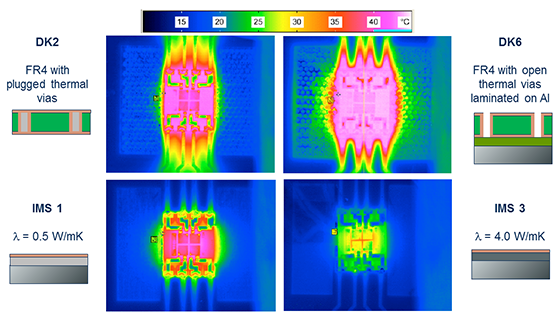
The most prominent advantage of aluminum PCBs is their exceptional aluminum PCB thermal dissipation capability. The aluminum base, typically 0.8 mm to 3.0 mm thick, has a thermal conductivity ranging from 150 to 200 W/m·K, which is hundreds of times greater than that of FR-4. Heat generated by components is rapidly transferred through the thin dielectric layer to the aluminum base, where it is efficiently spread across a larger area and dissipated to the ambient environment. This prevents the formation of hot spots and maintains lower operating temperatures for all components.
Related Reading: Aluminum PCBs: Thermal Management for High Power Electronics
2. Enhanced Reliability and Extended Lifespan
By keeping component temperatures consistently lower, aluminum PCBs dramatically enhance power supply reliability.
- Reduced Component Stress: Lower temperatures reduce thermal stress on semiconductor devices and other heat-sensitive parts. This directly translates to fewer failures and a longer operational lifespan for individual components and the entire power supply unit.
- Stable Performance: Components operating within their optimal temperature ranges exhibit more stable electrical characteristics, ensuring the power supply performs consistently over time and under varying load conditions.
- Compliance with Standards: Meeting thermal management requirements helps power supply designs comply with industry reliability standards and specifications, such as those related to mean time between failures (MTBF).
3. Improved Power Supply Efficiency
Efficient aluminum PCB thermal dissipation contributes directly to power supply efficiency.
- Reduced Conduction Losses: For power MOSFETs and IGBTs, their on-resistance (Rds(on)) typically increases with temperature. By keeping these devices cooler, their Rds(on) is lower, resulting in reduced conduction losses (I²R losses) and higher overall efficiency.
- Optimized Semiconductor Performance: Cooler operating temperatures allow semiconductors to perform closer to their ideal characteristics, minimizing switching losses and improving conversion efficiency.
- Elimination of Overdesign: With superior thermal performance, designers can sometimes select components with less conservative derating factors, or even slightly smaller components, without compromising thermal limits.
4. Miniaturization and Space Saving
The inherent heat sinking capability of aluminum PCBs often eliminates the need for bulky external heat sinks or reduces their size significantly.
- Compact Designs: This enables power supply units to be designed in much smaller form factors, which is critical for applications with limited space, such as consumer electronics, medical devices, and embedded systems.
- Reduced Weight: The aluminum base itself is lighter than many traditional heat sink assemblies, contributing to a lighter overall product.
- Simplified Assembly: Integrating the heat sink function into the PCB itself simplifies the mechanical design and assembly process, leading to potential cost savings.
5. Enhanced Mechanical Stability
The aluminum core provides a rigid and robust base for the PCB. This inherent mechanical stability can be advantageous for mounting heavy power components and for overall product durability, especially in applications subjected to vibration or mechanical stress.
Design Considerations for Aluminum PCBs in Power Supply Manufacturing
While aluminum PCBs offer significant benefits, optimizing their use in power supply design requires specific considerations during the manufacturing and design phases.
1. Thermal Dielectric Material Selection
The choice of dielectric material between the copper circuit layer and the aluminum base is paramount.
- High Thermal Conductivity (k): The dielectric's thermal conductivity is critical. Values typically range from 1.0 to 9.0 W/m·K, with higher values providing better heat transfer.
- Dielectric Strength: The material must provide sufficient electrical insulation to prevent breakdown between the high-voltage traces and the grounded aluminum base. This is specified in terms of kV/mm.
- Minimal Thermal Resistance: Designers aim for the lowest possible thermal resistance from the component junction to the aluminum base. This involves selecting a dielectric with high thermal conductivity and keeping its thickness to a minimum while meeting electrical isolation requirements.
- Glass Transition Temperature (Tg) and Decomposition Temperature (Td): These thermal properties ensure the dielectric material can withstand the operating and manufacturing temperatures without degradation.
2. Heavy Copper Weight and Thickness
Power supplies often handle high currents.
- Current Carrying Capacity: Utilizing heavier copper foils (e.g., 2 oz, 3 oz, or even up to 6 oz or more) for the circuit layer allows for higher current carrying capacity and minimizes resistive losses in the traces.
- Heat Spreading: Thicker copper also aids in lateral heat spreading on the circuit layer before transferring heat to the dielectric and aluminum base. IPC-2152, Standard for Determining Current-carrying Capacity in Printed Board Design, provides guidelines for copper trace sizing.
3. Thermal Via Strategy
While the aluminum base is the primary heat sink, thermal vias can still play a strategic role.
- Connecting to Ground/Aluminum: In some cases, especially with multi-layer MCPCBs (where additional copper layers are above the primary circuit layer), thermal vias are used to create direct thermal pathways from internal heat-generating components to the primary circuit layer or directly to the aluminum base.
- Heat Spreading within Copper: Even on a single-layer MCPCB, an array of copper-filled thermal vias under a component's thermal pad can ensure uniform heat transfer to the underlying dielectric.
4. Component Placement Optimization
Strategic placement is vital for maximizing aluminum PCB thermal dissipation.
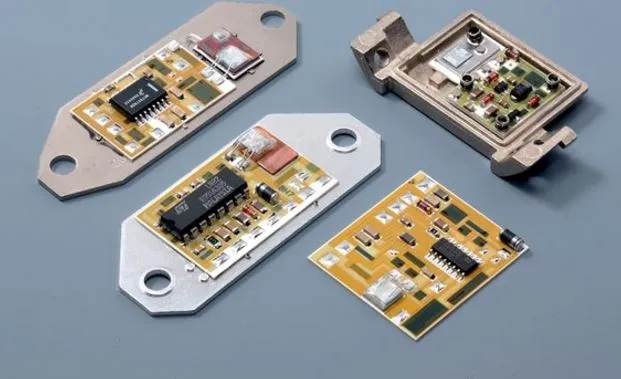
- Proximity to Aluminum: High-power and heat-generating components should be placed as close as possible to the aluminum base. Components with exposed thermal pads should be directly soldered over the dielectric layer to establish an efficient thermal path.
- Even Distribution: Distribute heat-generating components across the PCB to prevent localized heat saturation of the aluminum base, ensuring uniform thermal management.
5. Electrical Isolation and Safety
Creepage and Clearance: Maintain adequate creepage and clearance distances between high-voltage traces and the aluminum base, and between different voltage potentials on the copper layer, as per safety standards (e.g., IEC 62368-1). The dielectric strength of the insulating layer is crucial here.
Manufacturing and Quality Control for Aluminum PCB Power Supplies
Ensuring the quality and reliability of aluminum PCBs for power supplies involves specific manufacturing processes and stringent quality checks.
- Drilling and Etching: The manufacturing process for aluminum PCBs involves specialized drilling and etching techniques adapted for the aluminum substrate and dielectric materials.
- Dielectric Withstand Voltage (DWV) Testing: Also known as Hi-Pot testing, DWV tests are critical to verify the electrical insulation integrity of the dielectric layer between the circuit and the aluminum base. This ensures safety and prevents shorts under high voltage conditions.
- Thermal Cycling and Reliability Testing: Prototypes and production samples undergo rigorous thermal cycling tests (e.g., JEDEC JESD22-A104E) to simulate operational stresses and verify the long term reliability of the materials and solder joints.
- Thermal Imaging and Analysis: During development, thermal imaging (infrared cameras) is used to map temperature distributions on operational power supply units built with aluminum PCBs, identifying any unexpected hot spots and validating the thermal design.
Conclusion
Aluminum PCBs have transcended their role as mere heat sinks to become fundamental enablers of high-performance power supply design. By providing vastly superior aluminum PCB thermal dissipation compared to traditional FR-4, they directly contribute to significant improvements in power supply efficiency and power supply reliability. The ability to keep critical components operating at lower temperatures extends their lifespan, reduces losses, and enables the creation of more compact and mechanically robust power supply units. As electronics continue their trend towards higher power densities and smaller form factors, the strategic utilization of aluminum PCBs, coupled with meticulous design considerations and rigorous manufacturing controls, will remain a cornerstone for developing the next generation of efficient and reliable power delivery systems.
FAQs
QX: How do aluminum PCBs improve power supply efficiency?
AX: Aluminum PCBs improve power supply efficiency by rapidly dissipating heat from power components. This keeps devices like MOSFETs cooler, reducing their on-resistance and minimizing conduction losses (I²R losses), leading to higher overall energy conversion efficiency.
QX: What makes aluminum PCBs more reliable for power supplies than FR-4 PCBs?
AX: Aluminum PCBs enhance power supply reliability by effectively managing heat. Lower operating temperatures reduce thermal stress on components, prevent premature degradation, and extend the lifespan of the entire unit compared to FR-4, where heat buildup can cause frequent failures.
QX: What are key design considerations for thermal management in aluminum PCB power supplies?
AX: Key design considerations for aluminum PCB thermal dissipation power supply applications include selecting a dielectric with high thermal conductivity and dielectric strength, using heavy copper for current paths, optimizing component placement to leverage the aluminum base, and ensuring adequate electrical isolation.
QX: Can aluminum PCBs lead to smaller power supply designs?
AX: Yes, aluminum PCBs can lead to smaller power supply PCB design solutions. Their superior aluminum PCB thermal dissipation capabilities often eliminate the need for bulky external heat sinks or fans, allowing for more compact and lightweight designs, which is crucial for modern electronic devices.
References
IPC-2152 — Standard for Determining Current-carrying Capacity in Printed Board Design. IPC, 2009.
IPC-2221A — Generic Standard on Printed Board Design. IPC, 2003.
JEDEC JESD22-A104E — Temperature Cycling. JEDEC, 2019.
IEC 62368-1 — Audio/Video, Information and Communication Technology Equipment - Part 1: Safety Requirements. IEC, 2023.