As the transition to a more sustainable future continues, electric vehicles (EVs) play an important role in the evolving green energy landscape. Advances in technology, improving affordability, and government support for green energy programs have driven exponential growth in EV sales.
Global EV Adoption Trends
Research from the World Resources Institute, citing International Energy Agency data, shows that in 2022 about 10% of global passenger car sales were battery electric vehicles, a tenfold increase compared with five years earlier. Norway led the world with battery electric vehicles accounting for 80% of passenger car sales, followed by Iceland (41%), Sweden (32%), the Netherlands (24%), and China (22%).
China is the largest automotive market in the world. In 2022, EV sales in China exceeded the total of other regions combined. China has also made strategic investments in EV manufacturing, and consumers in the Chinese market have access to more than 300 EV models.
By comparison, EVs represented smaller shares of passenger car sales in the European Union (12%) and the United States (6%). Both markets are growing rapidly. In the United States, the market leader Tesla sharply reduced prices in 2023, pressuring competitors to consider price cuts as well. Average prices for new EVs fell about 22% in 2023 to $50,683. In the U.S., the average price gap between EVs and other models is now under $3,000. At present, EV supply in the U.S. has begun to exceed demand while automakers adjust their strategies.
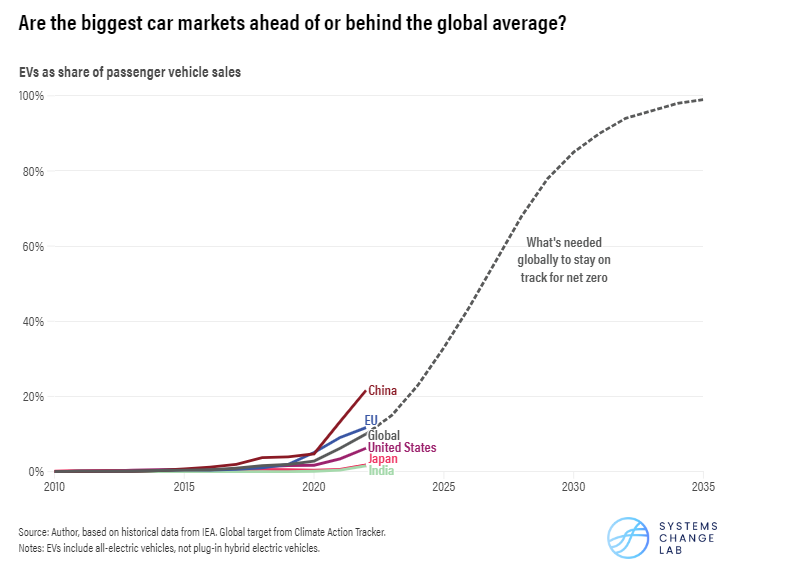
Source: World Resources Institute
EV cost, single-charge driving range, and charge time will all influence EV adoption. Experts predict that EV technology will reach an inflection point when purchase, ownership, and operating costs fall below those of conventional gasoline vehicles, which should accelerate adoption.
Why Battery Packs Matter
As EV demand grows, the battery pack remains the central component of vehicle operation, and deeper study of battery packs is necessary. The lithium-ion battery (LIB) pack is widely used in EVs because of its high energy density, high voltage, stability, low weight, and long service life.
This article examines EV trends, the critical role of battery packs, and the complexity of LIB manufacturing, and discusses why machine vision inspection and artificial intelligence (AI) are important for the industry.
EV and Lithium-Ion Battery Trends
According to Grandview Research, EV adoption has driven significant growth in global LIB production. The global LIB market was estimated at $54.4 billion in 2023, with a projected compound annual growth rate (CAGR) of 20.3% from 2024 to 2030.
Governments and industry are prioritizing a shift to sustainable, environmentally friendly transportation through incentives that support climate goals. In this context, demand for EVs has increased, and LIBs have become a cornerstone of this automotive transformation. LIBs provide the energy and performance that allow EVs to compete with internal combustion vehicles.
Role of the Battery Pack
The battery pack is the core of every EV. This component not only determines vehicle performance but also influences driving range. A pack consists of modules, and modules are composed of individual cells similar in size to common AA batteries.
LIBs are the current industry standard for EV power. Given their maturity and lower manufacturing costs, many LIBs are cylindrical cells. Since 2008, the average cost of EV LIB packs has dropped about 89%, from $1,355 per kilowatt-hour (kWh) to $153/kWh in 2022, and is projected to fall to $100/kWh by 2026.
Cylindrical cells were among the first lithium battery types to be mass-produced. They are built by stacking anode, separator, and cathode sheets, then rolling them into a cylinder. This form factor tolerates internal pressure without deforming and is well suited to automated manufacturing.

Cells are then placed in flip-top plastic cases to form modules. Multiple modules are assembled into a battery pack that powers the EV. Each vehicle may require hundreds to thousands of cells, and the battery pack is a key factor in final vehicle weight and cost.
Alan Eddy, chief technology officer at system integrator Tensor ID, which works with leading LIB manufacturers and top EV companies, notes that inspection systems must address multiple challenges when checking EV batteries, including detecting rust or dents on individual cells. "If a single cell is damaged, the life of the entire pack can be shortened," Eddy says.
LIB Manufacturing and Inspection
LIB manufacturing is complex, covering raw material procurement, electrode production, cell assembly, module assembly, and final pack packaging. Detailed quality inspection throughout these steps is critical to ensure battery efficiency and safety.
Inspection occurs at multiple stages, including:
- Inspecting foil used to make electrodes (cathode and anode)
- In-process assembly inspections
- Inspecting completed cells and modules
Quality control in battery production presents major challenges due to process variability and the potential impact of defects on performance and safety. Identifying internal defects, particularly microscopic ones, is difficult. This is where machine vision and artificial intelligence can add value.
In battery manufacturing, machine vision inspection systems can analyze complex details with high accuracy, speed, and efficiency to improve pack performance. Optimized quality inspection extends battery life and driving range.
For example, if an EV has a 95 kWh battery pack (as in some high-capacity models) and the pack cost is $150/kWh, the battery production cost alone is $14,250. Considering warranty costs, customer satisfaction, and brand reputation, battery quality is a critical factor for automakers.
At Tensor ID, integrators design machine vision systems to inspect complete battery cells and modules. Machine vision can be applied at any stage of manufacturing and assembly. Eddy explains that barcode camera readers have been supplied for years, but modern machine vision does much more. To achieve automation and improve efficiency, manufacturers must reexamine each step of the inspection process from end to end.
Tensor ID's vision systems use Teledyne DALSA area-scan cameras to inspect cells individually, since cells are fully assembled before being placed in flip-top cases. Manufacturers need to read barcodes, identify rust and dents, and determine polarity.
AI enhances inspection performance and can identify rust. Tensor ID uses four high-resolution Teledyne DALSA cameras to inspect battery modules.
Because cells arrive from suppliers in boxes, a robot typically picks each cell for inspection. Each cell must be checked before being placed into a flip-top module. To inspect large packs, Tensor ID uses four Teledyne DALSA Genie Nano cameras to capture images that are stitched across the entire three-foot-wide pack.
Rust detection employs an AI-based software platform to classify images. "AI has transformed battery inspection. Because cell surfaces are reflective, rust is particularly difficult to spot," Eddy says. Tensor ID uses the Teledyne DALSA Astrocyte AI training tool to train models to distinguish rust from other defects such as fingerprints or dust. The system can then identify and remove any rusted cells, since corrosion degrades cell effectiveness.
Beyond inspection, AI also helps optimize battery performance. AI-driven algorithms can analyze large datasets to fine-tune battery management systems (BMS), improving efficiency and extending battery life. Intelligent charging, guided by AI, can make charging smarter and more convenient for drivers.
Benefits of Machine Vision for LIB
Accuracy and Precision
Machine vision delivers high accuracy and precision and supports stringent quality standards. Traditional inspection methods may miss tiny defects that can seriously affect battery performance. Combined with AI, machine vision systems can detect extremely small defects, such as dents around 130 micrometers in size, roughly the width of a human hair. This ensures high accuracy and precision in inspection.
Efficiency and Speed
Machine vision improves both the accuracy and the throughput of inspection. Automated systems can rapidly analyze large volumes of cells, shortening production time and lowering costs. This efficiency benefits manufacturers and supports scalability of EV production.
Safety and Reliability
Ensuring EV safety and reliability is essential. Machine vision inspection helps achieve this by identifying potential defects that could compromise pack integrity or full-charge capacity. Removing substandard cells before they reach the market improves overall EV safety and power-system reliability.
Battery and EV Future Trends
With ongoing technical progress, the outlook for EV batteries is favorable. Solid-state batteries, which may increase energy density and safety, are a key trend to watch. Next-generation materials will also be explored to improve battery performance and sustainability. Currently, average EV driving range is about 219 miles, but cobalt-free chemistries could enable single-charge ranges up to 500 miles. New solid-state cells under test aim for charge times as short as seven minutes.
Besides technological advances, sustainable battery manufacturing is receiving attention. Industry efforts include innovative battery recycling methods to reduce environmental impact and circular-economy approaches to recover materials from old batteries for use in new ones.
Conclusion
Transportation accounts for about 27% of global greenhouse gas emissions. Replacing internal combustion engines with electric or hybrid powertrains helps reduce pollution. For a successful transition to EVs, manufacturers must focus on ensuring high-quality lithium-ion batteries, since LIBs are among the most important and costly components in EVs.
Machine vision inspection is emerging as a transformative capability in the dynamic field of EV battery manufacturing. As Alan Eddy of Tensor ID summarizes, "Battery inspection for EVs is complex; even a 1% failure rate can have serious consequences." The battery pack is not only the EV's "heart" but also its "power plant." Combining AI accuracy with rigorous quality control, machine vision helps ensure packs are reliable, safe, and efficient. Looking ahead, AI integration, advanced battery technologies, and commitments to sustainability are likely to reshape the EV industry toward cleaner, smarter, and more reliable transportation.