Overview
From current technical routes, DC charging is the main approach for fast charging. Fleet and commercial vehicles rely heavily on fast charging due to high opportunity costs of downtime.
DC off-board charging stations convert AC to DC via internal AC-DC modules to charge the vehicle traction battery. Therefore, the performance of the AC-DC module is a key factor that determines the performance of a DC charging station.
Market Power and Voltage Trends
DC charging stations are mainly used for high-power charging. Three-phase input DC chargers range from 11 kW up to and beyond 500 kW. With some vehicles removing the on-board charger, single-phase 220 V low-power DC wall-mounted units (for example 7 kW) have become more common. DC chargers have gone through multiple power upgrades, from 20 kW to 180 kW, 240 kW, 360 kW, 480 kW, 600 kW and above.
The vehicle charging voltage platform is also changing rapidly. Passenger cars have moved from around 300 V to beyond 600 V, and several OEMs already offer 800 V platforms. Charging current is also increasing: some 600 kW platforms are specified for up to 1000 V and 600 A or higher.
The output voltage and current of a DC charger are determined by the AC-DC module. Passenger vehicle voltage ranges used to be 200–450 V, and commercial vehicles 300–750 V; later universal ranges such as 200–750 V emerged. With auxiliary 12 V systems being standardized, module output ranges of 200–1000 V are becoming mainstream in the Chinese market.
1. Charging Module
The charging module performs rectification and filtering of the AC input, boost and regulation (control and conversion). The module power and count determine the charger output power. Core technologies include power electronics conversion circuits and topology innovation, the reliability of real-time embedded control algorithms, electrical system safety design, high-power thermal management structural design, and high power-density integration capability.
1.1 Working Principle
The charging module is the key component for DC charging. Although different modules may operate differently, the principles of AC/DC conversion and control are consistent.
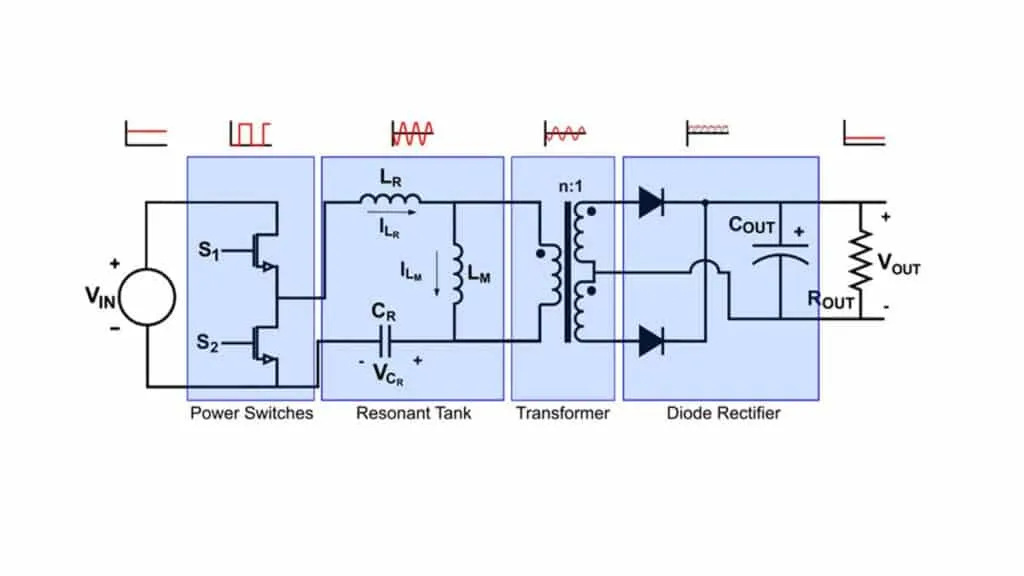
The charging module consists of a three-phase active PFC, a DC/DC converter, auxiliary power supplies, input/output detection, and protection circuits. The front-end three-phase active PFC and EMI input circuit implement rectification, filtering, and power factor correction to meet EMC standards and achieve total current harmonic distortion (THDi) below 5%. The three-phase active PFC is controlled by a dedicated DSP, which shapes the input current to follow the AC input voltage and generates PWM drive signals for the power stage while implementing protection measures. The downstream DC/DC converter, controlled by the DSP, regulates the DC voltage from the PFC, uses a high-frequency transformer and rectification/filtering to produce the stable DC voltage required by the charging module. The auxiliary power supply uses the DC output of the three-phase active PFC to generate the control circuit rails. Input detection measures AC input voltage and current for PFC control and protection. DC/DC detection and protection monitor output voltage, current, and temperature for control and safety. A CAN bus provides communication between the rectifier modules and control module and supports current sharing among multiple rectifier modules.
When the device is connected to 380 Vac three-phase power (three-phase, three-wire), after EMC filtering and three-level active PFC correction of the input voltage/current, the PFC output feeds a three-level full-bridge DC-DC converter. Once the auxiliary power is available, the power indicator shows the module is powered and the control circuit supplies module startup. Both the APFC and DC-DC stages are managed by DSPs. The device can communicate directly with a vehicle BMS via CAN; when CAN communication is present, the BMS controls the charge voltage and current.
The control board clarifies how output voltage and current vary and explains why modules from different vendors are often not interchangeable across different chargers due to software compatibility issues on the control board.
2. DC Charging Station
Main components include charging modules, a master controller, insulation detection module, smart meter, card reader, communication module, air switch, main contactor, and auxiliary switching power supplies.
2.1 Key Performance Parameters (480 kW liquid-cooled)
| Item | Specification | Remarks |
| AC input voltage | 380 V ±15% | Three-phase five-wire |
| AC input frequency | 45–65 Hz | |
| Rated output power | 480 kW | |
| Output voltage | DC 200–1000 V | |
| Output current | 0–600 A | |
| Power factor | ≥0.99 | At output ≥50% Po |
| Efficiency | ≥95% | Peak efficiency |
| Metering | DC meter | Accuracy class 0.5 |
| Cooling | Liquid cooling + air cooling | |
| Ingress protection | IP54 | |
| Altitude | ≤2000 m | |
| Operating temperature | -25°C to 50°C | Derate above 50°C; stop operation at 75°C |
| Relative humidity | ≤95% | No condensation |
| Charging gun | national standard 600 A DC plug | |
| Communications | Ethernet, 4G | |
| Installation | Floor-mounted | |
| Startup | Card swipe, QR code scan |
2.2 Charging Connector
The DC charging interface complies with GB/T 20234.1 and GB/T 20234.3. It uses a standard 9-pin plug as shown below. The plug supports an electromagnetic locking function. Cable length is configured per project requirements.
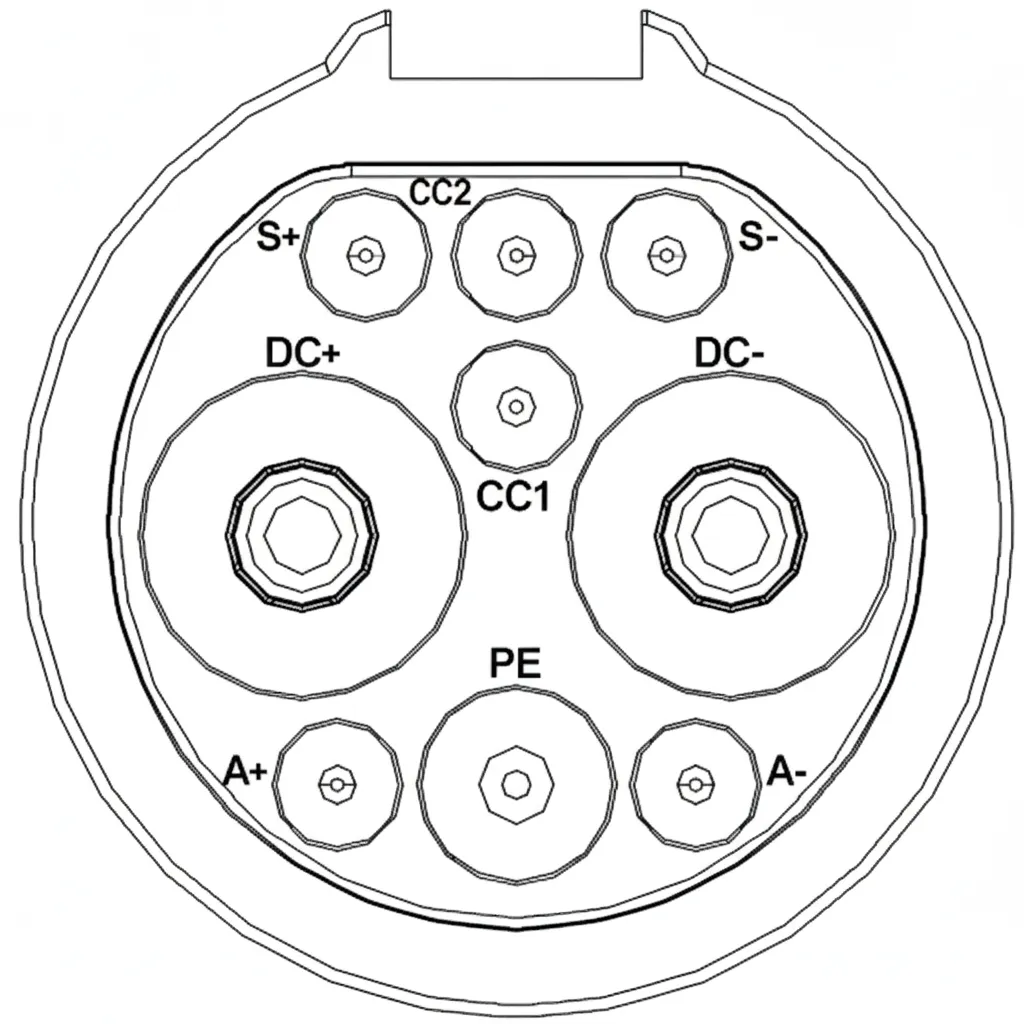
Basic plug parameters:
| Name | Parameter |
| Rated voltage | 1000 V DC |
| Rated current | 600 A |
| Operating temperature | -20°C to 50°C |
| Insertion/extraction force | <140 N |
| Ingress protection | IP55 (when mated) |
| Mechanical life | >10000 cycles |
| Dielectric withstand | 3500 V AC |
Electrical contact pin descriptions:
| No. | Name | Rated voltage | Rated current | Function |
| 1 | DC+ | 1000 V DC | 600 A | Positive DC power, connects to battery positive |
| 2 | DC- | 1000 V DC | 600 A | Negative DC power, connects to battery negative |
| 3 | PE | N/A | N/A | Protective earth, connects charger earth and vehicle chassis |
| 4 | S+ | 30 V | 2 A | Communication CAN_H, connects charger to vehicle communication |
| 5 | S- | 30 V | 2 A | Communication CAN_L, connects charger to vehicle communication |
| 6 | A+ | 30 V | 15 A | Auxiliary power + |
| 7 | A- | 30 V | 15 A | Auxiliary power - |
| 8 | CC1 | 30 V | 2 A | Charging connection confirmation |
| 9 | CC2 | 30 V | 2 A | Charging connection confirmation |
3. Protection Functions
3.1 Input Protection
Input over/under voltage protection, three-phase imbalance detection, and phase-loss protection are provided.
3.2 Output Protection
Output over/under voltage, overcurrent, overtemperature, overload, short circuit, insulation monitoring, battery reverse connection, and current backfeed protections are provided.
3.3 Remote Control
In case of anomalies, remote start/stop and remote firmware upgrade can be performed via the backend.
3.4 System Fault Protection
During charging, in emergencies such as the emergency stop switch activation, BMS communication failure, control guide faults, or loss of input power, the charger can open the DC output contactor within 100 ms and reduce the output voltage to below 60 V within 1 s.
3.5 Overtemperature Protection
If the air filter is blocked, a cooling fan fails, or internal temperature exceeds the overtemperature threshold, the charger will reduce output power or cut DC output and issue an alarm. If the DC connector temperature (measured by a temperature sensor on the charging gun) exceeds its threshold, the charger will reduce output power or cut DC output and issue an alarm. If the battery temperature exceeds the battery protection threshold, the BMS will request a lower charge rate; the charger will comply and reduce output power to protect the battery and extend its life.
3.6 Contactor Sticking
The charger controller automatically detects contactor open/closed states. If any main contactor is stuck closed (cannot open) or stuck open, the charger aborts insulation detection during startup and issues an alarm.
3.7 Dual Battery Protection
During charging, if the output voltage exceeds the vehicle's maximum allowed total voltage or the output current exceeds the vehicle's requested current, the charger will open the output contactor within 1 s and issue an alarm.
3.8 Door Interlock
If the front door of the charger is opened before charging, the charger cannot start. If the cabinet door is opened during charging, the charger immediately cuts power input and DC output.
3.9 Charging Gun Lock
If the electronic lock is not reliably engaged, charging is not allowed. During the entire charging process (including insulation detection), the electronic lock must be reliably engaged; energizing unlock is not permitted. An emergency unlock function is provided so that if charging cannot continue due to a fault or when charging is complete, unlocking occurs only after the vehicle interface voltage has dropped below 60 V DC.
3.10 Insulation Detection
The charger includes an insulation detection circuit. After the vehicle connector is connected and before the vehicle charging circuit contactor closes, the charger closes the DC output circuit contactor to perform insulation testing on internal components (including the charging cable). If insulation is abnormal, charging will not start.
4. High-Power Charging
High-power charging is a complex system-level challenge, not only a module issue. It involves current-related thermal concerns at key nodes throughout the system, including battery thermal management. Since P = I^2 * R, increasing current from 60 A to 360 A multiplies current by 6 and heating power by 36. Thus, thermal management is the most critical aspect of high-power charging.
Some argue that delays in national standards restrict high-power charging development. However, standards require extensive testing and data accumulation. Defining a standard before system-level validation is premature. Standard-setting bodies rely on industry leaders to invest in R&D and testing to generate the necessary data. For example, a common European approach places the cooling circulation drive inside the charger while the cable itself may be uncooled; cooling fluid is delivered to the connector and returned in a loop. German cable manufacturers that include on-cable cooling report that a 25 mm2 cable can carry 350 A based on extensive temperature-rise testing. Connector temperature rise is also critical: the DC+ and DC- terminals are the hottest locations, so individual temperature monitoring of each terminal is essential. To distinguish whether a cable has on-cable cooling, IEC is moving toward defining RC1 and RC2 charging levels, where RC2 refers to current levels that require cooling.
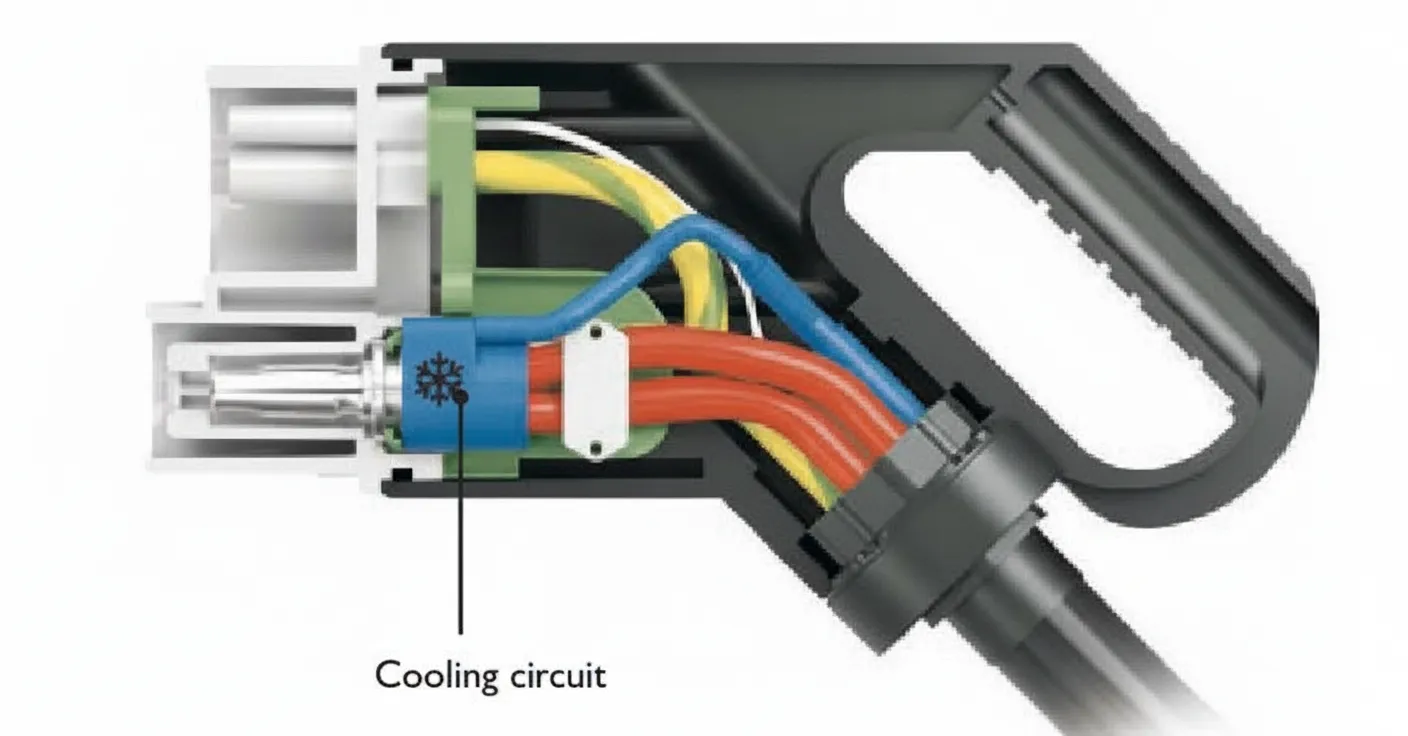
Regarding terminal temperature control, the plating thickness on connector pins is a key factor. In IEC discussions, a delegation from China advocated removing the lower tolerance because an 8-5 tolerance yields only a 3 μm thickness, and also proposed removing the term ELECTROPLATING since layer formation is not only achieved by electroplating. The proposal provoked intense debate: opponents argued against strict lower limits, possibly because of differences in materials and manufacturing processes. European and American manufacturers do not necessarily require an 8 μm plating thickness.
Cooling systems typically use intelligent activation rather than continuous operation. Some vendors choose to enable cooling starting at 200 A to keep temperatures below 50°C, based on testing such as how long 180 A or 200 A can be sustained before reaching critical temperatures. Other research topics include coolant loss or leakage risk, flammability, compatibility of coolants with insulating materials, and other potential hazards—all important details in high-power charging development.