Observed behavior
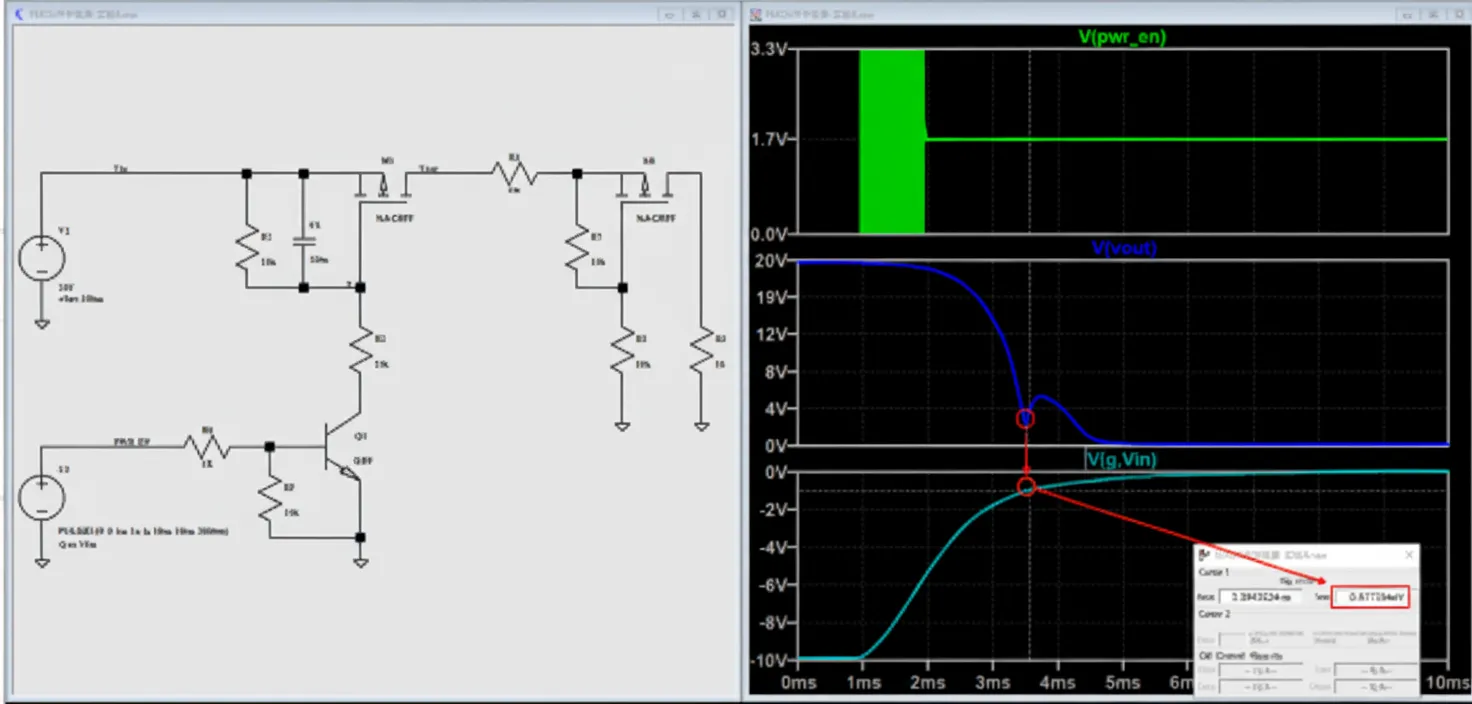
Circuit phenomenon: after the PMOS turns off, the output voltage Vout first falls, then rises, and then falls again, producing a rebound on the falling waveform.
Circuit description
The schematic is a PMOS switch simulation where the load has been replaced by a switch circuit. After changing the load, the falling waveform at Vout becomes abnormal. Why does this happen?
When the PMOS transitions from on to off, its impedance goes from near zero (on) to a very large resistance (off). There is a transition interval during which the PMOS presents a finite resistance, and the load is not a constant resistor.
During the Vout falling process, the voltage across the load may drop to a level where the load suddenly stops operating due to undervoltage, and the required current sharply decreases. In other words, the load's equivalent resistance suddenly increases, changing the voltage divider between Vin, the PMOS, and the load. If the load RL suddenly increases, Vout can abruptly rise as a result.
Mechanism of the rebound
Therefore, during the transition from conduction to cutoff, when the PMOS gate-source voltage Vgs passes through the threshold Vgsth, the output can exhibit a rebound.
Mitigation options
There are two practical approaches to address this issue.
1. Speed up PMOS turn-off
Make the PMOS turn off faster. For example, reduce the capacitor between the PMOS gate and source from 100 nF to 10 nF; this significantly reduces the rebound.
2. Add an output filter capacitor
Add a filter capacitor at the output to prevent the load equivalent RL from jumping to a much larger value. With the capacitor in place, the effective load becomes RL in parallel with the capacitor's impedance. Even if RL suddenly increases, the total load impedance will not exceed the capacitor's impedance.
Because the PMOS turn-off transient is short, the signal can be treated as an AC event, so the capacitor should not be considered an open circuit during this interval; it contributes to the total impedance. With a suitably chosen capacitor value, the rebound issue can be mitigated.