Overview
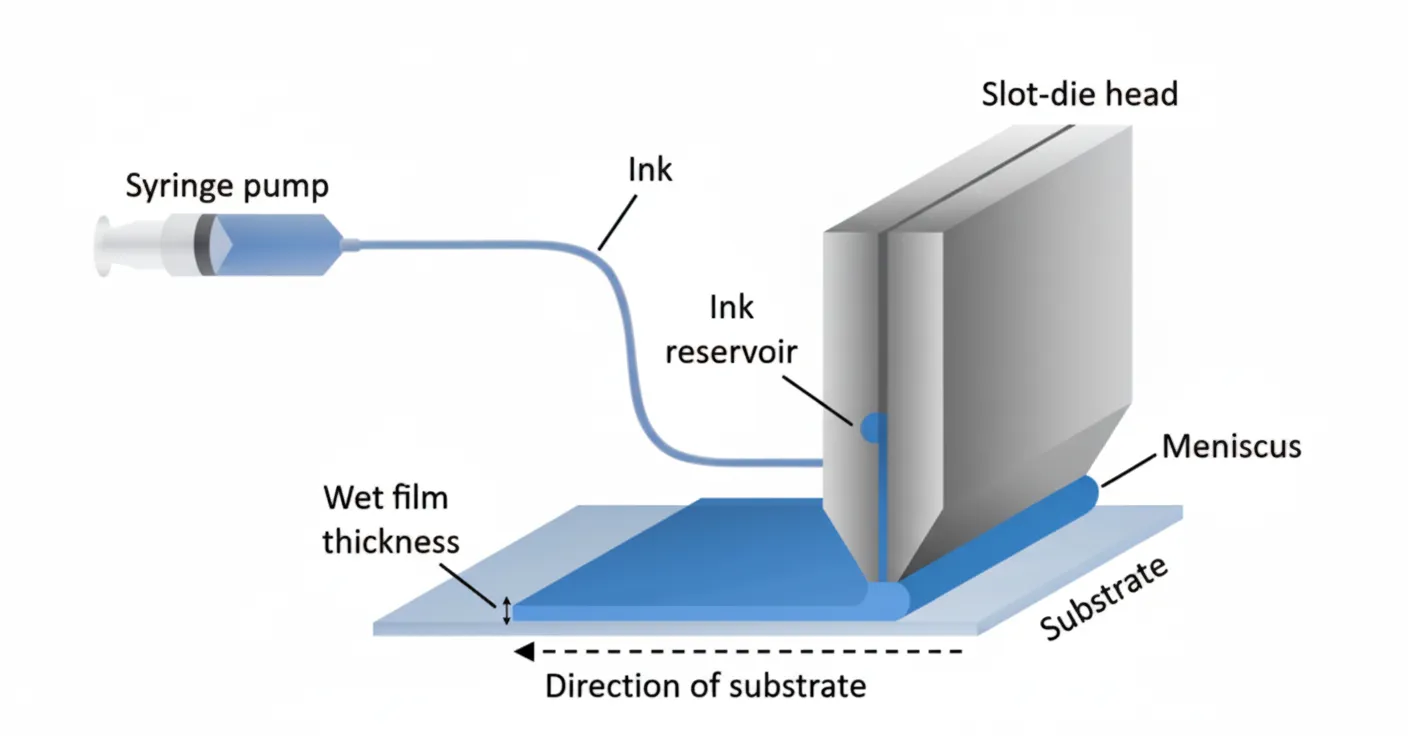
Slot-die coating is a deposition technique used to apply a solution, slurry, or extruded film onto typically flat substrates such as glass, metal, paper, textiles, or plastic foils. The process was originally developed in the 1950s for industrial production of photographic film and since then has been applied to many commercial processes and research areas related to nanomaterials. Slot-die coating produces thin films via solution processing. The coating material is normally dissolved or suspended in a precursor solution or slurry, often referred to as "ink," and delivered to the substrate surface through a precision coating head called a slot-die. The slot-die head features a high-aspect-ratio outlet that controls the amount of coating liquid delivered to the substrate. This enables continuous production of wide coatings, with the width adjustable according to the die outlet dimensions. By closely controlling the solution deposition rate and the relative speed of the substrate, slot-die coating provides controllable film thicknesses in the range of about 10 nm to 100 μm after solvent evaporation.
Advantages and Limitations
Common advantages of the slot-die coating process include pre-metered thickness control, a non-contact coating mechanism, high material-use efficiency, scalability of coating area and throughput, and compatibility with roll-to-roll processing. The process also accommodates a wide range of layer thicknesses and precursor solution properties, such as material choice, viscosity, and solids content. Typical drawbacks include relatively higher equipment and process-optimization complexity compared with similar coating techniques (for example, knife coating and spin coating). In addition, slot-die is a coating process rather than a printing process; it is therefore better suited for depositing uniform, thin material layers rather than printing or continuously building complex images and patterns.
Small-Scale Tools and Scalability
Before committing to full pilot or production-scale equipment, an increasing number of small slot-die tools are available to support development of new roll-to-roll compatible processes. Compared with larger slot-die coating lines, these tools retain similar core components and functionality but are designed for integration into pre-production research environments. Common adaptations include accepting standard A4-size substrate sheets rather than full substrate rolls, using syringe or other laboratory pumps instead of industrial pumping solutions, and relying on hot plates for drying rather than large industrial ovens that provide meters of residence time. Some equipment suppliers offer compact coaters that combine these features with simplified control software.
Because slot-die coating can be scaled between large and small areas by adjusting die dimensions and throughput, processes developed on laboratory-scale tools are generally considered reasonably scalable to industrial roll-to-roll and sheet-to-sheet coating lines. This capability has increased interest in slot-die coating as a route to scale up new thin-film materials and devices, particularly in thin-film solar cell research such as perovskite and organic photovoltaics.