Overview
FEM, or front-end modules, are RF front-end modules. In hardware designs, FEMs perform transmit and receive amplification of RF signals and provide functions such as power detection, control, and switching. FEMs integrate power amplifiers (PA), low-noise amplifiers (LNA), and switches (SW). The RF power amplifier is a key component. In a transmitter front end, the RF signal is amplified by the PA to produce sufficient transmit power for the antenna to radiate.
Output power and efficiency are important metrics for RF amplifiers. Increasing output power, together with high gain and low current consumption that improve efficiency, is a primary way to evaluate RF amplifier performance.
Example Measurement
Typical measurement output may include lines such as:
802.11ax output power: +18.5 dBm, -43 dB DEVM, MCS11
In this example, 802.11ax refers to Wi?Fi 6. Wi?Fi 6 introduced 1024-QAM modulation, enabling higher-order MCS combinations such as MCS10 and MCS11. A specification of -43 dB DEVM indicates a dynamic error vector magnitude requirement of -43 dB. A smaller (more negative) DEVM indicates better signal quality; achieving higher output power under tighter DEVM limits is more challenging. Pursuing high output power while maintaining high signal quality is a common design objective for RF IC engineers.
What Are EVM and DEVM?
EVM stands for error vector magnitude. It quantifies the difference between the ideal transmitted signal and the actual transmitted signal and is a primary metric for vector signal quality.
In a transmission chain, the baseband vector signal is modulated and then converted by a DAC before passing through an upconverter and the PA for transmission. In practice, nonideal behaviors such as PA nonlinearity and upconverter spurs distort the vector signal, causing the transmitted vectors to deviate from their ideal positions.
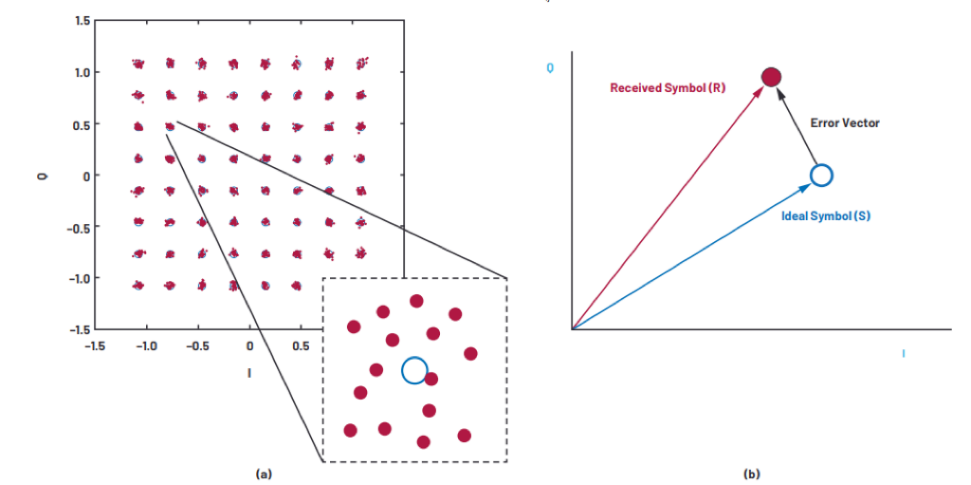
The red solid dots in the figure represent measured vectors and the blue hollow circles represent ideal vectors; EVM describes the vector difference between them.
When computing the error vector, amplitude, phase, and frequency differences are considered, producing a multi-dimensional error vector whose magnitude is the EVM value. In measurement practice, EVM is usually expressed as a root-mean-square statistic describing the overall error vector magnitude of the modulated signal over a unit of time, not an instantaneous value. It evaluates the communication signal based on the ensemble of samples.
EVM & DEVM
DEVM stands for dynamic EVM and is used widely in wireless communications, especially Wi-Fi, to assess system signal quality. Traditional EVM evaluates the signal using the ensemble of samples, but Wi-Fi characteristics make an overall-sample metric less suitable in some cases.
The main reason is that Wi-Fi is a TDD (Time Division Duplexing) system where transmit and receive share the same RF frequency; uplink and downlink use different time slots. To reduce system power consumption, the PA may be powered down or disabled when not transmitting (for example during receive periods) or between packets. Therefore, evaluating Wi-Fi signal quality requires measuring errors at each instant rather than averaging across a time interval. DEVM measures the error at every waveform sampling instant, where "dynamic" reflects this continuity.
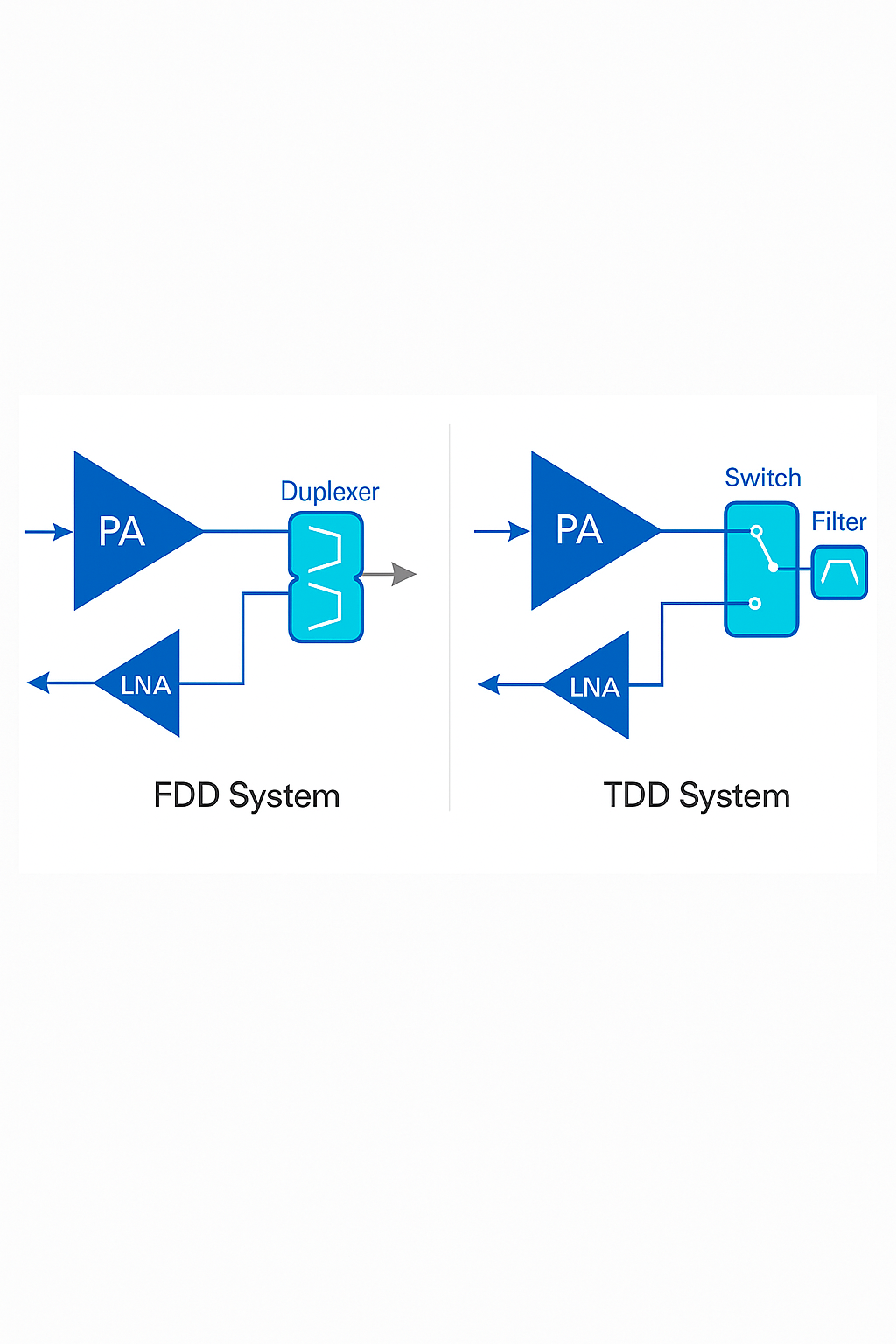
PA power cycling and thermal transients during actual operation can degrade channel estimation and transmitter performance, causing DEVM to be worse than traditional EVM.
Comparison: Traditional EVM vs DEVM
| Comparison Item | Traditional EVM | Dynamic EVM |
|---|---|---|
| Mathematical definition | Calculated by comparing the demodulated reference signal with the measured signal | Calculated by comparing the input excitation signal with the output response signal |
| Applicable Device Under Test | Single-ended measurements, e.g., transmitters | Two-port through-type devices, e.g., power amplifiers and transmit chains |
| What it measures | Overall transmitter quality | Degradation of chain EVM caused by one or more devices |
| Reference signal | Reference is the demodulated input signal | Reference is the excitation signal (actual input to the DUT) |
| Measurement time points | Measured only at symbol decision instants | Measured at all waveform sampling instants |
| Filtering | Passes through a baseband filter | No baseband filtering |
Implications for WiFi
In WiFi systems, spectrum congestion and growing data demands make signal quality an important control factor. A smaller DEVM value means the modulated signal is closer to the ideal, improving wireless link quality; a larger DEVM indicates larger errors that may degrade communication performance. For example, common 5 GHz WiFi 6 FEMs under a -43 dB DEVM requirement typically have output power around 18–20 dBm; even a 0.5 dBm gain in output power can be significant for engineers.
Power amplifiers are RF components where performance is refined continuously. Under Wi-Fi 6 modulation and coding schemes, DEVM imposes tight limits to ensure high-quality amplification. As Wi-Fi 6 (802.11ax) and the forthcoming Wi-Fi 7 (802.11be) become widespread, DEVM will appear more frequently in performance specifications.