Overview
Any field that uses electromagnetic waves to transmit information relies on an antenna. Today we look at several early pioneers associated with antenna development.
For many, there is no single definitive answer to who "invented" the antenna.
Radio did not become a practical technology until the late 19th century. That progress owed as much to experimentalists as to theoretical scientists, and many pioneers contributed to the work.
Key Figures
Around 1864, Scottish physicist James Clerk Maxwell formulated the theoretical foundations of radio.
In 1888, German physicist Heinrich Hertz experimentally demonstrated the existence of radio waves.
On August 14, 1894, British physicist Oliver Lodge demonstrated how radio waves could be used to transmit a signal from one room to another. In his 1932 autobiography he described the experiment as "a very crude wireless telegraph."
Oliver Lodge (1851–1940)
On February 1, 1898, Lodge applied for a U.S. patent for a "telegraph" that described "an apparatus by which an operator may send intelligence to any one or more of many different persons at different places by what is now called the 'Hertzian wave telegraph'..."
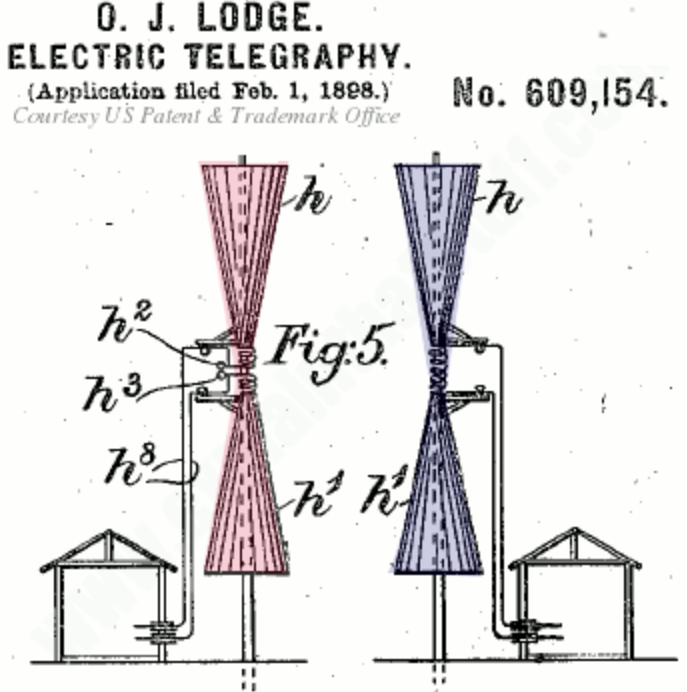
The diagram from Lodge's telegraph patent shows radio waves transmitted through space from a red transmitter to a blue receiver at some distance.
Lodge was not aware at the time that Guglielmo Marconi was conducting parallel experiments in Italy and eventually became the more prominent presenter of the technology.
Because of that visibility, many people regard Marconi as the "inventor of radio." In reality, he was one of several visionaries who helped convert electromagnetic-wave science into practical technology.
Lodge has received relatively little public recognition compared with some of his contemporaries.
Alexander Popov
Another early pioneer was the Russian Alexander Popov. At age 29, after learning of Hertz's discovery of electromagnetic waves, Popov reportedly said he had spent his life installing electric lighting to illuminate a small corner of Russia, but if he could command magnetic waves they could travel across the world.
In 1894 Popov built a radio receiver. During experiments he observed that the detection distance of his receiver suddenly increased in some trials. After investigating, he found a wire lying on the coherer (metal-filings detector). When he removed the wire, the bell stopped ringing; when he reattached a wire extension, the bell rang again at much greater distance.
Popov's experiments showed that using a wire connected to the detector greatly increased signal range, which led some observers to credit him as an inventor of the antenna.
Conclusion
There is no single inventor who can be credited exclusively with inventing the antenna. Maxwell and Hertz established the theory and experimental proof of electromagnetic waves, while practitioners such as Oliver Lodge, Alexander Popov, and Guglielmo Marconi translated those discoveries into working systems and devices. Each contributed in different ways to what became practical radio communication.