Electromagnetic warfare professionals need to understand how frequency bands are divided. Previously the radar frequency letter designation standards were introduced, which provide the standard method for naming radar frequency bands by letter.
Electronic systems use a different band designation from radar; they use sequential letters.
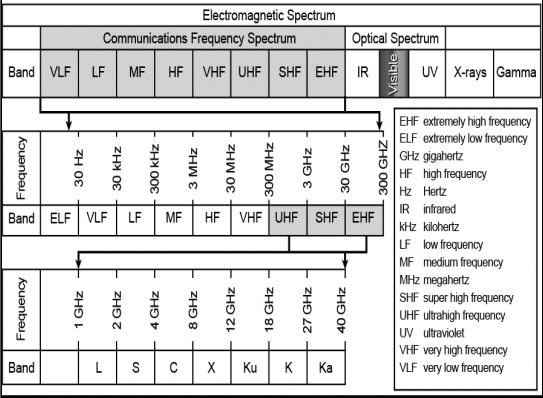
An English report released in 2023, replacing "Electronic Warfare Techniques", provides in its appendix a method for dividing radio wave bands:
This division is based on wavelength orders of magnitude and is fairly detailed. Notably, according to the MHz column, VLF is defined as 3–30 kHz, i.e., below 0.03 MHz, which overlaps with LF. Even with this division, the 30 Hz to 3 kHz range is omitted. The table below shows, at a glance, the frequency ranges commonly referred to as meter-wave or millimeter-wave radar:
ELF, Extremely Low Frequency
ELF occurs incidentally or naturally, for example as white noise and hum in circuits, or from interactions between the solar wind and atmospheric charges. ELF can be used for underground communication.
VLF, Very Low Frequency
VLF signals are compatible with the Earth-ionosphere waveguide, enabling long-range propagation with low attenuation and high stability. The Earth-ionosphere waveguide is a phenomenon that allows certain radio waves to propagate in the space between the ground and the ionosphere boundary. During geomagnetic storms, VLF may be the only method for long-range radio communication. Because of the long wavelengths and the need for large antennas, operators do not typically use very low frequencies for long-distance terrestrial links. Although geomagnetic storms have little effect on propagation in this band, atmospheric noise can be problematic. VLF applications include navigation, time signals, submarine communication, and some aircraft systems.
LF, Low Frequency
As frequency increases into the LF band, diffraction decreases and attenuation increases with distance, so for a given power output the achievable range drops rapidly. Using a more efficient transmitting antenna can offset the power decrease and extend range. LF signals are most stable within the transmitter's ground-wave range. Pulsed signals allow separation of stable ground-wave pulses from variable sky-wave pulses; separation distances can reach 1500 km (932 miles), and sea-paths up to 2000 km (1243 miles). The Loran system uses the low-frequency band; it is useful for radio direction finding.
MF, Medium Frequency
Medium-frequency ground waves can provide reliable service, but long-distance communication requires increased transmitter power. For a 1 kW signal, the range can vary from about 645 km (400 miles) at the lower end of the band to about 24 km (15 miles) at the upper end. Achievable distance depends on: 1) transmitter power level; 2) antenna efficiency; 3) terrain between transmitter and receiver. Raising the antenna allows direct-wave transmission, which can improve signal quality. In the lower part of the band, sky-wave propagation may be used both day and night. As frequency increases, ionospheric absorption reaches a maximum around 1400 kHz. Higher frequencies have less absorption, so sky-wave use increases. However, because the ionosphere varies with hour, season, and solar cycle, sky-wave reliability is variable. With careful frequency selection, multiple skip signals can be used. Frequency selection is critical: if the frequency is too high, the signal penetrates the ionosphere and is lost in space; if too low, the signal is too weak. Generally, sky-wave reception is similar day and night, though lower frequencies are preferable at night.
HF, High Frequency
HF ground-wave range is limited to about 5 km, but antenna height can increase the direct-wave transmission distance. Antenna height also strongly affects sky-wave propagation. During the day, usable frequencies may be 10–30 MHz; at night, usable frequencies may drop to 8–10 MHz. Military forces use HF radios for beyond-line-of-sight communications.
VHF, Very High Frequency
VHF communications use direct waves, or direct waves plus ground-reflected waves. Although some interference occurs between the direct and ground-reflected waves, raising the antenna to extend the direct-wave range increases reception distance. VHF diffraction is much less than at lower frequencies, though diffraction is noticeable when signals pass over sharp peaks or ridges. Under certain conditions ionospheric reflection can be strong enough to be used, but usually it is not available. This band experiences little atmospheric noise. VHF can employ reasonably efficient directional antennas. VHF uses include line-of-sight, ground-to-air, air-to-air, and land and maritime mobile communications. Most tactical radios also operate in the VHF range.
UHF, Ultra High Frequency
UHF has no sky-wave propagation because the ionosphere lacks sufficient density to refract these waves, so they can pass through the ionosphere into space. While some wave interference exists, ground waves and ground-reflected waves are available. Diffraction is negligible, but due to refraction the radio horizon extends about 15% beyond the visual horizon. UHF reception experiences almost no fading or atmospheric noise interference. The band is widely used for ship-to-ship and ship-to-shore communications. Military forces use UHF for narrowband (single-channel) tactical satellites, some radars, and line-of-sight communications.
SHF, Super High Frequency
In the SHF band, also called the microwave or centimeter wave band, there is no sky-wave propagation. Transmission is entirely by direct waves and ground reflections. Diffraction and interference due to atmospheric noise are practically nonexistent. Transmission characteristics are similar to UHF but with greater impact from the shorter wavelengths. Reflection from clouds, water droplets, and dust particles increases, causing greater scattering, interference, and attenuation. SHF is commonly used for line-of-sight radio, radar, and broadband satellite communications.
EHF, Extremely High Frequency
Compared to SHF and lower bands, EHF is more susceptible to atmospheric attenuation. Protected satellite communications use EHF.