Introduction
This article summarizes how positioning technology began and how recent advances continue to change applications that rely on location data. It explains the basics and advantages of ultra wideband (UWB) and the industries and devices that can make use of UWB technology.
How positioning technology changed everyday life
Twenty years ago, location information was not readily available to the public. Public access to the Global Positioning System (GPS) for navigation and location-based services began in May 2000. Before GPS, people relied on maps, asking for directions, or trial and error to find their way.
About a decade ago, indoor navigation emerged. Think of Google Maps coverage inside shopping centers, airports, and other large buildings. New location-based services helped people find stores and enabled targeted marketing, increasing the value of location data.
It is difficult to imagine modern services without easy navigation, both indoors and outdoors. For example, without GPS, large e-commerce logistics operations would be far more complex. These services extend beyond a single industry and have reshaped many sectors.
We are now seeing the rise of a new generation of positioning: precise micro-location systems. These systems can locate objects and people with unprecedented precision. The main driver is demand from consumers and businesses for more reliable and accurate ways to locate nearly anything, from keys and remotes to a specific shelf in a grocery store. Both B2B and consumer retail sectors recognize that more precise and reliable indoor positioning can add operational and user experience value, such as navigation inside venues, higher levels of home and building automation, and real-time visibility of assets and personnel for improved operations.
Value of location information
Existing embedded technologies let devices determine content and time and report that information to users. Sensors provide content data, precise system clocks provide time, and devices exchange information via radio frequency (RF) links.
Adding a location dimension to device functionality is akin to giving it a sixth sense. Location data enables context-aware products and services that were previously impossible.
Potential benefits of knowing location include:
- Efficiency: In factories and warehouses, real-time asset location improves utilization, reduces search time, and enhances just-in-time workflows.
- Safety: Knowing the real-time positions of people, automated guided vehicles, and robots helps control interactions, prevent incidents, and keep personnel out of hazardous areas.
- Decision support: Real-time location can enable context-based decisions, such as adjusting audio when moving between rooms or controlling devices by pointing at them.
- Security: If locations are hard to spoof, they can serve as a new security credential, restricting access to areas and protecting physical assets and communications.
Why new real-time positioning technologies are needed
To fully realize the potential of location services, we need technologies that meet application and environmental requirements. High accuracy is an obvious requirement: object and person positioning and navigation often require centimeter-level precision, while traditional technologies such as GPS deliver meter-level accuracy.
Accuracy alone is not sufficient. The technology must also:
- Deliver robust performance in challenging environments
- Scale to support thousands of people and assets in large venues
- Consume very low power
- Be cost-effective
- Be embeddable in a wide range of devices, from high-end smartphones to low-cost asset tags
- Operate in real time, since location is tied to motion
Bluetooth Low Energy (BLE) and Wi-Fi have been useful for some positioning systems, but they were not designed for real-time, high-precision micro-location services. BLE is suited to low-power data communication, but despite engineering efforts, BLE and Wi-Fi often cannot meet the accuracy, reliability, and real-time requirements of precise indoor positioning. Typical BLE accuracy is on the order of meters and its reliability depends heavily on the environment.
Because BLE and Wi-Fi have been widespread for years, they remain the first choices that come to mind. Beacons and access points have been used for positioning: a beacon is a small wireless transmitter that uses Bluetooth to send signals to nearby smart devices, enabling location search and interaction. However, these technologies require substantial processing and measurement to yield a useful position and tend to be slower and more power-consuming.
Given these limitations, it is time to deploy UWB. UWB is a standard developed specifically to meet real-time positioning requirements.
Overview of ultra wideband (UWB)
UWB is an IEEE 802.15.4a/z standard technology optimized for secure, precise micro-location applications. It meets the requirements listed above. Like GPS, UWB can materially increase the value of location information by significantly improving precision and reliability.
UWB characteristics include:
- High accuracy: UWB can locate people and objects within a few centimeters, roughly 100 times more precise than Wi-Fi and BLE. This level of precision matters when tracking small objects or determining which side of a wall an object is on.
- Robustness: UWB is less affected by multipath and interference. Indoor RF positioning is challenging due to reflections and other interference, but UWB mitigates these effects.
- Low latency: UWB can be up to 50 times faster than GPS, with update rates up to 1,000 times per second. It is thousands of times faster than BLE beacons, making it suitable for fast-moving objects such as drones.
- Low power and cost-effective: UWB can be implemented with low power consumption; many UWB devices run from coin cells.
- Single-point ranging: UWB can determine location reliably with single-point measurements, whereas many narrowband RF techniques require multiple samples and filtering.
- Security: UWB uses transmission distance limits defined by IEEE and incorporates measures that make relay attacks and other exploits difficult.
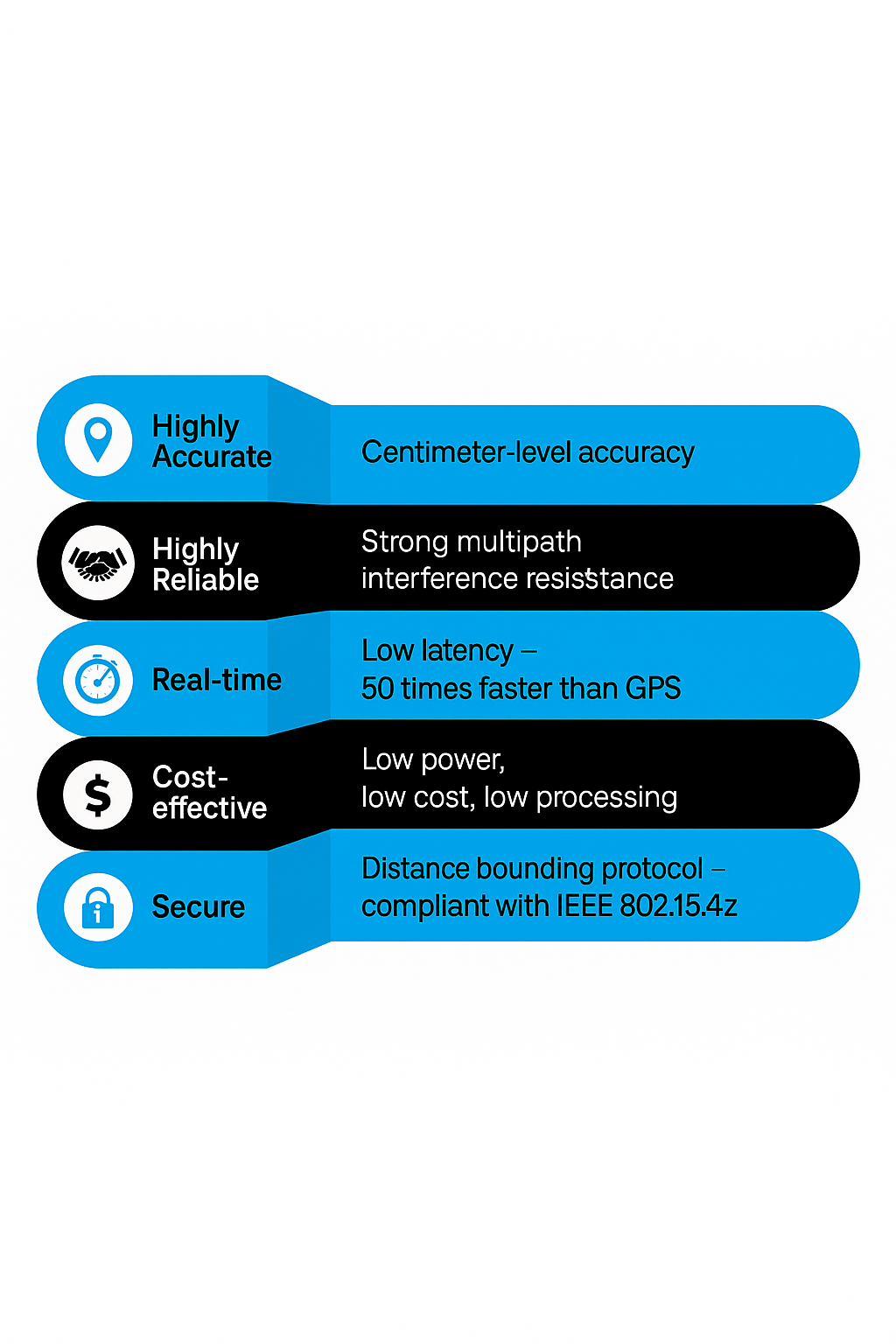
Figure 1: Ultra wideband technology features
Comparison: UWB versus other standards
When designing an indoor positioning system, many factors must be considered. You should choose the technology that best fits the application. Available technologies differ in coverage, accuracy, reliability, and other properties.
The following sections review key differences among these technologies.
1. Infrastructure range and cost
Range and cost are related because working range determines the number of infrastructure devices needed inside a building. Larger range means fewer devices per area and lower cost.
For example, UWB RF range is about 50 to 70 meters, Bluetooth positioning typically covers 10 to 20 meters, and Wi-Fi covers about 40 to 50 meters. BLE and Wi-Fi positioning commonly rely on received signal strength; accuracy drops rapidly as devices move away from infrastructure. UWB positioning is based on time-of-flight (ToF), so accuracy remains consistent across its working range.
Theoretical range and algorithmic accuracy together determine practical anchor spacing. Using UWB to cover an area typically requires fewer wireless anchors than Bluetooth or Wi-Fi, which can significantly reduce infrastructure, deployment, and maintenance cost.
2. Data communication rates
Indoor positioning systems must often collect sensor data from embedded devices. Using multiple technologies increases complexity and cost. In addition to positioning, UWB supports data rates up to 27 Mbps, which makes it suitable for fast, efficient sensor data collection. Engineers are working with standards bodies to increase UWB data rates beyond 27 Mbps.
3. Scalability
For large-scale deployments, a key consideration is the number of devices (sensors and actuators) that can operate simultaneously in a venue. Factories often need to track thousands of assets. Because UWB packets are very short, UWB systems can handle thousands of devices, whereas Wi-Fi and Bluetooth typically support only a few hundred.
4. Latency
System latency, i.e., the delay between position reports, is critical for applications where tracked objects are moving. UWB's short packets and precise measurements enable sub-millisecond latency, enabling truly real-time positioning. Other technologies can take seconds to acquire and compute positions required by many applications.
UWB applications and deployments
Consumer use cases include connected home, retail, robotics, TV/set-top box interaction, augmented reality and virtual reality (AR/VR), sports tracking, and drones.
Automotive use cases include secure keyless entry and start for vehicles.
Industrial use cases include building control, healthcare, agriculture, security, factory automation, robotics, and mining.
In manufacturing, industrial logistics, smart home, and automotive Industry 4.0 scenarios, UWB provides clear visibility of objects and people, improving operational efficiency, safety, and asset tracking.
Notable UWB use cases include:
- Home security and connected home — UWB enables seamless experiences. Systems can detect when an authorized user approaches or leaves with a smartphone in a pocket, enabling automatic arming or disarming without keys or touch panels. UWB also enables intuitive remote control: by using the remote's position and orientation, the correct device can be targeted.
- Industry 4.0 — UWB provides precise, reliable location for objects and personnel to improve efficiency, safety, and asset tracking. Factories can warn workers when they approach hazardous zones and confirm safe evacuation during emergencies. UWB tags can track forklifts and tools to provide near-real-time visibility of work progress, optimize workflows, and remove bottlenecks.
- Automotive — UWB-enabled key fobs deliver secure ranging to prevent vehicle theft. UWB uses ToF and security measures defined in IEEE 802.15.4z to mitigate relay attacks.
- Robotics — UWB enables precise robot navigation. Examples include autonomous lawn mowers and automated guided vehicles (AGVs) that deliver parts to specific workstations. Personal transport robots can follow users and carry heavy items.
- Sports — With centimeter-level accuracy and low latency, UWB is well suited for sports analytics. It tracks athletes during high-speed motion reliably and has been used in professional sports to improve performance and reduce injury risk.
- Enterprise — UWB supports reliable social-distancing solutions and safe worker transport to job sites. Its precision, reliability, and real-time characteristics make it a preferred technology for enterprise applications, including contactless access control that eliminates the need for swipe cards.
UWB achieves these capabilities because it uses very wide transmission bandwidths (greater than 500 MHz) and time-of-flight measurements rather than narrowband communication and received signal strength indicator (RSSI) methods.