Overview
Recently, a team led by researchers at Northwestern University developed an AI system that can design robots from scratch. The related study was published on October 3 in the Proceedings of the National Academy of Sciences.
Notably, the AI ran on an ordinary laptop and completed the entire design process in 26 seconds without any design hints from the researchers. In other words, the AI discovered on its own that long legs are an effective way to traverse land.
Method and Results
“We found a very fast AI-driven design algorithm that bypasses the long path of evolutionary history and does not rely on human designers' biases,” said Sam Kriegman of Northwestern University. Kriegman is an assistant professor in computer science, chemistry and biological engineering, and mechanical engineering, and a member of the Center for Robotics and Biosystems.
“We told the AI we wanted a robot that could walk on land, pressed a button, and that was it. In the blink of an eye the system produced a robot that does not resemble any animal that has walked on Earth. I call this process 'instant evolution.'”
At the start, the researchers gave the AI a simple prompt: design a robot that can walk on a flat surface.
While natural evolution took billions of years to produce the first walking species, the new algorithm compresses that process to lightning speed — producing a successful walking robot in 26 seconds.

The system's speed is notable because it runs on a personal laptop and creates novel morphologies from scratch. This contrasts with other AI systems that typically require supercomputers and massive datasets, and which often reproduce human design patterns instead of generating genuinely new solutions.
The AI began with a block of material roughly the size of a bar of soap. Initially the block only wobbled and could not walk. The AI recognized the goal had not been met and then iterated rapidly. At each iteration the AI evaluated performance, identified flaws, and updated the structure by trimming. Eventually the robot could bounce in place and then jump forward. After nine attempts, the AI produced a robot that moves forward at about half a body length per second, roughly half typical human walking speed.
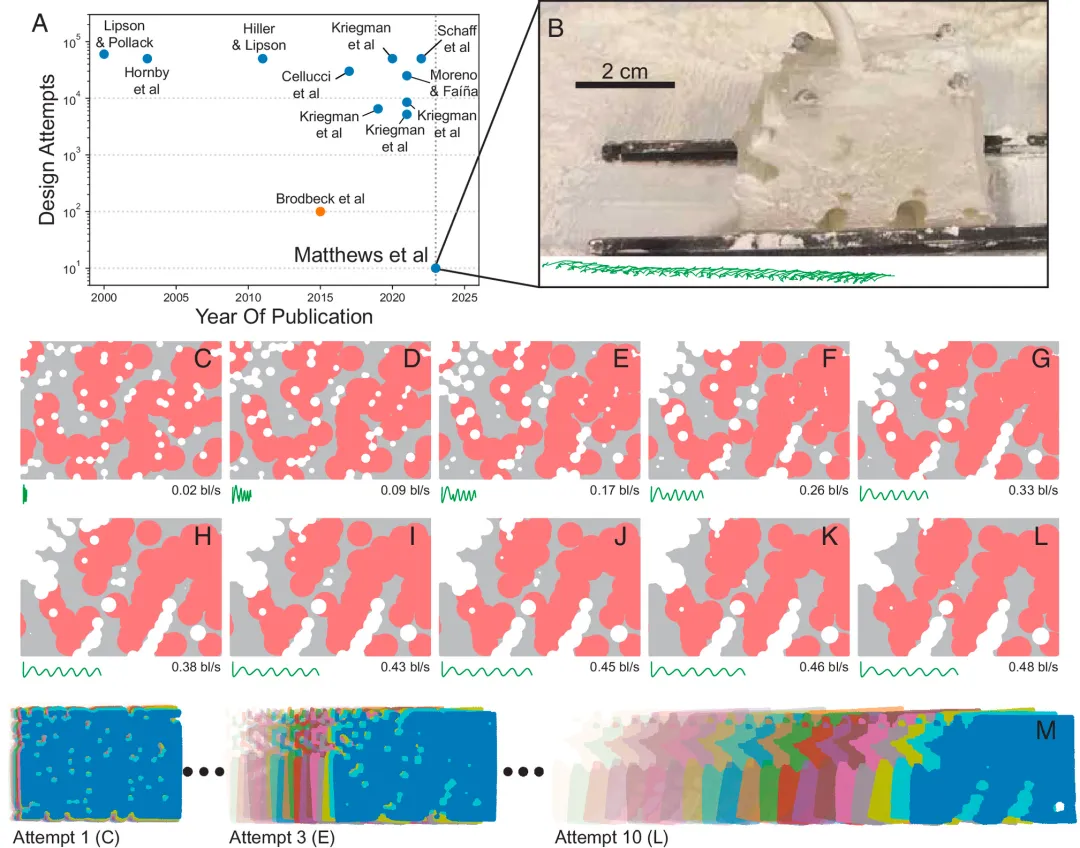
The entire design process — from an immobile block to a walking robot — took 26 seconds on a laptop.
Physical Prototyping
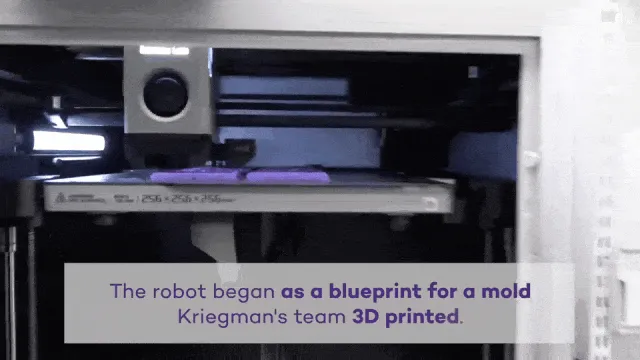
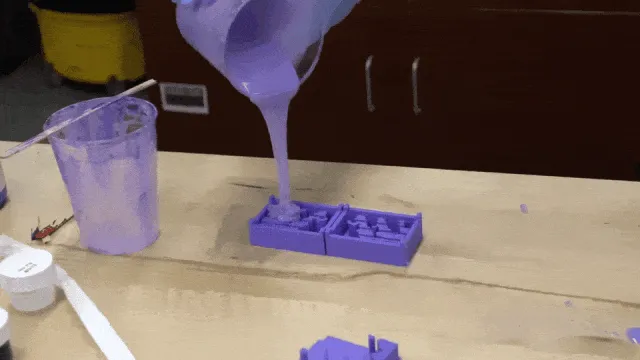
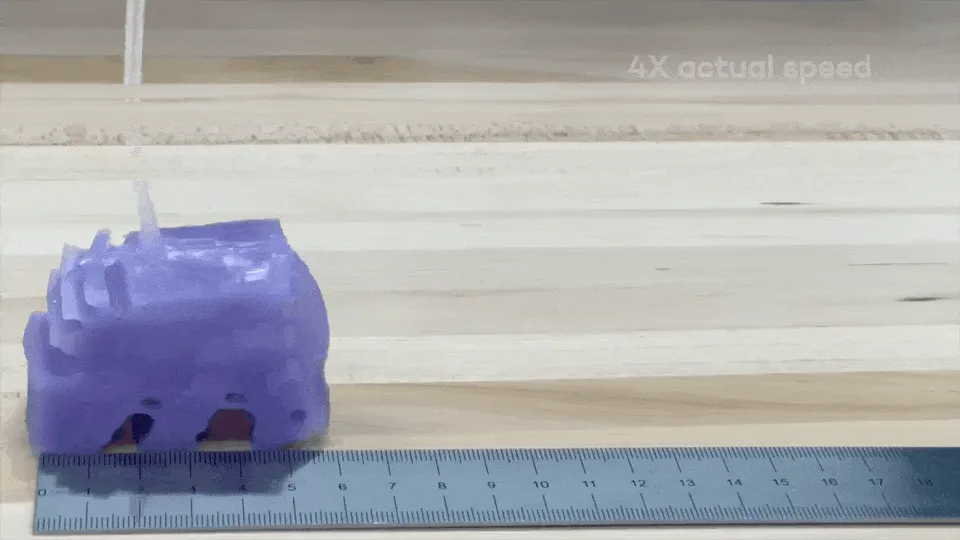
To test if the design would work in reality, Kriegman and his team 3D-printed molds of the negative space around the robot's body and filled them with liquid silicone. After several hours of curing, they removed the solidified silicone from the molds to obtain soft, elastic bodies.
They then inflated the robot with air. The three legs inflated and deflated repeatedly; as air was pumped in and out, the legs expanded and contracted and the robot moved slowly but steadily forward.
A New Form Emerges
David Matthews, the paper's first author, worked closely with Sam Kriegman and coauthors Andrew Spielberg, Daniela Rus (MIT), and Josh Bongard (University of Vermont) over several years to achieve this result.
Kriegman previously gained attention in early 2020 for developing xenobots, the first living robots made entirely from biological cells. The team now sees this new AI as the next step in exploring the potential of artificial life.
The robot itself is small, soft, and asymmetrical, made from inorganic materials. Kriegman said this represents a first step toward AI design tools that can act directly on the physical world like animals do.
“When people look at this robot they might see a small, odd device,” Kriegman said. “I see the birth of a new kind of organism.”
“As AI generates increasingly effective robot bodies in real time, anyone can observe evolution in action,” Kriegman said. “What once required weeks of trial and error on supercomputers — and billions of years for biological evolution — can now be compressed into moments. Evolution lacks foresight; it cannot know whether a specific mutation will be beneficial or catastrophic. We found a way to remove that obscuring factor and compress billions of years of evolution into an instant.”
Design Features
Working from the design prompt alone, the AI independently discovered the biological solution of legs for terrestrial locomotion. However, the AI's design differs from perfectly symmetric biological forms: the robot has three legs, fins on its back, a flat face, and numerous pores.
“This is interesting because we never told the AI that the robot should have legs,” Kriegman said. It rediscovered legs as an effective method for land movement. Indeed, legged locomotion is one of the most efficient forms of ground movement.
The perforations are unusual; the AI appears to have introduced holes. Kriegman hypothesizes that porosity reduces weight and increases flexibility, enabling the legs to bend for walking.
“We do not really know what the holes do, but we know they are important,” he said. “Removing them either prevents locomotion or degrades walking performance.”
Overall, Kriegman expressed surprise and fascination with the robot's design, noting that most human-designed robots tend to resemble humans, dogs, or hockey pucks.
“When humans design robots, we tend to make them look familiar,” he said. “But AI can generate possibilities and evolutionary pathways humans have never considered, helping us think differently about some of our hardest problems.”
Potential Applications
Although the first AI-designed robot walks only haltingly, Kriegman envisions a future in which AI designs tools. AI-designed robots could one day navigate rubble to find trapped people and animals, traverse sewers to repair damage, or produce microscopic robots that enter the human body to clear arteries, diagnose disease, or destroy cancer cells.
“The only thing stopping us from using these new tools and therapies is that humans do not yet know how to design them,” he said. “Fortunately, the AI has its own ideas.”
Note: affiliations mentioned in the text include Northwestern University, MIT, and the University of Vermont.