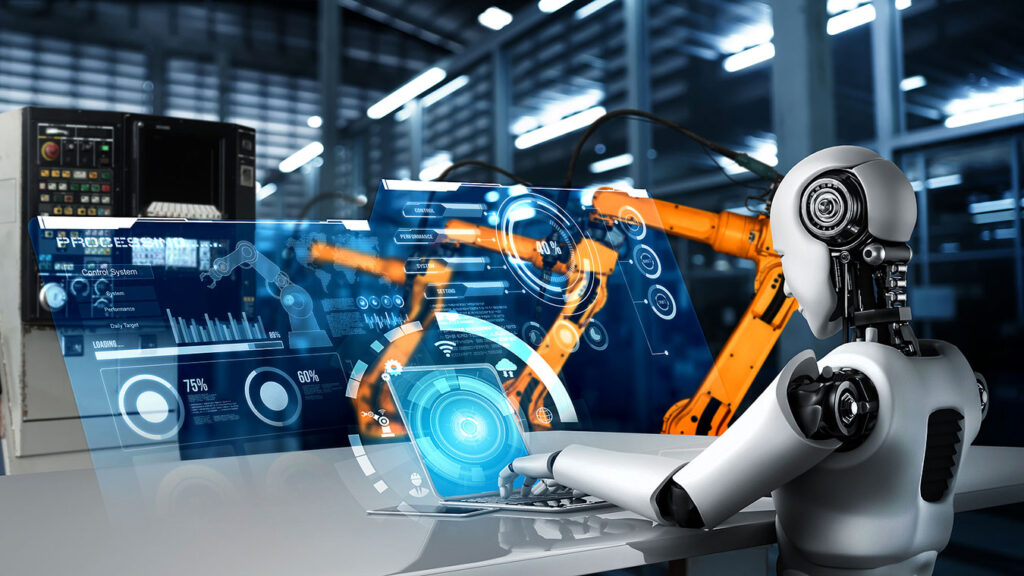
With rapid advances in technology, industrial robots have become a key part of modern manufacturing. They play important roles across many industries by improving production efficiency, reducing costs, and enhancing product quality. This article describes the main components of a complete industrial robot and their functions to provide a clearer technical overview.
1. Mechanical Structure
The basic mechanical structure of an industrial robot includes the base/torso, arm, wrist, and fingers or end effector. These parts form the motion system that enables precise positioning and movement in three-dimensional space.
- Base/torso: The base is the main body of the robot, typically made of high-strength steel. It supports other components and provides internal space for sensors, controllers, and other devices.
- Arm: The arm is the primary part for executing tasks and is usually actuated by joints to provide multiple degrees of freedom. Depending on the application, arms may use fixed axes or telescopic designs.
- Wrist: The wrist connects the arm to the end effector and typically consists of several joints and linkages to enable flexible grasping, placement, and manipulation.
- Fingers / End effector: The end effector includes tools and grippers used to perform specific operational tasks.
2. Control System
The control system is the core of an industrial robot. It receives information from sensors, processes that data, and sends commands to drive the robot's motion. Common control system components include:
- Controller: The controller acts as the robot's brain, processing signals from various sensors and generating control commands. Common controller types include PLC (programmable logic controller), DCS (distributed control system), and IPC (industrial PC or intelligent control system).
- Drivers: Drivers interface between the controller and the motors, converting controller commands into actual motor motion. Depending on application requirements, drivers can be for stepper motors, servo motors, or linear motors.
- Programming interface: The programming interface is the user interaction tool, which may be computer software, a touchscreen, or a dedicated control panel. Through this interface, users set motion parameters, monitor operation status, and diagnose faults.
3. Sensors
Industrial robots rely on various sensors to obtain information about their environment for accurate positioning, navigation, and obstacle avoidance. Common sensor types include:
- Vision sensors: Vision sensors capture images or video data of target objects, such as cameras and LiDAR. Analysis of this data enables object recognition, localization, and tracking.
- Force/torque sensors: These sensors measure external forces and torques acting on the robot, including pressure sensors and torque sensors. The data is important for motion control and load monitoring.
- Proximity/distance sensors: Proximity and distance sensors measure the distance between the robot and surrounding objects to ensure safe motion. Common types include ultrasonic and infrared sensors.
- Encoders: Encoders measure rotational angles and position information, such as optical and magnetic encoders. Processed encoder data enables precise position control and trajectory planning.
4. Communication Interfaces
To collaborate with other equipment and share information, industrial robots typically provide communication interfaces. These interfaces connect the robot to other devices on the production line and to higher-level management systems such as ERP and MES, enabling data exchange and remote control. Common interface types include:
- Ethernet: An IP-based network interface widely used in industrial automation for high-speed data transfer and real-time monitoring.
- PROFIBUS: An international fieldbus protocol used in industrial automation for reliable, fast data exchange and coordinated control among devices.
- USB: A general-purpose serial interface used for connecting input devices, storage, and other peripherals to support user interaction and information transfer.
In summary, a complete industrial robot consists of mechanical structure, control system, sensors, and communication interfaces. These components work together so the robot can perform high-precision, high-speed tasks in complex industrial environments. As technology and application demands continue to evolve, industrial robots will remain important in modern manufacturing.