Overview
Today I will share an overview of electronic controller modules used in industrial robots. Modern industrial robots are widely applied across many industries. Even if you do not develop robots directly, as engineers you may still use robots to facilitate work and daily tasks. Robots are increasingly appearing in factories and other environments, where collaboration between robots and people can significantly improve production efficiency. In some hazardous situations, robots can replace human operators.
Core technologies in robots
Robots integrate a large amount of modern electronics, information, and control technologies. Examples include motion control systems, motor drive technology, sensing and vision for acquisition and positioning, computer analysis and computation, and precise control for actuators. These functions rely on multiple electronic controller modules.
Key components and definitions
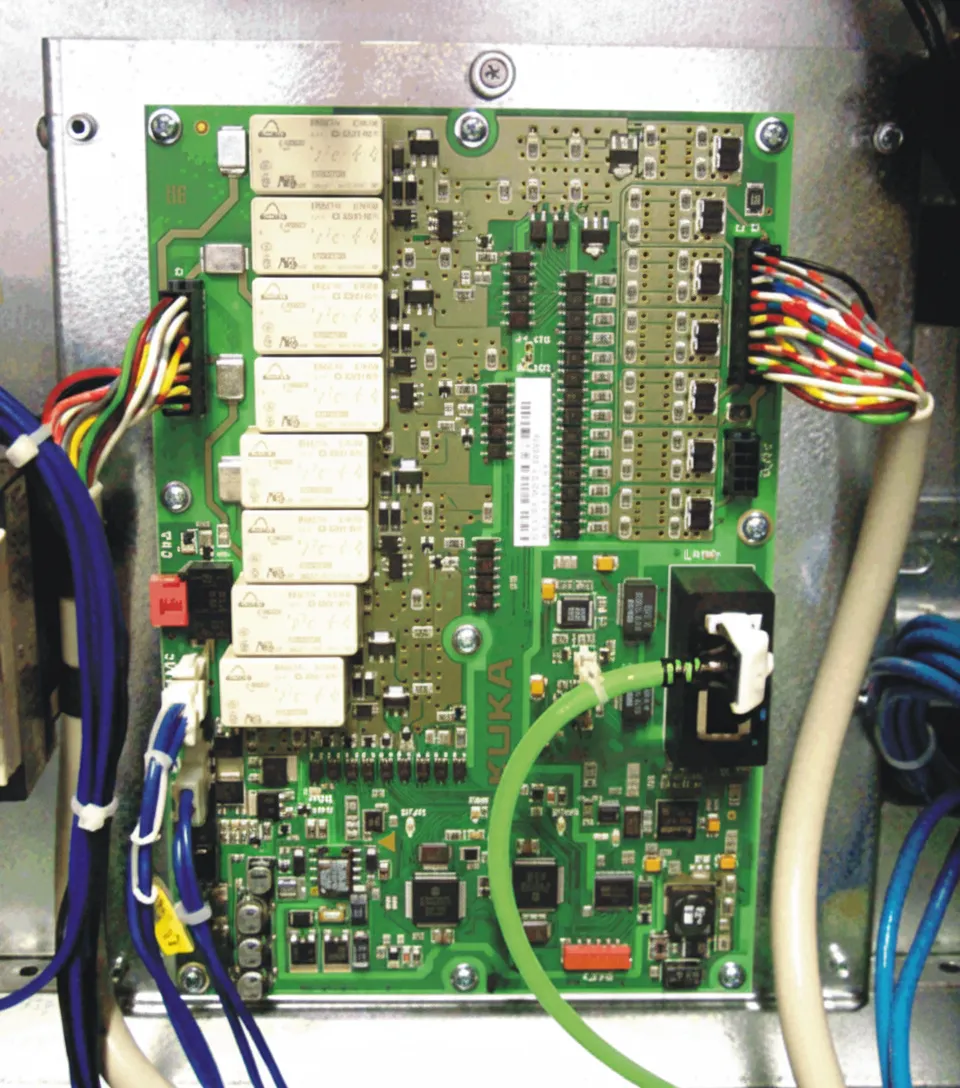
Controller system: A set of logical control and power functions that can monitor and control the robot mechanism and communicate with environment devices and users. It is the brain of the robot and may include motion controllers, internal and external communication systems, and potentially power stages. This area involves power conversion controllers, motor drive controllers, data acquisition controllers, and control computing modules.
Manipulator
Manipulator: A machine whose mechanism typically consists of a series of interconnected or sliding elements designed to grip and/or move objects (parts or tools) across several degrees of freedom or axes. The manipulator, often called the robotic arm, defines the number of axes the robot has to perform a task. Precise motor control technology is required, so high-flexibility, high-precision controller designs are essential.
Teach pendant
Teach pendant: A multifunctional portable device used for programming and teaching industrial robots. A teach pendant usually incorporates an LCD touch panel, enable switches, and an emergency stop button. The teach pendant connects to the robot controller system and is used for data acquisition, display, and transfer.
End-of-arm tooling (EOAT)
End-of-arm tooling: Devices attached to the robot wrist or arm end. The system controller controls EOAT using discrete I/O for simple tools or industrial communication protocols for advanced tools. This area uses many electronic controllers, such as indicator control, relay control, MOSFET-based switching, and motor controllers.
Vision and sensors
Vision and sensors enable robots to scan their surroundings and stop or slow down when humans approach, depending on whether the robot is industrial or collaborative. Vision and sensing are implemented using lidar, radar-based safety scanners, or 3D cameras. Collaborative robots sometimes use sensor-based "safety skins" that stop the arm when touched or approached. These functions involve camera capture, video acquisition controllers, radar controllers, and other sensor interfaces. Sensor data enriches a robot's environmental perception and can be transmitted to the system or remote monitoring systems, which involves IoT technologies.
System integration
Building a robot system requires the integration of mechanical and electrical structures, electronics and information technology, control systems, robot functions, and safety considerations. Electronic controller modules play a central role in enabling these capabilities.