Overview
Many people, especially those new to the field, are unclear about the relationship among industrial robots, PLCs and automation. Below is a concise explanation of each and how they relate to one another.
What is an industrial robot?
An industrial robot is a multi-joint or multi-degree-of-freedom manipulator that performs work using a control system and its own actuators. It is primarily used in manufacturing to replace manual labor and to execute predefined standard workflows, reducing defects and improving throughput.
Since their introduction, the visible mechanical structure of industrial robots has changed little, but the unseen parts have evolved significantly. New materials, control concepts and sensors have turned modern robots into highly integrated devices similar to servers. These systems often connect to peripheral devices such as cameras and laser rangefinders. A typical industrial robot consists of the mechanical body and a controller.
Industrial robots are driven by multiple motors. Controlling a robot essentially means controlling those motors to rotate forward or backward, change speed or torque. To command those motors to act as intended, a control platform such as a PLC is commonly used to run the necessary programs.
Robots rarely operate in isolation. Production lines typically require multiple robots to collaborate and also include other moving parts such as conveyors and AGVs. Coordination among these elements is commonly handled by PLCs.
What is a PLC?
PLC stands for programmable logic controller. It is a widely used digital electronic system in modern industry. A PLC integrates human-machine interface units and communication modules and controls production equipment through digital and analog inputs and outputs. Its operating cycle typically consists of three stages: input sampling, program execution and output refresh, repeated cyclically.
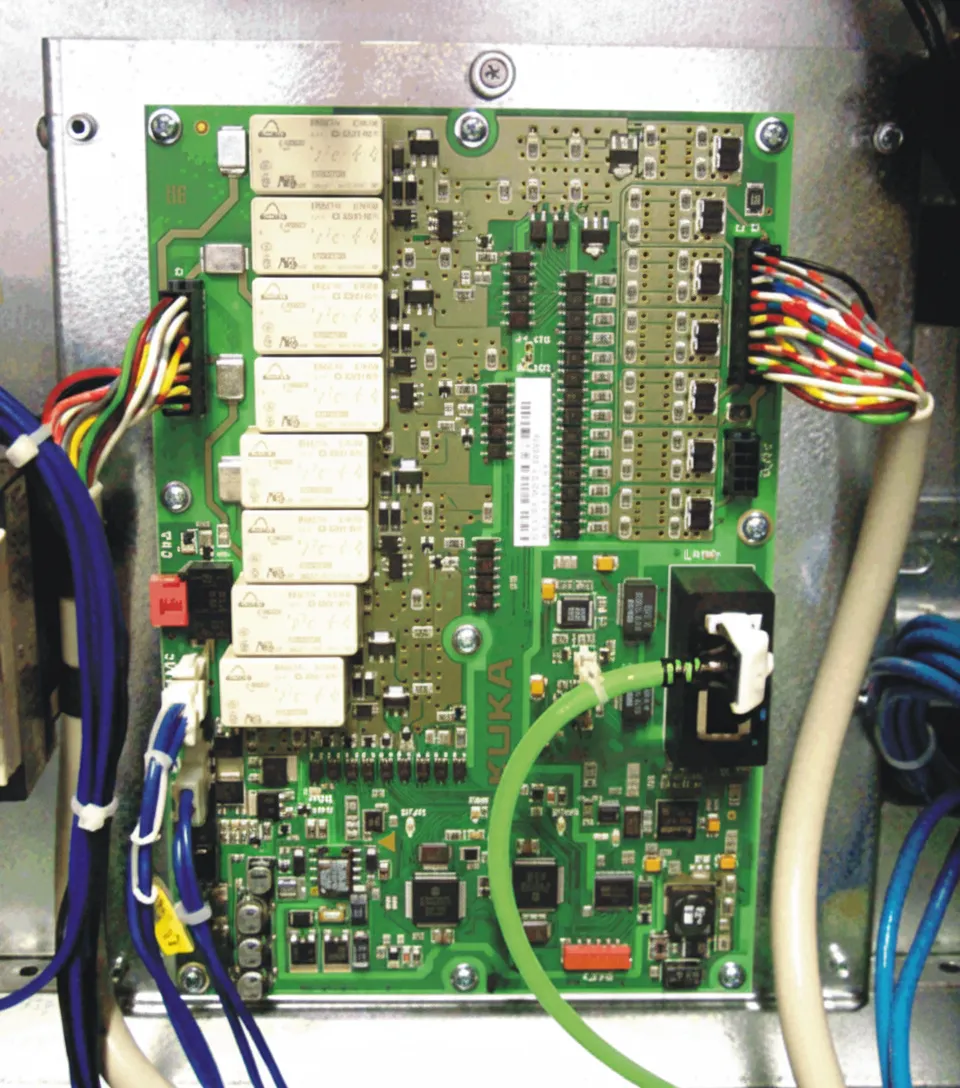
A PLC can be viewed as a small industrial computer capable of many tasks. Controlling an industrial robot directly with a standard PLC can be challenging because the typical PLC instruction set may not provide the specialized functions required for robot motion. Robot control often requires extensive function libraries that are beyond the skill set of ordinary electrical engineers.
PLC platforms can meet robot control requirements, but industrial robot controllers are focused and optimized for robotic tasks. In that sense, robot controllers can be seen as a specialization branching from PLC functionality, providing development environments tailored for robotics that save development time and include built-in safety measures. For example, FANUC offers integrated robot systems and controllers designed for robotic automation.
What is automation?
Automation refers to machines or production processes performing measurement, manipulation and information processing and process control to achieve intended goals without direct human intervention. Embedded systems, which integrate mechanical or electrical components with application-specific computers, are widely used in modern manufacturing.
The concept of automation has evolved. Initially, automation focused on replacing manual physical labor with mechanical actions. With advances in electronics and information technology, and the advent of computers, automation has expanded to replace or assist mental labor as well as physical labor. The broader meaning of automation includes replacing physical labor, assisting or replacing mental labor, and coordinating, managing, controlling and optimizing human-machine systems and the entire manufacturing system. It also extends across the entire product lifecycle, not just individual production steps.
Summary
Industrial robots perform tasks according to predefined workflows. PLCs are digital control systems that provide human-machine interfaces and manage inputs and outputs. Automation encompasses systems that achieve predefined goals using specialized computing systems and coordinated control.
In a production line changeover, updating the PLC program and fine-tuning robots is often sufficient to start a new production run. Learning PLCs provides deeper insight into robot operation and overall plant behavior. PLC knowledge enables engineers to flexibly implement and control industrial automation; without it, one may be limited to basic start/stop operations and may not meet baseline maintenance standards.