Introduction
Robots are increasingly used in industrial production to improve efficiency. Industrial robots mainly use servo motors for motion control, enabling movement and tool manipulation. This article explains the characteristics of servo motors and the control principles for different motor types.
Motion Control Principles
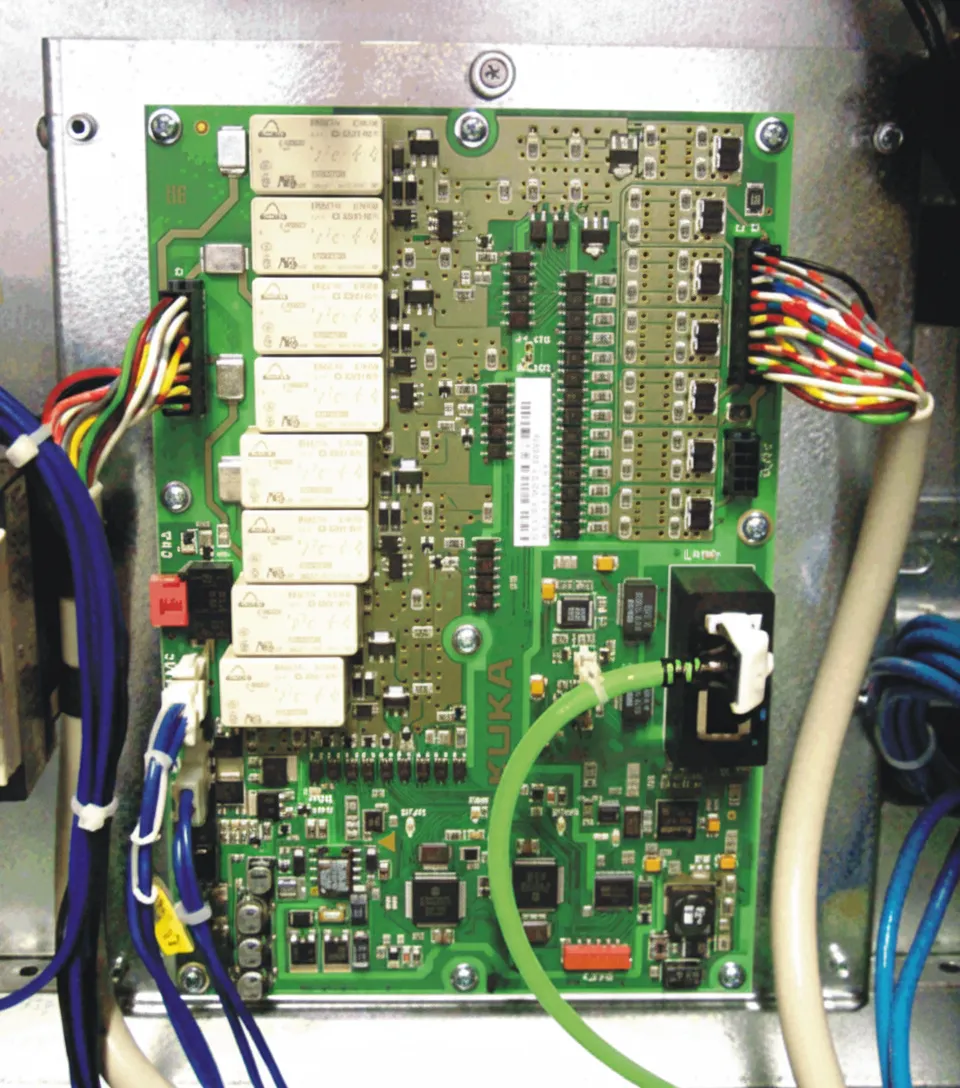
Motion control is integral to robotics. Industrial robots move and execute tasks using actuators made up of various motors. A typical robot motion control system includes a motor controller, a motor drive, and the motor itself, often a servo motor. The motor controller performs computation and issues commands to drive the motor. The drive supplies boosted current according to controller instructions to power the motor. The motor can move the robot directly or through transmission systems such as gear trains or chains.
Output Types and Platforms
Mobile robots traverse large areas and use various locomotion mechanisms such as propellers, legs, wheels, tracks, or robotic arms. Example research platforms include VINI, VolksBot, and Isadora. These platforms use omnidirectional (Mecanum) wheels, conventional wheels, and robotic arms respectively. For embedded control, platforms such as CompactRIO integrate a real-time controller and FPGA, offering reconfigurable chassis that accommodate diverse I/O configurations including sensor inputs and motor control.
VINI is an omnidirectional platform that can move in any direction by changing wheel axis rotation, enabling movement in confined spaces such as automated forklifts. VINI is also a mapping robot: an industrial controller and CompactRIO perform path planning and data processing. The embedded controller provides laser scan mapping and performs machine vision processing, allowing CompactRIO to receive sensor data and control servo motors for camera systems.
VolksBot uses wheels developed by the Fraunhofer Institute. Isadora is a humanoid robot that reproduces recorded motions: a scaled human-operated robot provides input, and the humanoid replays the movements. Isadora uses two CompactRIO units, one for recording simulated motion and another for reproducing the trajectory.
Servo Motor Control Principles and Types
Servo motors are commonly used in robotics. Their fundamental control principle is a closed-loop control system combined with motor feedback to achieve desired states such as position and velocity. Because servo motors rely on feedback to determine current state, they typically offer higher stability than stepper motors.
Servo motors can be either brushed or brushless. The essential operating principle is commutation: changing the direction of current through windings to alter magnetic poles and produce torque. In practice, this means sequentially changing currents in coils so the rotor rotates relative to the stator magnetic field.
Brushed Servo Motors
Brushed servo motors use mechanical brushes to reverse current in the motor windings. Because they can reverse current direction mechanically, they are commonly driven from a DC power supply. A brushed motor typically consists of two main parts:
- Field magnet or stator.
- Rotor made of coils on an iron core connected to a commutator.
Brushes contact the commutator to route current into the coils. Over time, brushes wear and introduce friction and maintenance needs; this wear does not occur in brushless designs.
Brushless Servo Motors
Most brushless servo motors use electronically commutated AC or switched DC drive methods. In a common configuration, the rotor is a permanent magnet and the stator contains the windings. External electronics monitor rotor position and switch currents in the stator windings according to rotor position; this electronic commutation replaces mechanical brushes. There are brushless DC variants that use electronic switching to convert DC inputs into sequential currents for stator phases. Brushless motors generally cost more but have lower wear and maintenance.
Stepper Motors
Stepper motors are less common than servo motors in motion applications but remain important. They are simpler to use and provide precise positional control at typically lower speeds. Stepper motors have a series of teeth on the rotor and stator; when current is applied, electromagnetic forces cause the rotor to step to the next tooth position. Because each step corresponds to a fixed angle, stepper systems can often operate open loop without feedback. However, missed steps due to obstacles can occur, so encoders are sometimes added for feedback.
Motion Controllers and Software Architecture
Many vendors provide proprietary drive systems to control robots. At a basic level, motion control implements a closed-loop cycle that takes desired position or velocity, computes control outputs, and sends signals to motor drives. Higher-level task planning determines how the robot should achieve goals, possibly encapsulating multiple objectives or guiding the robot to a target pose.
In tele-operated systems, commands often originate from an off-board computer, allowing a human operator to select subsequent actions. In fully autonomous systems, decision algorithms may run on-board. During path planning, questions such as "How should I reach this target to complete the task?" or "How should the manipulator move to this pose?" are resolved by the motion controller.
Once the target and motion speed are defined, the servo motor controller outputs control signals (for example PWM or current commands) to the motor drive to reach the target. Control functions are commonly implemented using PID or PI controllers. Safety functions must also be implemented. For example, if a robot moving at high speed detects a person on its path, it should issue an emergency stop command to halt motors or apply brakes immediately.