Introduction
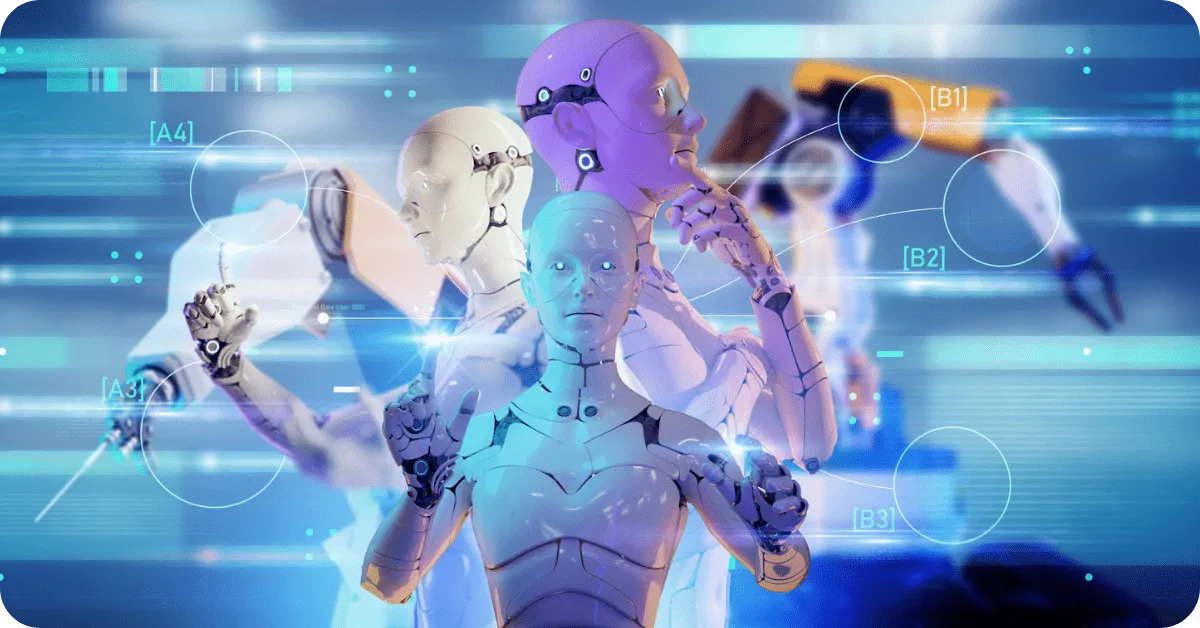
Humanoid robots, a cyberpunk-era human fantasy, are moving out of laboratories and gradually entering the market. Embodied intelligent robots that can perceive, decide, and act autonomously are viewed as a key application for large AI models, and humanoid robots are being considered as a potential solution to labor shortages. Why is there so much interest in humanoid robots? Some researchers point to cultural drivers, while others highlight technological forces. This article summarizes the recent story of humanoid robots.
History of Humanoid Robots
Looking back, the idea of robots dates far back. In the 4th century BC, the Greek philosopher Aristotle imagined uses for automated devices. During the Three Kingdoms period in China, Zhuge Liang created the "wooden ox and flowing horse" to transport military supplies, foreshadowing later developments.
Over subsequent centuries, robots became more anthropomorphic and concrete, gradually evolving toward humanoid forms.
Renaissance
Leonardo da Vinci drew the first known humanoid robot in Western civilization, giving it a shell of wood, leather, and metal and mechanisms that could move its arms and allow it to sit or stand.
1920s–1960s
In 1920, Czech writer Karel Capek used the word "Robot" in his play R.U.R., which established the term's modern origin.
In 1927, engineer Wensley at Westinghouse built Televox, an early robot equipped with a radio transmitter, though it could not walk.
In 1963, NASA built two Power Driven Articulated Dummies (PDAD) to simulate 35 basic human motions for spacesuit design and testing.
1970s–2000s
Under Ichiro Kato, Waseda University launched a humanoid robot project and in 1972 developed WABOT-1, the first full-scale humanoid intelligent robot, capable of tasks such as carrying objects and comparable in ability to a one-and-a-half-year-old child.
In 1986, Honda developed bipedal robots starting with EO, followed by the E series and the P series of humanoid research robots.
In 2000, the P4 robot, also known as ASIMO, was introduced.
Why Many Teams Are Building Humanoid Robots
In 2021, Tesla drew attention to the Tesla Bot during an AI Day demonstration. Elon Musk commented, "We have already built wheeled robots (Tesla cars), so we now have almost all the parts needed to make humanoid robots." The Tesla Bot announcement sparked a wave of interest in the Chinese market for humanoid robots because automotive companies and humanoid robotics share common components, such as cameras and data collection for AI training. Automakers thus became early entrants into the humanoid field. For example, Xiaomi released CyberOne in 2022, and XPeng released its first humanoid robot, PX5, in 2023.
More technology companies have also entered the humanoid robotics track. Chen Li, co-founder of Unitree Robotics, said the move was an alignment of trends. On one hand, the underlying architectures and knowledge for humanoid and quadruped robots are very similar, and Unitree's leadership in quadruped robots reduces the difficulty of moving to humanoid designs. On the other hand, the rapid development of general AI and large models last year is a milestone for future technology. As PC and smart device markets reach saturation, general-purpose humanoid robots could become a principal deployment platform for general AI.
Chen further explained that in the era of large AI models, methods such as imitation learning and reinforcement learning make humanoid robots more generally applicable than traditional collaborative robots. "Humanoid robots can match the human-world demand for general-purpose robots," he noted.
Thus, driven by technological shifts, humanoid robots have become a new breakthrough and a new carrier for AI applications. Throughout their development, humanoid robots have focused on achieving humanlike features. Even when a humanoid robot is dressed to appear lifelike, most still display a bent-knee posture.
Why Many Humanoid Robots Walk with Bent Knees
Robot legs can be straightened, but doing so leads to two unavoidable consequences. First, the ankle can only move along a circular arc with radius equal to the leg length, reducing the reachable workspace of the joints. Second, when the knee is straight, the leg has poor load-bearing capacity perpendicular to the leg axis, though its capacity along the leg axis increases. In plain terms, the "locked knee" posture is awkward for humans but creates significant control challenges for robots.
From a motion control perspective, walking with bent knees provides superior control compared with straight-knee walking. On uneven terrain, bent-knee gaits leave room for the leg to extend, which helps maintain stability and balance. Additionally, a bent-knee stance lowers the center of gravity and improves balance control.
Therefore, a bent-knee design ensures the robot's posture avoids singular configurations and optimizes control performance. During walking, this design helps maintain a stable gait and improves dynamic performance.
Recent Examples and Capabilities
Notable recent humanoid robots include Unitree's H1, described as China's first full-size, general-purpose humanoid robot capable of running, with a stable gait and highly flexible movements; it can walk and run autonomously over complex terrain and perform backflips and other dynamic maneuvers. Researchers at the Massachusetts Institute of Technology have also developed humanoid robots capable of jumping and performing backflips.
Image source: Cailian Press
How Long Until Humanoid Robots Become Widely Used?
Will 2024 be the "first year" for humanoid robots? Chen Li said that if the definition is simply the entry of startups and large companies into the humanoid track, then 2024 can be considered a first year. If the standard is widespread practical application, 2024 is still debatable, since real-world applications are not yet that mature.
The International Federation of Robotics predicts a compound annual growth rate of 71% for the global humanoid robot market from 2021 to 2030. Data from the Chinese Institute of Electronics suggests that by 2030 China's humanoid robot market could reach 870 billion yuan.
However, realizing these projections requires finding buyers. In addition, humanoid robotics is a high-barrier industry that must solve core technical challenges, reduce costs, and address periodic talent shortages.
Facing the likely influx of new entrants, Chen said all products go through phases where many companies enter when timing becomes right, resulting in broad competition. This can help drive product R&D, definition, promotion, and sales.
With sustained industry interest and frequent conferences on humanoid robotics, the field is at a critical window for transitioning from labs to the market. Industry leaders in China and abroad are increasing investment, technical levels are advancing, and application scenarios are expanding. Looking ahead, humanoid robots have the potential to significantly change production and daily life and to advance social productivity.