Introduction
The emergence of mobile devices has changed daily habits and marked a shift toward more mobile lifestyles, which in turn drove early stages of technology innovation. As technologies advance, an increasing number of smart display devices appear, such as smartphones, smartwatches, and smart glasses. These consumer products bring additional functionality and convenience.
Global display panels and touch panels primarily serve downstream consumer 3C products. By size, large displays are mainly LCD TVs, LCD monitors, and laptops. Small and medium displays are mainly tablets, smartphones, and wearable devices.
Many modern 3C devices combine a display panel with a touch panel. Tablets and smartphones primarily use touch panels as their main input interface. Some devices use dual input methods, for example laptops that combine a touch panel with a traditional keyboard and mouse. Displays with integrated touch functionality are therefore a mainstream trend for many upcoming products.
Wearable Product Examples
There are many wearable devices across head-to-toe applications, including military helmets, smart glasses, smartwatches, fitness bands, and smart shoes.
Smartwatch Panel Specifications by Brand
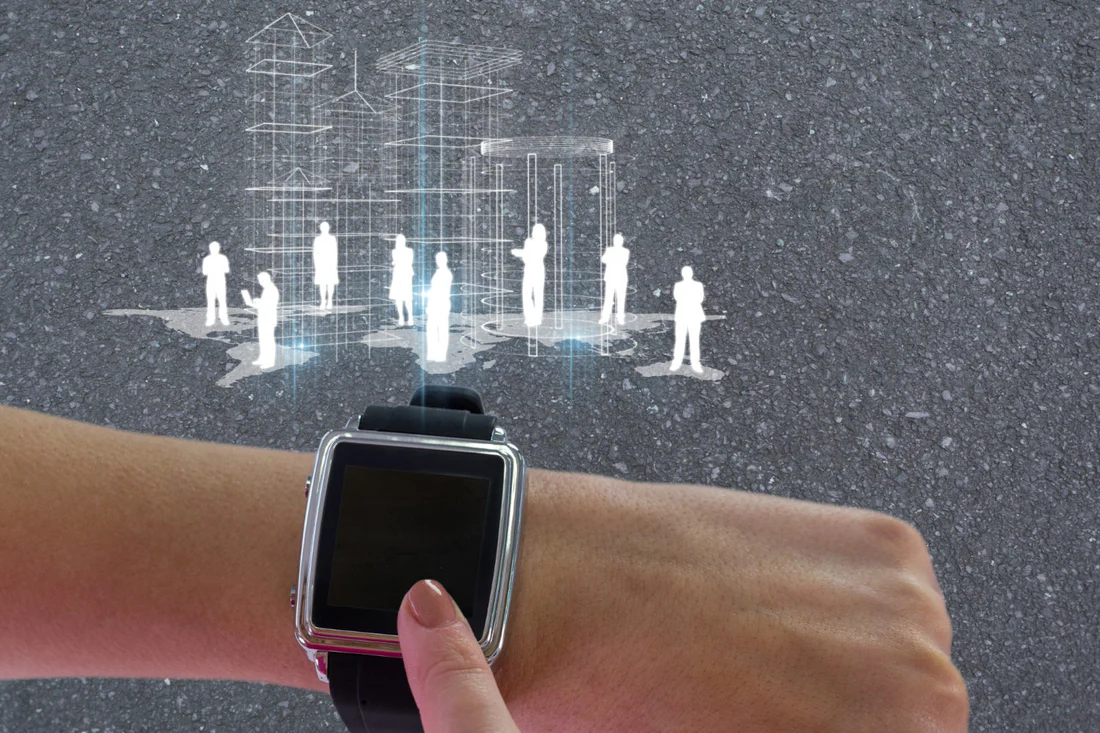
Major smartwatch brands such as Samsung, LG, Sony, ASUS, Motorola, and Apple have released flagship smartwatches with different display sizes. Because smartwatches are thin and small wearable displays, they typically use rectangular or circular mid-to-high resolution panels smaller than 2 in.
Samsung's Gear S uses a 2 in rectangular curved Super AMOLED panel with an on-cell projected capacitive touch panel. The resolution is about 480×360 with a pixel density around 300 ppi.
LG's G Watch R uses a 1.3 in circular P-OLED panel with a projected capacitive touch panel, resolution 320×320 and pixel density about 348 ppi.
Sony's SmartWatch 3 uses a 1.6 in rectangular LCD panel with a projected capacitive touch panel, resolution 320×320 and pixel density about 283 ppi.
ASUS ZenWatch uses a 1.63 in rounded-rectangle AMOLED panel with a projected capacitive touch panel, resolution 320×320 and pixel density about 278 ppi.
Motorola's Moto 360 uses a 1.56 in circular LCD panel with a projected capacitive touch panel, resolution 320×290 and pixel density about 277 ppi.
Apple's Apple Watch, released in early 2015, is available in two display sizes. The larger model for men uses a 1.54 in rectangular AMOLED panel with 2.5D curved edges and a haptic-feedback projected capacitive touch panel, resolution around 400×320 and pixel density about 332 ppi. The smaller model for women uses a 1.32 in rectangular AMOLED panel with 2.5D curved edges and a haptic-feedback projected capacitive touch panel, estimated resolution around 400×320 and pixel density about 386 ppi.
Apple Watch represents a major vendor's entry into the wearable display market. Whether it will drive another wave of demand for wearable displays remains to be seen.
Market Outlook
Global shipments of smart wearable displays are estimated on an annual basis. Wearable displays are required to be thin, small, wearable, and to provide long standby/use times. Many wearable displays are designed as extensions of other mobile devices—for example, smartwatches as extensions of smartphones.
Smart glasses, smartwatches, and fitness bands are the three most popular wearable display categories and could help drive future growth in the display panel industry.
Estimated global shipments were about 39.1 million units in 2014 with year-on-year growth of about 49.8%. Shipments were projected to reach 65.9 million units in 2015 with year-on-year growth of about 68.5%, and 108.9 million units in 2016 with year-on-year growth of about 65.3%.