What is a smartwatch?
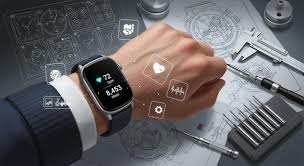
As mobile technology evolved, many traditional electronic products added mobile capabilities. Watches that once only showed the time can now connect to smartphones or home networks and the Internet to display incoming call information, Twitter and news feeds, weather data, and other items. These networked, feature-rich timepieces are commonly called smartwatches.
Beyond software and connectivity, the defining characteristic of modern smartwatches lies in their highly integrated internal hardware architecture. The ability to combine displays, processors, wireless modules, batteries, and multiple sensors within a compact, wrist-worn form factor relies heavily on HDI PCB technology, which supports fine-pitch components, multilayer routing, and high integration density. Without such PCB technologies, the functional scope and form factor of contemporary smartwatches would be difficult to achieve.
History of smartwatches
The first computable watch appeared in 1940; its notable aspect was that it performed calculations mechanically. In 1972, Hamilton introduced the Pulsar, an electronic watch whose display resembled a luxury gold version of calculator watches, but it still offered limited intelligence.
In 1985 Epson released one of the first platform watches capable of running applications. Based on a Zilog Z80 architecture, it could load different applications via ROM modules.
In 1998 Seiko released the Ruputer smartwatch, featuring a 16-bit 3.6 MHz CPU, 128 KB of RAM, and 2 MB of storage. It could load any program written for the platform and is often regarded as an early prototype of the modern smartwatch.
Early smartwatch operating systems
Early smartwatches had limited functionality. As operating systems developed, watches entered a new era: they relied not only on hardware but also on software platforms to extend their capabilities. The following sections summarize notable early smartwatch operating systems.
Linux
In 2000, IBM demonstrated an early Linux-based smartwatch. At the time, some observers questioned the value of investing in wrist-worn devices amid debates about whether mobile phones would replace watches, but the demonstration foreshadowed later smartwatch and wristband trends.
The initial prototype offered about six hours of battery life; a revised version extended this to around 12 hours. It had 8 MB of memory and ran Linux 2.2. Later iterations added an accelerometer, a vibration mechanism, and fingerprint sensors. IBM partnered with Citizen to develop the WatchPad. WatchPad 1.5 featured a 320 x 240 QVGA display and ran Linux 2.4. It included calendar software, Bluetooth, 8 MB of temporary storage, and 16 MB of flash. Citizen targeted students and business users and set a suggested retail price of $399. The project was discontinued around 2001–2002.
These early watches with operating systems had costly hardware and modest specifications by today’s standards; however, the inclusion of Linux 2.4 made the device resemble a wrist-worn computer. At that stage Linux support for consumer entertainment software was still immature, which limited user-facing features, but the platform-level experimentation provided valuable lessons for later developments.