In recent years the wearable device market has diversified, with many products appearing. Many users are familiar with the range of functions but less aware of the underlying technologies. These technologies are essential to implementing and expanding device capabilities. This article summarizes the three most valuable technologies in smart wearable devices.
1. Wireless transmission
WiFi is one of the most widely used technologies in smart devices and continues to evolve. The protocol has developed to 802.11ac, with theoretical throughput up to 1 Gbps.
As hardware advances have enabled sleeker and lighter devices, and system-on-chip designs trend toward higher performance with lower power consumption, wearable devices increasingly function as intelligent nodes within a broader connected ecosystem. In this context, HDI PCB architectures are critical, as they allow dense routing of RF signals, compact integration of wireless modules, and controlled impedance paths within extremely limited board areas—requirements that are difficult to meet with traditional PCB designs.
Bluetooth is also a common wireless connection technology, supporting short-range communication with data rates around 1 Mbps. Its small form factor and ease of integration make it suitable for many wearable designs. Its low cost and efficient transmission have helped wearables transition from niche to mainstream adoption.
NFC, a contactless identification technology, offers simpler operation and faster pairing than Bluetooth in some use cases. In the cloud era, everyday data generated by life and social activities are commonly mediated by smartphones, and NFC can serve as an alternative to transit cards, bank cards, and access cards. Many wearables include NFC to support mobile payments and short-range data exchange.
Overall, wireless technologies are indispensable in current wearable systems. Multiple wireless technologies are likely to coexist when integration permits, since each has optimal use scenarios. Relative to others, Bluetooth Smart (BLE 4.0 and above) and Wi?Fi tend to offer advantages in wearable applications.
2. Sensing technology
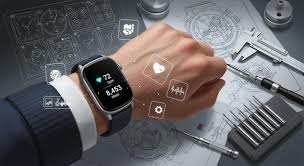
Data in wearable devices does not come only from touchscreens or manual input; much of it is collected automatically through sensors that monitor user activity and environmental changes. Consequently, sensing technology is central to wearables.
For example, early fitness bands relied on accelerometers to count steps. As additional sensors have been integrated, the functional scope has expanded significantly.
GPS can record geographic position and movement trajectories. Optical heart rate sensors use LEDs to illuminate the skin and detect variations in light absorption caused by blood flow, enabling heart rate estimation. Bioelectrical impedance sensors provide more detailed monitoring by measuring the body's impedance to infer blood flow, which can be converted into metrics such as heart rate, respiration rate, and skin conductance indices. Electrodermal activity (EDA) or galvanic skin response sensors detect sweat-related conductivity changes in the skin and are used to assess physiological responses such as exertion or stress.
With a range of sensors, wearable devices can better understand a user's physiological state. Collected data can then be processed by algorithms to generate actionable health or activity insights.
3. Human-computer interaction
Because wearables are worn throughout the day, effective interaction methods are essential. Interaction enables users to control devices and allows devices to infer user intent. The main interaction technologies can be grouped into four categories:
1. Eye-tracking interaction
Eye-tracking typically uses one of three approaches: tracking changes in the eye and surrounding features, tracking changes in iris angle, or actively projecting infrared beams onto the iris to extract features. This technology is widely used in smart glasses. Subtle eye movements produce extractable features that can be captured by imaging systems to track gaze in real time, predict user state and intent, and enable gaze-based control.
2. Voice interaction
Voice interaction is one of the most direct interaction methods for wearable devices. Modern voice systems integrate front-end voice capture with cloud-based backend services, enabling natural-language understanding and intent detection. Backend components such as web search, knowledge computation, databases, question-answering, and recommendation systems compensate for the limitations of relying solely on local voice commands.
3. Motion-sensing interaction
Motion-sensing interaction uses techniques from computer graphics and sensing to recognize body language and translate it into commands. Gesture interaction is the most representative form: sensors continuously capture hand shape and displacement, periodically build models to form a sequence of frames, and convert that sequence into control commands. As sensors and algorithms have matured, gesture recognition has reached practical usability, and related products and solutions have emerged.
4. AR/MR interaction
Augmented reality (AR) overlays informational and media content—such as graphics, text, audio, and hyperlinks—onto the real environment, combining virtual and real elements. AR and mixed reality (MR) provide new application modes for wearables by creating virtual screens for scene-based interaction. These technologies are commonly applied in smart glasses, immersive devices, and motion-sensing games.